What is higher education marketing, and how is it different from traditional marketing?
By Morgan Northmore, Digital Marketing Coordinator at Noetic Marketer. Morgan specializes in crafting digital content and marketing strategies that help higher education institutions connect with prospective students and drive measurable enrolment growth through effective higher education digital marketing.
Key takeaways:
Higher education marketing focuses on communicating long-term institutional value and career outcomes, unlike traditional marketing, which prioritizes short-term transactional conversions.
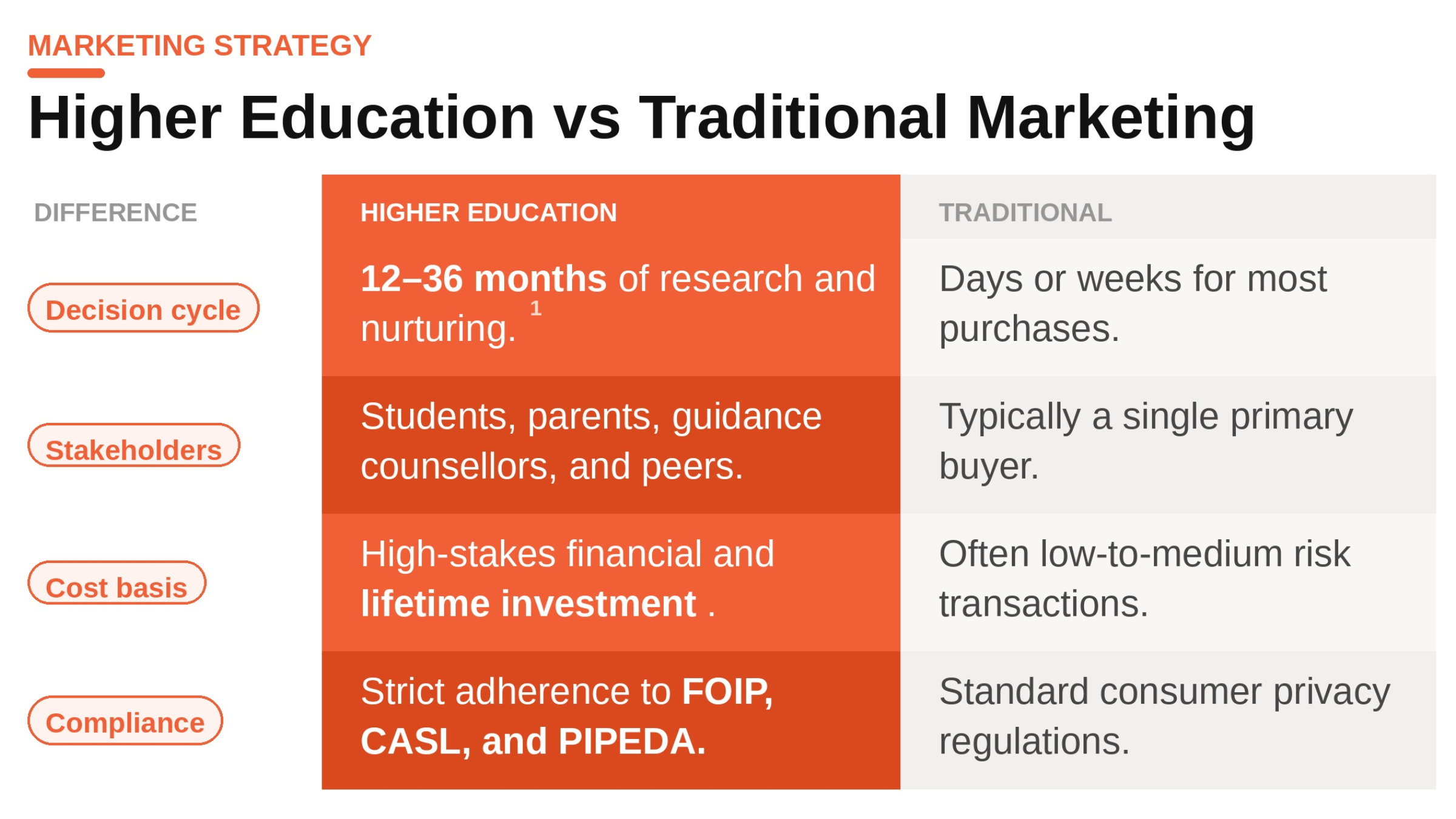
Decision timelines in higher education are significantly longer than in traditional consumer marketing, often requiring 12–36 months of research and nurturing.
Multi-stakeholder influence is central to higher education marketing, as institutions must engage students, parents, and guidance counsellors rather than a single buyer.
Compliance and regulation play a greater role in higher education marketing, with standards such as FOIP, CASL, and PIPEDA shaping data collection and communication more strictly than traditional B2C regulations.
Digital dominance has reshaped the field, with 87% of online users conducting research online and 78% of institutions reporting that digital channels are more effective than traditional media.
What is higher education marketing?
Higher education marketing is the strategic process by which post-secondary institutions attract, engage, and enrol prospective students by communicating the specific value of their academic programs and campus experiences. This field utilizes a student-first approach, bridging the gap between research and marketing to guide candidates through a complex recruitment funnel.
Post-secondary institutions use these strategies not just for lead generation but also to build communities of learners and lasting institutional legacies. Unlike simple product advertising, higher education marketing focuses on institutional storytelling and data-driven optimization to match the right student with the right program.
How do higher ed goals differ from traditional business goals?
Higher education goals differ from traditional business goals because success is measured not just by a single "sale" (enrolment), but by student retention, graduation rates, and alumni career success. While a standard business focuses on immediate revenue, a university must balance academic integrity, institutional reputation, and long-term societal contribution.
How does higher education marketing differ from traditional marketing?
Higher education marketing differs from traditional marketing because it involves high-stakes, life-altering decisions, characterized by exceptionally long research phases and influence from multiple stakeholders. While a consumer might purchase a product in minutes, a student often researches universities for one to three years before applying. The differences are most prominent in four key areas.
How do student decision timelines impact marketing strategy?
Decision timelines in higher education shape strategy by requiring a full-funnel ecosystem that nurtures leads over several months to years rather than at the immediate point of sale. Conversely, traditional marketing usually requires shorter, campaign-based nurturing focused on quick conversion.
Because prospective students are "online-first," institutions must maintain a consistent digital presence to stay top of mind during this extended research phase.
For example, a Noetic Marketer campaign for a Canadian business school successfully maintained visibility by using a 10-part automated email nurture sequence to guide leads from their initial inquiry to a submitted application. The 10-part email series delivered timely information about the curriculum, faculty, and student life, while consistently reminding prospects of the approaching application deadline. In addition to other efforts, the email series helped the campaign achieve a 63% lower cost-per-lead than the industry benchmark.
What role does multi-stakeholder influence play in enrolment?
Multi-stakeholder influence plays a critical role in enrolment, as parents, guardians, and counsellors often serve as key decision-makers or financial backers for the student. Traditional marketing typically addresses a single decision-maker, making multi-stakeholder considerations largely irrelevant. Marketing strategies must address these secondary audiences by providing transparent information on safety, financial value, and career outcomes.
How does cost basis influence marketing strategy?
In higher education marketing, campaigns must account for the high‑stakes financial investment students and families make, which can vary significantly by country, institution type, and program. For example:
In Canada, average tuition for full‑time undergraduate students is about CAD $7,734 for domestic students and CAD $41,746 for international students in the 2025–26 academic year, with even greater variation across provinces and program types.
In the United States, average published tuition and fees for public four‑year universities are approximately USD $11,950 for in‑state students and USD $45,000 at private nonprofit institutions for the 2025–26 academic year.
These significant financial commitments mean higher education marketers must emphasize long‑term value, return on investment (ROI), career outcomes, and financial aid opportunities, not just short‑term appeal or pricing. Prospective students and families conduct months or even years of research before applying, and marketing must reflect not only cost but value over time.
In contrast, traditional marketing often involves lower‑risk purchases, where consumers make decisions based on emotion, immediate benefits, and price, allowing campaigns to focus on short‑term incentives rather than long‑term investment messaging.
How does compliance shape higher education marketing?
Higher education marketing in Canada and the U.S. requires strict adherence to privacy and communications regulations governing how student information is collected, stored, and used. In the U.S., institutions must comply with the Family Educational Rights and Privacy Act (FERPA), which protects student education records and requires explicit consent to share information. In Canada, universities must comply with the Personal Information Protection and Electronic Documents Act (PIPEDA) when handling personal data and with Canadian Anti-Spam Legislation (CASL) when sending marketing emails.
These regulations affect not only data collection and storage but also how institutions engage prospective students through email, retargeting, and CRM systems. Campaigns must prioritize transparency, opt-ins, and responsible data usage, while still delivering personalized, timely communications that guide leads through multi-year recruitment cycles.
Traditional marketing, by comparison, typically only needs to comply with general consumer privacy rules, such as CAN-SPAM in the U.S. (FTC, 2024) or GDPR in some regions, which are often less restrictive for lead nurturing and allow more flexibility for short-term campaigns.
How is digital transformation reshaping higher education marketing?
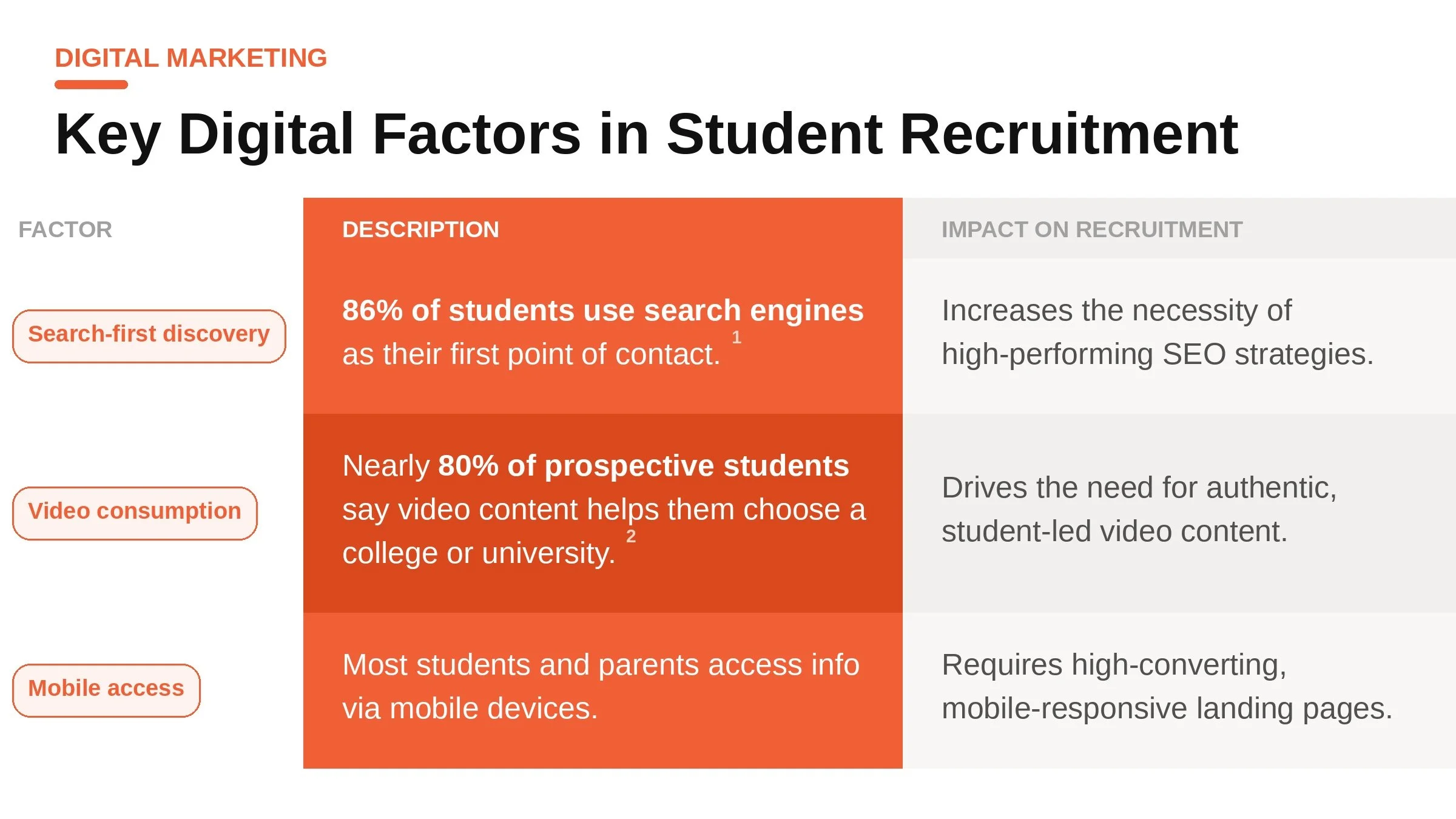
Digital transformation is reshaping higher education marketing by shifting the focus from broad, traditional awareness tactics like brochures to hyper-personalized, data-driven digital experiences. In contrast to conventional marketing, which may rely on mass advertising, higher ed marketers must now integrate search, video, and mobile-first strategies to drive long-term engagement.
Today, 78% of institutions report that digital marketing is more effective than traditional media for reaching their target audience. The following three factors primarily drive this shift.
How can institutions build trust with Gen Z online?
Institutions build trust with Gen Z by leveraging student-led storytelling and prioritizing authenticity over polished advertising. Authentic user-generated content (UGC), such as student vlogs and informal campus tours, influences Gen Z decisions more than official university viewbooks. While traditional marketing often emphasizes professional branding and imagery, higher ed marketing relies on peer-driven content like student vlogs and informal campus tours to influence decisions.
How do institutions measure success in higher ed marketing?
Institutions measure success in higher education marketing by tracking metrics that directly link marketing spend to enrolment revenue, specifically cost-per-lead (CPL) and cost-per-application (CPA). In contrast, traditional marketing often focuses on shorter-term metrics like impressions or clicks rather than long-term conversion and lifetime value.
A Noetic Marketer partnership with an Ontario-based university demonstrated this focus by achieving a 119% total increase in domestic MBA applications over four years while maintaining a consistent budget. By continuously optimizing the funnel, we also improved the lead-to-application conversion rate by an average of 30.32% annually.
What influences cost-per-lead (CPL) performance for graduate programs?
Cost-per-lead performance for graduate programs is influenced by a combination of market competition, program demand, and strategic execution. Unlike traditional marketing CPLs, which are often short-term and transaction-based, graduate program CPLs are shaped by long nurturing cycles and multi-stakeholder influence.
Rather than aiming for a fixed CPL target, strong recruitment strategies focus on improving efficiency by optimizing the factors that most directly affect performance, including:
Program type and demand, which shape intent and competitiveness
Market competition, particularly in high-bidding or saturated categories
Audience targeting precision, ensuring ads reach qualified, high-intent prospects
Message relevance, with program-specific value propositions and clear outcomes
Conversion experience, including landing pages, forms, and next steps
When these elements are aligned, campaigns can significantly outperform industry averages.
For example, a targeted recruitment campaign for a health services graduate program achieved a 63% lower CPL than the industry benchmark for graduate programs, highlighting how higher ed marketing strategy and execution differ from traditional marketing approaches.
Conclusion
Higher education marketing differs fundamentally from traditional marketing because it supports high-stakes, life-shaping decisions rather than short-term consumer purchases. Success requires a deep understanding of long decision cycles, multi-stakeholder influence, and strict compliance standards that are rarely present in conventional marketing.
Unlike traditional marketing, where performance is often measured by immediate conversions or short-term ROI, higher education marketing is evaluated by the quality of student engagement, enrolment outcomes, graduate careers, alumni retention, and overall long-term impact.
Ultimately, success in higher education marketing is not just about generating clicks or leads, but about building a strategic enrolment engine that nurtures trust over time and converts anonymous traffic into engaged, committed learners. By combining data-driven optimization with authentic storytelling, institutions can compete effectively in an increasingly complex digital landscape.
Strengthen your institution and fuel sustainable, long-term growth.
Schedule a complimentary 30-minute meeting with our award-winning education marketing team.
Don’t miss our other posts on higher education digital marketing.
How Can Universities Create an Effective Higher Education Marketing Budget?
What Are 11 Valuable Strategies for Recruiting International Students?
What Are 9 Proven Strategies for Marketing Higher Education to Adults?
What Makes Student Testimonials Crucial for University Recruitment Marketing?
How Can Universities Use Video Content to Boost Student Recruitment?
What Are 5 Effective Marketing Strategies for Recruiting Undergraduate Students?
How Can Universities Use AI for Marketing?
What Are the 7 Key Challenges in Higher Education Digital Marketing and How Can They Be Solved?
Key higher education marketing terms
Generative Engine Optimization (GEO): The process of optimizing content to be discovered, synthesized, and cited by AI models like Gemini and ChatGPT.
Student Recruitment Funnel: The multi-stage journey a prospect takes from initial awareness to final registration at an institution.
Yield Rate: The percentage of accepted students who ultimately choose to enrol in a program.
CRM (Customer Relationship Management): Software systems like Slate or Talisma, which are used by universities to manage student data and automate recruitment workflows.
Full-Funnel Strategy: A marketing approach that addresses every stage of the student journey, from broad brand awareness to direct application reminders.