What Are 9 Proven Strategies for Marketing Higher Education to Adults?
By Morgan Northmore, Digital Marketing Coordinator at Noetic Marketer. Morgan specializes in crafting digital content and social media strategies that help higher education institutions connect with prospective undergraduate students and drive enrollment.
Key Takeaways:
Understanding the unique motivations of adult learners, such as career advancement and flexibility, is the first step in creating an effective marketing strategy.
Successful programs for adults emphasize convenience (e.g., online, evening, or weekend classes) and practical, hands-on experience relevant to current industry demands.
Digital marketing channels like LinkedIn and Google Search are highly effective for this demographic, but the messaging must focus on tangible outcomes and return on investment (ROI).
To convert adult learners, institutions must provide clear financial aid information, personalized support services, and strong social proof through alumni success stories.
A seamless, professional user experience, from a user-friendly website to exceptional customer service, is critical for building trust with this demographic.
Adult learners have different needs and motivations compared to traditional college students, which can make it challenging for institutions to reach and engage them effectively. They are often juggling full-time work and family responsibilities, and need to see a clear return on their investment if they are to pursue your program.
This guide provides nine proven strategies to help your institution overcome these challenges. By implementing these tactics, you can increase your institution's visibility, connect with potential adult students, and help them achieve their educational and career goals.
1. Understand the Needs and Motivations of Adult Students
It is important to understand the motivations of adult students, as they have different needs than traditional students and are driven by factors such as career advancement or a complete career change. To effectively market your institution to this demographic, it's crucial to understand what drives them and tailor your marketing materials and messaging accordingly.
What are the common motivations for adult learners?
Common motivations for adult learners include career advancement, personal fulfillment, increased earning potential, and social connection.
Career Advancement: Non-traditional students often want to climb the career ladder. They may seek qualifications to gain a competitive edge or remain relevant in a rapidly evolving job market.
Personal Fulfillment: Many adults return to school for the intrinsic rewards of learning, such as a passion for a subject or the satisfaction of personal growth.
Increased Earning Potential: Financial security is a significant motivator. Adult learners often view higher education as an investment in their future, hoping a degree will lead to higher salaries and better job opportunities.
Social Connection: Returning to school can also be a way to expand social and professional networks, leading to new partnerships and opportunities.
2. Develop Relevant Programs for Prospective Adult Students
Universities can develop programs that attract adult students by prioritizing offerings aligned with their career aspirations and incorporating practical, hands-on experience into coursework.
Why should programs align with industry demands?
Programs should align with industry demands, as non-traditional students are driven to enhance their skills in their chosen field or to start a new career path. Offering programs that align with current industry needs ensures that adult learners acquire relevant, in-demand expertise, making them more competitive in the job market.
Why is practical, hands-on experience important?
Practical, hands-on learning is important because it enhances a program's relevance to adult learners. You can incorporate this by using real-world case studies, offering internships or co-op placements, and providing opportunities for project-based learning.
For example, Southern New Hampshire University offers an online boot-camp-style certificate program in coding and technology for professionals looking to change careers or expand their skill set.

3. Highlight Flexibility and Convenience
Flexibility and convenience are critical for adult learners because they must balance their education with work and family commitments. To make your school more attractive, you must showcase flexible program options.
What flexible learning options appeal to adult students?
Flexible learning options that appeal to adult students include online classes, evening and weekend schedules, and accelerated degree programs.
Online, Evening, and Weekend Classes: These formats allow adults to access course materials and attend lectures at times that fit their busy schedules. Online learning continues to grow as a preferred option for mature learners.
Accelerated Degree Programs: These programs allow adult learners to complete their education in a shorter timeframe, enabling them to advance their careers or transition to new fields more quickly.
For example, Yorkville University offers programs both on-campus and online, with full-time and part-time curricula so students can learn at their own pace.

4. Leverage Digital Marketing Channels
What are the best digital marketing channels for reaching adult students?
The best digital marketing channels for reaching adult students include social media platforms such as LinkedIn, targeted email marketing, search engine optimization (SEO), and pay-per-click (PPC) advertising. Utilizing these channels can help craft the most effective marketing strategy for your higher education institution.
How should universities use social media to engage adult learners?
Universities should use social media platforms like Facebook, LinkedIn, and Instagram to connect with adult learners by sharing content that highlights program benefits, flexibility, and success stories.
For example, a Noetic Marketer campaign for an Alberta-based university's graduate programs targeted mid-career healthcare professionals. The strategy used LinkedIn for precise professional targeting, while Meta (Facebook and Instagram) proved highly efficient for generating cost-effective leads. This targeted approach resulted in a cost-per-lead that was 63% lower than the industry benchmark for graduate programs.
Why is email marketing effective for nurturing adult learners?
Email marketing is effective for nurturing adult learners because it maintains a direct relationship with them, allowing you to share program updates, financial aid information, and personalized content based on their interests.
To maximize the effectiveness of your email marketing, you should also focus on your conversion rate optimization (CRO) by testing different subject lines, call-to-actions, and email layouts to see what resonates best with your audience.
How does search engine optimization (SEO) attract adult students?
Search engine optimization (SEO) attracts adult students by improving your website's visibility on search engines like Google, which they use to research schools and programs. Key strategies include conducting keyword research, creating high-quality content, and ensuring your website is mobile-friendly.
What is the role of pay-per-click (PPC) advertising?
Pay-per-click (PPC) advertising helps you reach a larger audience and target specific demographics by promoting particular programs or targeting keywords with high commercial intent.
A focused PPC strategy is highly effective at finding high-intent professionals. For instance, a Noetic Marketer campaign for an Ontario-based university's Master of Engineering Management program was optimized to reach specific professional segments. This data-driven approach led to a 20.21% year-over-year decrease in cost-per-enrollment, demonstrating a clear return on ad spend.
What digital marketing tools can I use to optimize my higher education marketing?
Here are some practical tools that institutions can deploy to streamline campaigns and boost adult‑learner reach (see our complete list of recommended higher education digital marketing tools from Noetic Marketer):
SE Ranking – Plan keywords, track ranking, and audit your site’s organic performance.
Grammarly – Improve readability and correctness of content for websites, emails, and blogs.Jasper – AI-powered writing assistant to ideate and draft content quickly.
Asana – Project management tool to coordinate team tasks, track progress, and manage deliverables.
ClickUp – Manage campaigns, workflows, and task assignments efficiently.
ActiveCampaign – Automate email marketing and CRM workflows to nurture leads effectively.
Google Analytics – Measure traffic sources, user behaviour, and conversion funnels.
Hotjar – Track user engagement with heatmaps and session recordings for site optimization.
By equipping your marketing team with these foundational tools, you’ll be better positioned to attract, engage, and convert adult learners — and maintain efficiency even with limited resources.
5. Provide Clear Information on Costs and Financial Aid
Clear information on costs and financial aid is essential because adult learners are often more price-conscious than traditional students. You must make it easy for them to understand the total costs and the available financial aid options. Provide clear, concise information on tuition, fees, scholarships, and grants, and offer resources to help them navigate the financial assistance process.
For example, Excelsior University provides detailed information on tuition fees and financial aid options on its website, making it easier for non-traditional students to understand the costs of their education.

How can universities simplify financial aid explanations?
Simplifying financial aid explanations builds trust with adult learners and increases the likelihood they will complete applications.
Universities can make financial aid easier to understand by:
Using clear net‑price tables: Show total cost after grants and scholarships to help students quickly see what they would actually pay.
Building interactive calculators: Let students explore different loan, grant, and work-study scenarios.
Providing step-by-step visual guides: Break down the application and award process into digestible steps.
Filming short explainer videos: Use video walkthroughs to simplify complex topics.
Writing FAQs and offering chat support: Provide immediate answers to common financial aid questions and guidance for next steps.
Responding quickly: 73% of students report leaving a school if financial aid packaging takes too long.
Highlighting scholarships vs. loans: Clearly differentiate grants, scholarships, and loan obligations to avoid confusion.
This proactive transparency reduces surprises for students and increases trust in the institution’s brand.
6. Offer Personalized Support for Adult Learners
How can universities provide personalized support for adult learners?
Universities can provide personalized support for adult learners by creating a welcoming environment that caters to their unique needs, such as offering dedicated advisors, tailored workshops, and implementing a customer relationship management (CRM) system.
What support services are most valued by adult students?
The most valued support services for adult students include dedicated advisors, tailored workshops, and integrated CRM systems for tracking progress.
Dedicated Advisors: Adult learners benefit from advisors who understand their unique circumstances and can provide tailored guidance.
Tailored Resources: Workshops designed specifically for adult learners that address topics such as study skills, academic writing, and technology proficiency are highly valuable.
CRM Implementation: A customer relationship management (CRM) system helps track students' progress, needs, and preferences, enabling better, more personalized support.
For instance, a Noetic Marketer campaign for an Ontario-based university used a CRM system to identify that applicants from specific industries were the most qualified. By developing hyper-targeted messaging for these segments, the campaign significantly improved lead quality and reduced the average cost-per-application by 68.94% across two programs.
7. Leverage Alumni Success Stories
Why should universities leverage alumni success stories?
Universities should leverage alumni success stories because they inspire prospective adult students and provide tangible social proof of the program's value. Add student testimonials to your website in the form of student testimonial blog posts and social media posts to highlight alumni achievements.
Where should universities display student testimonials?
To maximize visibility and influence prospective students at various stages of their decision-making process, universities should strategically showcase student testimonials across their website and all social media channels. This includes their homepage, specific program pages, alumni sections, dedicated testimonial pages, and Instagram, Facebook, TikTok, LinkedIn, and any other social media platforms on which the institution has a presence. Given that the target audience spends considerable time online, they frequently rely on social media and university websites for information and validation.
Homepage: Highlight high-impact testimonials from recognized individuals, such as successful alumni or respected faculty, to establish credibility immediately.
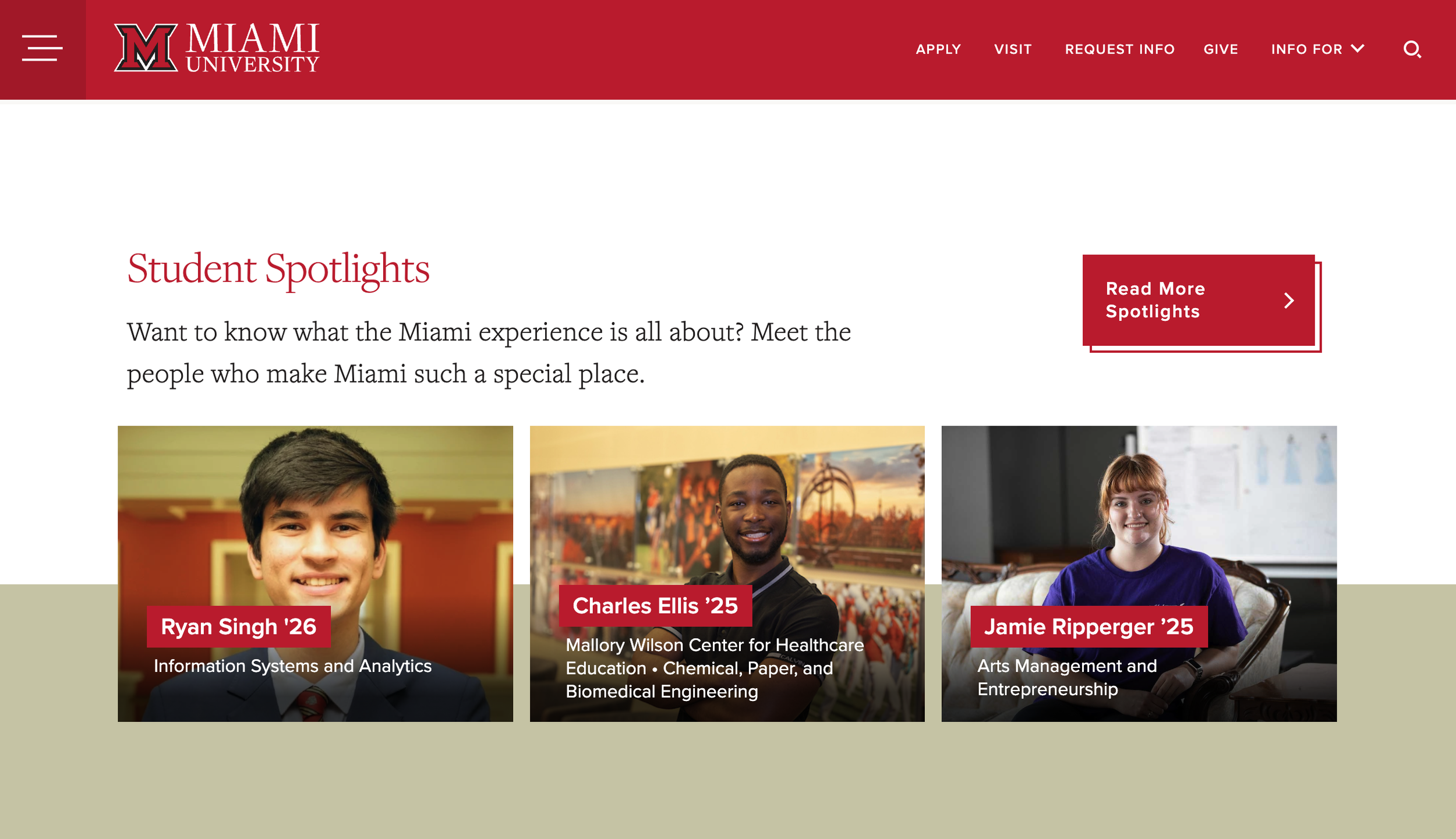
Miami University’s homepage features a “Student Spotlights” section where current and former students share their experiences and what the university has meant for them.
Program Pages: Showcase testimonials relevant to specific programs from students or faculty within that department. This provides targeted social proof for prospective students.
Shippensburg University’s English Department uses both written and video testimonials to illustrate student experiences on their program page.
Campus Life & Activity Pages: Feature testimonials that focus on student life, clubs, or extracurricular activities.
Alumni Pages: Dedicate space to alumni stories to showcase career paths, professional accomplishments, and the long-term benefits of your programs.
Stanford’s GCE/IEPA program features dedicated alumni testimonials (text + images) to highlight outcomes and impact.
Blog Posts: Embed testimonials within blog articles to support key points, build credibility, and create authenticity. This approach strengthens your content strategy while reinforcing social proof.
Dedicated Testimonial Pages: Create a central hub for all testimonials, allowing prospects to browse a wide range of student stories. Include a submission form to gather new testimonials, ensuring a steady flow of fresh, authentic content.
8. Foster a Community for Prospective Students
Fostering a community is important for adult learners because they may feel isolated or disconnected from the traditional college experience.
How can institutions build a community for adult students?
Institutions can build a community for adult students by hosting events geared toward them, creating online forums, and offering tailored campus tours or open houses.
Host Tailored Events: Organize workshops or mixers for non-traditional students to build connections with peers and faculty.
Create Online Groups: Establish online forums or social media groups for prospective and current non-traditional students to provide a sense of belonging.
Offer Flexible Tours: Offer tours and open houses with flexible timing and content that highlights resources relevant to working adults, rather than traditional campus tours.
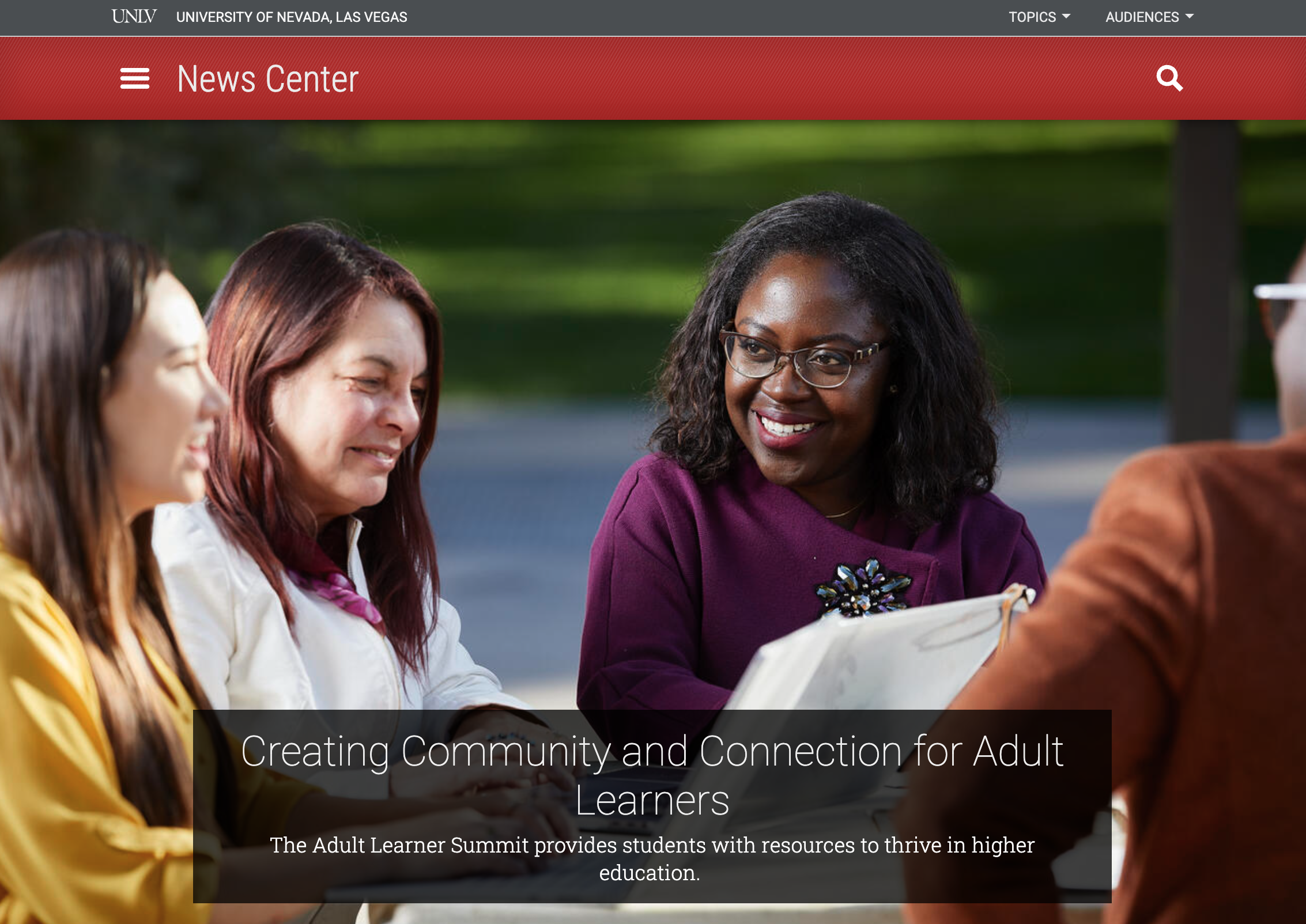
University of Nevada, Las Vegas (UNLV) hosts an annual “Adult Learner Summit” and maintains an Adult Learner Advisory Board that helps build community, share resources, and support returning students balancing life and study.
9. Provide Exceptional Customer Service
Exceptional customer service is a key marketing strategy because adult learners value efficiency and professionalism; a seamless experience is essential to attract and retain them.
How can a university improve its customer service for prospects?
A university can improve its customer service for prospects by providing a user‑friendly website with clear navigation and offering multiple, responsive contact options, such as phone, email, chat support, and live help.
Ways to enhance prospect‑focused customer service:
Omnichannel support: Ensure prospects can reach you via phone, email, live chat, SMS, WhatsApp or a chatbot. For example, one study found that 79% of customers favour live chat over other channels for its immediacy.
24/7 or extended‑hours availability: Many adult and international learners may contact outside typical hours; offering after‑hours chat or phone support improves responsiveness.
Straightforward, intuitive website navigation: The website should serve as a first point of contact; pages should guide prospects clearly to actions such as “Request Info,” “Apply,” and “Contact Us.” An article by Campus Technology emphasizes that your website may be a prospect’s first impression — if it’s confusing, interest can end at your home page.
Automated chatbot support with escalation to humans: Use AI/chatbot for standard queries (programs, deadlines, tuition) and escalate to human agents when needed. This increases speed and consistency.
Fast response & low-friction contact forms: Keep contact or inquiry forms short, ask only essential information, and follow up quickly. Slow response times reduce trust and risk losing the prospect.
Personalized follow‑up & lead‑routing: Use data (program interest, timeframe, learner segment) to route inquiries to the right advisor and send timely, personalized communications.
Accessible self‑service resources and knowledge base: Provide FAQs, video tutorials, chatbot help, or interactive tools so prospects can find answers instantly without waiting.
Quality training for prospect‑facing staff: Staff across phone/chat/email should apply active listening, cultural sensitivity, and timely follow‑up — internal standards in higher ed emphasize these behaviours.
Proactive engagement and outreach: Sending a friendly “how can we help you?” message after inquiry, offering a virtual information session, or even peer chats can improve the service experience and increase conversion.
Track and optimize service metrics: Monitor response times, channel use, conversion from inquiry to application, and use feedback loops to improve.
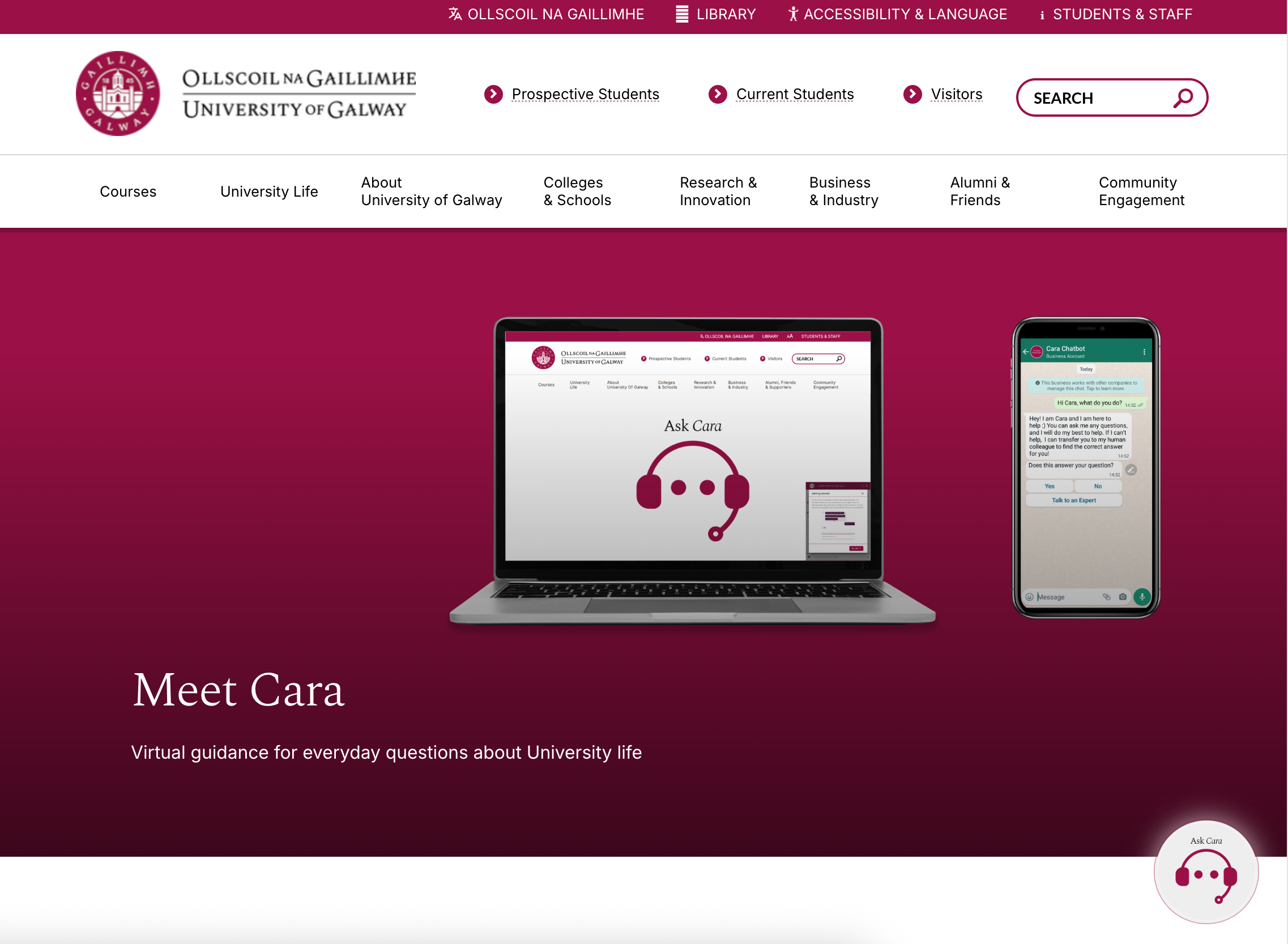
Example: University of Galway (Ireland) uses a virtual assistant called “Cara,” accessible via the website and WhatsApp, to answer admissions and program queries in real‑time, demonstrating strong digital support for prospects.
How Can You Successfully Engage Adults with Higher Education Marketing?
Marketing higher education to adults requires a tailored approach that addresses their unique needs and motivations. By understanding these factors—from their desire for career-focused programs and flexibility to their need for clear ROI and personalized support—you can implement the strategies outlined in this guide. This will help you attract adult learners, build trust, and ultimately contribute to their success and your institution's growth.
Boost Your Enrollment of Adult Learners
Implementing new marketing strategies requires careful planning and flawless execution. We offer customized, full-service higher education marketing services to fill your pipeline with high-quality prospects and applications.
Book a free, no-obligation consultation with our education marketing experts today.
Don’t miss our other posts on higher education digital marketing.
What Are 11 Valuable Strategies for Recruiting International Students?
What Makes Student Testimonials Crucial for University Recruitment Marketing?
How Can Universities Use Video Content to Boost Student Recruitment?
What Are 5 Effective Marketing Strategies for Recruiting Undergraduate Students?
How Can Universities Use AI for Marketing?
What Are the 7 Key Challenges in Higher Education Digital Marketing and How Can They Be Solved?
Key Higher Education Marketing Terms
Adult Learner (or Non-Traditional Student): A segment of students, often 25 or older, who are returning to education while balancing other life commitments, such as a full-time career or family responsibilities.
Chatbot: An AI-powered program designed to simulate human conversation and provide automated, instant responses to user inquiries online, often used for customer service.
Conversion Rate Optimization (CRO): The process of enhancing a website, email, or advertisement to increase the percentage of users who complete a desired action, such as filling out an inquiry form.
Cost-per-application (CPA): A marketing metric that measures the average cost to acquire one completed application for a program.
Cost-per-enrollment: A marketing metric that measures the average cost to acquire one new enrolled student.
Cost-per-lead (CPL): A marketing metric that measures the average cost to acquire one new prospective student contact (a "lead").
Customer Relationship Management (CRM): A system that helps manage and track interactions with current and prospective students, enabling personalized communication and automated marketing efforts.
Omnichannel Support: A customer service strategy that provides a seamless, consistent experience for prospects across all possible communication channels (e.g., phone, email, live chat, chatbots).
Pay-Per-Click (PPC): A digital advertising model where an advertiser pays a fee each time one of their ads is clicked. This is common on platforms like Google Ads and LinkedIn.
Return on Investment (ROI): A performance measure used to evaluate the efficiency of an investment. For adult learners, this often means comparing the cost of tuition against the value of career advancement and increased earning potential.
Search Engine Optimization (SEO): The practice of optimizing a website's content and technical setup to improve its visibility and ranking in organic (non-paid) search engine results.
Social Proof: Evidence from other people (like alumni or current students) that validates a choice. For adult learners, this often takes the form of alumni success stories or testimonials.