How can boarding schools create effective marketing strategies to attract students in 2026?
By Morgan Northmore, Copywriter and Digital Marketing Coordinator at Noetic Marketer. Morgan specializes in crafting digital content and marketing strategies that help educational institutions connect with prospective families and drive measurable enrolment growth through effective search engine optimization (SEO) and social media engagement.
Key takeaways:
Addressing Parent Concerns: Boarding school marketing requires addressing prospective parents’ specific concerns about safety, supervision, and student well-being away from home.
Authentic Storytelling: Successful boarding school marketing strategies focus on authentic storytelling through student testimonials, virtual tours, and day-in-the-life content.
Essential Digital Tactics: Digital marketing tactics, including SEO, social media, and targeted digital advertising, are essential for reaching prospective families researching boarding options.
Building Trust: Transparent communication about campus life, academic programs, and support systems is critical for building trust and increasing conversion throughout the admissions process.
Strategic Connection: Effective boarding school marketing combines an emotional connection with measurable, practical strategies to guide families through the decision-making process.
Only 27% of private and independent schools met their student recruitment goals by mid-2023, a proportion that has been declining since 2021. For boarding schools operating in an increasingly competitive landscape, the challenge is even more pronounced. Many families conduct extensive online research, compare multiple institutions, and make decisions from a distance, often over months or years.
This guide provides a comprehensive framework for success in boarding school marketing in 2026. We will cover the unique challenges boarding schools face, how to identify and reach your target audience, which digital marketing strategies deliver results, and how to build the trust necessary to convert prospective students into enrolled students. Each section draws on current enrolment data, expert insights, and practical strategies that admissions professionals can implement immediately.
Why is marketing different for boarding schools compared to day schools?
Marketing for boarding schools differs from that for day schools because it must overcome significant emotional and trust barriers that prospective families face when considering sending their child to live away from home. Unlike local day schools, boarding institutions are asking parents to entrust them with guardianship and student well-being 24 hours a day.
Why is the trust gap significant for boarding parents?
The trust gap is significant for boarding parents because their concerns extend far beyond academics to include child safety, security, and cultural adjustment. Research from the Boarding Schools Association indicates that roughly 79% of prospective parents to UK boarding schools cited child safety and security as their top concern. Other prominent worries include anxiety about racial discrimination, homesickness, food standards, and cultural adjustment. These concerns are substantially stronger than those faced by local independent schools or day schools.
How does decision complexity influence recruitment?
Decision complexity influences recruitment by extending the admissions cycle, as many families begin researching years before enrolment. Data from Niche’s 2023 State of Enrolment & Marketing Survey show that boarding school families are more likely to begin engagement with an online inquiry (37%) than to attend an in-person event first (32%), due to geographic distance and reliance on digital content.
Why is clear value communication necessary?
Clear value communication is necessary because tuition and fees at boarding schools represent a substantial investment. Busy parents expect transparency not only about costs but also about return on investment (ROI): college acceptance rates, academic achievements, and the social-emotional support their child will receive. Your school’s story must clearly articulate why the boarding experience justifies the investment compared to other schools, including independent day schools and international options.
Who are your target audiences for boarding school marketing?
Your target audience for boarding school marketing includes multiple distinct groups: domestic full-pay families, international students and their families, students in specific grade levels (typically Grades 7-12), and families seeking niche programs such as STEM leadership, environmental education, arts, or specialized learning support.
What do international students look for in a boarding school?
International students look for a boarding school that offers a clear path to academic success and cultural adaptation in a new country, insights that often parallel broader higher education recruiting strategies. Key factors include visa support, orientation programs, and a welcoming multicultural community. In 2023, Canada hosted over 1 million international students, making this a critical segment despite new permit caps.
How do domestic families research boarding options?
Domestic families primarily research boarding options through search and review platforms, making lead generation for educational institutions a critical part of your digital strategy. Niche research indicates that 84% of boarding school families used search and review platforms during their research, and 66% said reviews influenced their decisions. Schools that actively manage their presence on platforms like Niche, Boarding School Review, and Google significantly improve their visibility to families' search processes.
Why should your marketing target secondary audiences?
Your marketing should target secondary audiences, such as feeder schools, educational agents, and alumni networks, because they serve as vital referral sources. Alumni stories and testimonials carry substantial credibility with prospective families. Building relationships with these referral sources creates a sustainable pipeline, ensuring your enrolment funnel remains healthy year-over-year.
What digital marketing strategies work best for boarding schools?
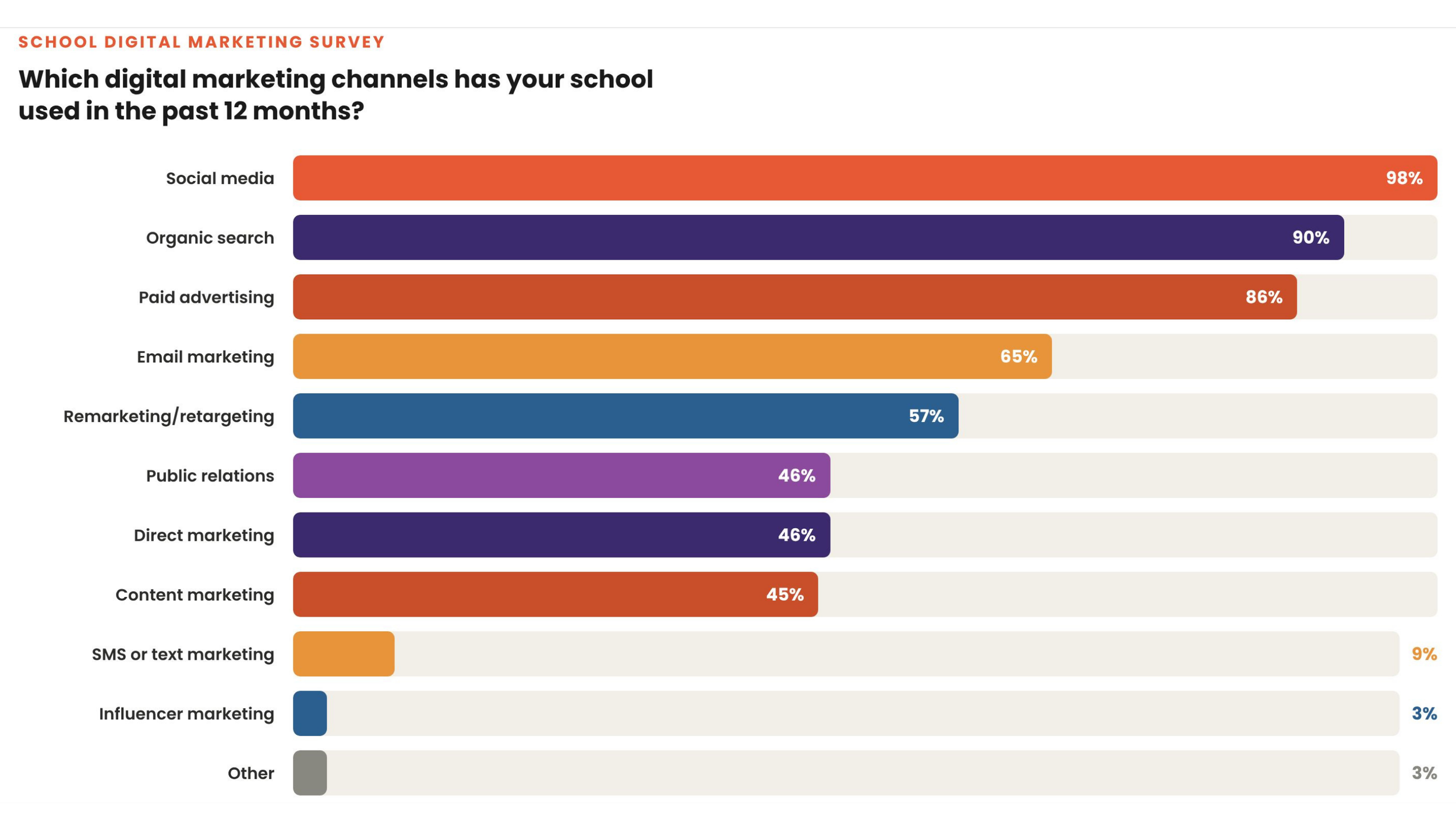
The most effective digital marketing strategies for boarding schools include SEO-optimized websites, authentic content marketing, targeted social media engagement, email nurturing, and immersive virtual tours, all of which benefit from a coordinated, full-funnel approach to education marketing services. According to recent research from the National Association of Independent Schools, social media is the most widely used digital marketing channel among independent schools, followed by organic search, paid advertising, and email marketing.
How does SEO drive boarding school enquiries?
SEO drives boarding school enquiries by ensuring your institution ranks for high-intent terms like "best boarding schools for STEM" or "boarding school safety," and sustained investment in search engine optimization for education helps keep your programs visible to the right families.
Why is email and CRM nurturing important for K-12 education marketing?
Email and CRM nurturing are important for K-12 education marketing because families often research for 12 to 36 months before making a commitment. Strategic email marketing for educational institutions keeps them engaged throughout that long decision cycle. Segmented email campaigns keep your school top of mind and allow you to address international students differently from domestic families, improving relevance and engagement.
What role do immersive experiences play in education marketing?
Immersive experiences, such as 360-degree virtual tours, allow distant families to explore dorms, classrooms, and sports fields from anywhere in the world, much like creative college enrolment strategies using virtual tours help higher education institutions stand out. Tools like SeekBeak and OmniSight enable interactive campus walkthroughs that reduce geographic friction and provide a tangible sense of campus life before a family commits to an expensive in-person visit.
How should boarding schools optimize their websites for prospective families?
Boarding schools should optimize their websites by directly addressing prospective parents’ top concerns, safety, supervision, daily life, and student well-being, while showcasing the academic and extracurricular opportunities that make your school stand apart. This must be supported by thoughtful education-focused website design and UX.
Boarding Life: Detailed information about dorms and accommodations, daily schedules, weekend activities, and the supervision structure.
Safety and Security: Specific information about staff training, emergency preparedness, security infrastructure, and mental health resources.
Academic Programs: Faculty credentials, class sizes, college counselling services, and academic achievements.
Admissions and Financial Aid: Clear tuition information, financial aid options, and the admissions process.
Technical Considerations: Mobile optimization is essential, as many busy parents research on their phones. Fast page speed and clear navigation are also critical to reducing drop-off rates.
What content marketing approaches resonate with boarding school families?
Content marketing approaches that resonate focus on authentic, student-centred material that addresses the concerns and aspirations of prospective families while showcasing what makes your school experience distinctive. This is where strategic content marketing for education can amplify your institutional mission.
Student Testimonials: Videos and blog posts featuring current students describing their boarding experience, personal growth, and daily life build credibility and emotional connection.
Faculty Profiles: Highlighting teachers’ credentials, teaching philosophy, and relationships with students reassures parents about academic excellence and mentorship.
Parent Testimonials: Other families describing their positive experiences provide powerful word-of-mouth validation.
Quantitative Outcomes: Showcase college acceptance rates and scholarships to establish ROI.
For example, a Noetic Marketer campaign for an Ontario-based university used outcome-driven messaging to achieve a 325% increase in new students across two programs compared to the previous year.
How do you build trust with prospective boarding school families?
Trust is built through radical transparency about every aspect of student life, including safety protocols, supervision arrangements, emotional and mental health support, daily routines, and weekend programming, communicated consistently across multiple digital channels.
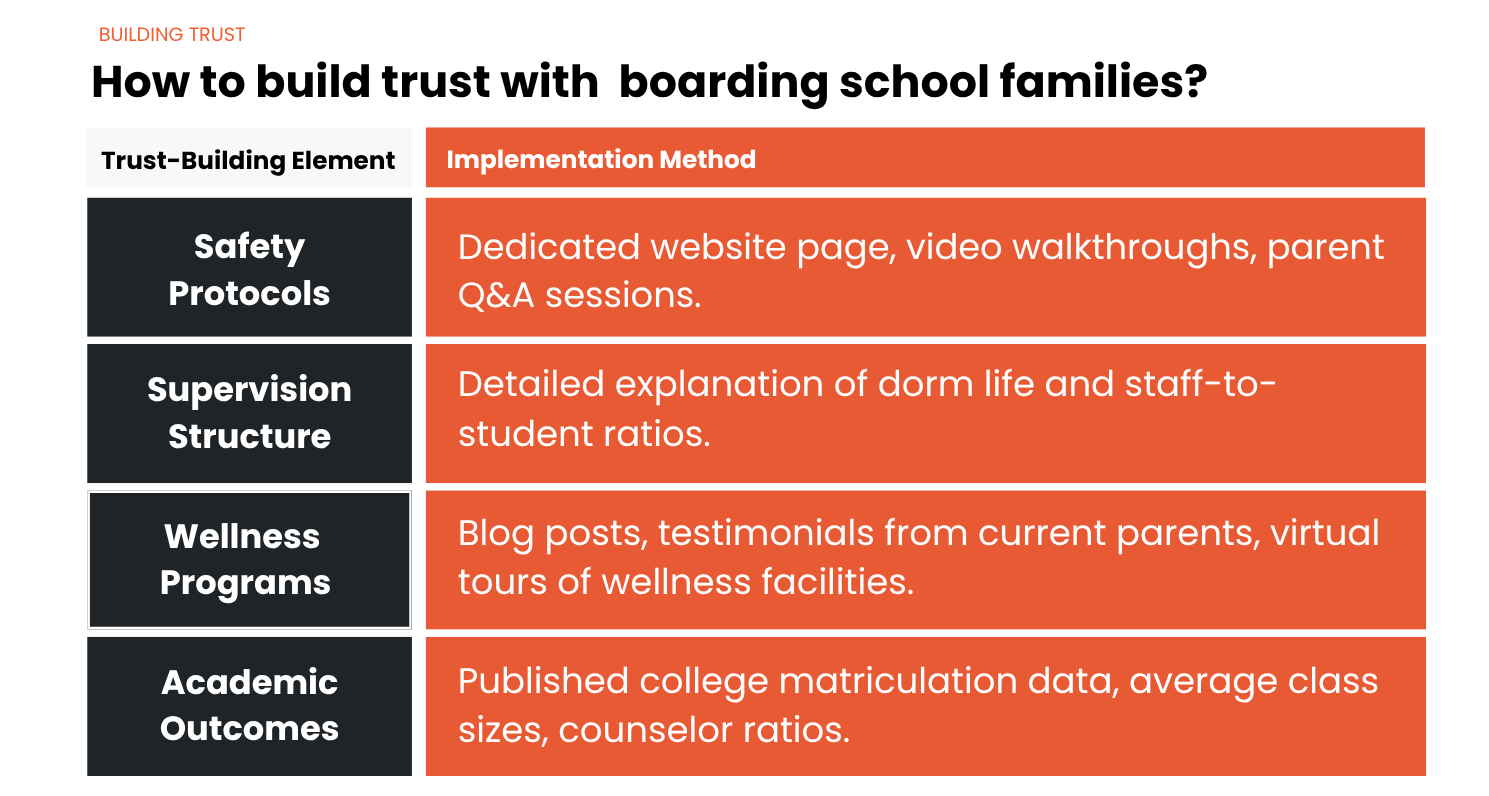
"In our work with educational institutions, we've found that transparency about outcomes and daily life is the single most effective trust-building tool," notes the Noetic Marketer education team, underscoring how intentional institutional brand building supports long-term enrolment health.
What role does social media play in boarding school marketing?
Social media plays a role in showcasing authentic campus life, building community connections with prospective students and current families, and extending your school’s reach to future students researching options online. Consistent social media management for schools is an essential part of your modern marketing mix.
Instagram and TikTok: Ideal for short-form video content like dorm tours, student takeovers, and classroom moments. Authenticity matters more than production value for Gen Z audiences. Deliberate social media advertising strategies can extend this authentic content to new qualified families.
Facebook: Remains valuable for reaching current parents and prospective parents in older age groups. Use this platform for longer updates, parent testimonials, and community event recaps.
YouTube: Longer-form content like full campus tours, faculty profiles, and student/parent testimonial interviews provides depth for families deeper in the research process.
LinkedIn: Useful for alumni engagement, showcasing academic research, and positioning school leadership as thought leaders in education.
How do you measure success in boarding school marketing?
Success in boarding school marketing is measured through a combination of inquiry generation, application rates, and enrolment conversion, tracked across digital channels to determine which efforts drive results. Disciplined lead nurturing and campaign optimization turn early interest into completed applications.
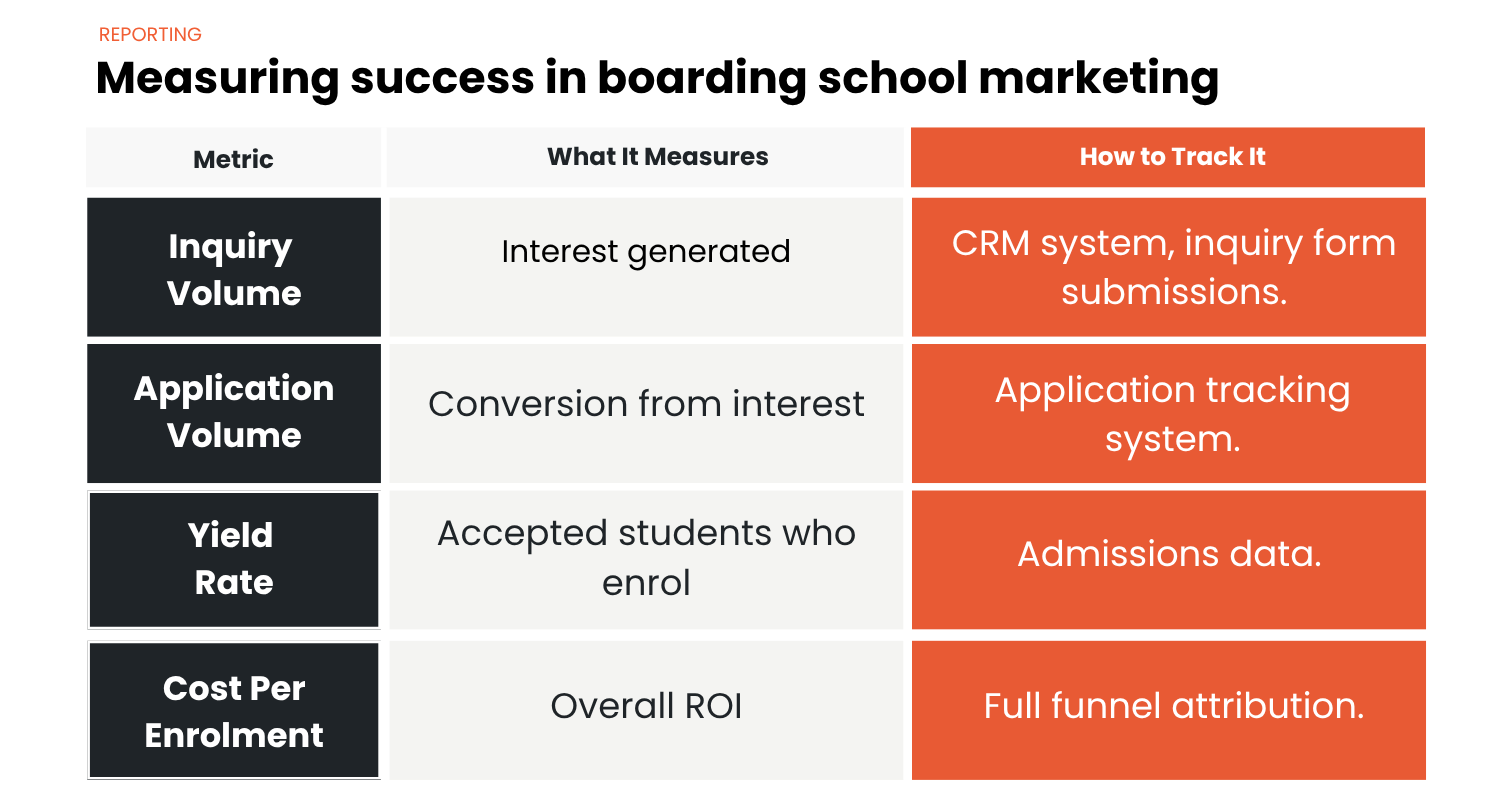
By using UTM parameters and CRM integration, institutions can calculate a true cost-per-enrolled-student. A Noetic Marketer partnership with a graduate engineering portfolio utilized these methods to achieve a 20.21% decrease in cost-per-enrolment, illustrating the value of structured strategic enrolment planning.
Conclusion
Effective boarding school marketing in 2026 requires a fundamentally different approach than day school recruitment. Success comes from combining authentic storytelling, through student testimonials and virtual tours, with data-driven strategies that directly address the emotional and practical concerns families face when sending a child to live away from home.
The institutions that meet their enrolment targets will be those that reinforce trust while showcasing the unique value of the residential experience. The goal is not viral content or polished advertising. The goal is to help the families see that your school is the place where their child will thrive academically, socially, and personally.
Achieve your enrolment goals
Schedule a meeting with our education marketing experts today for a focused conversation about your enrolment goals and marketing opportunities.
Don’t miss our other posts on digital marketing for education.
How do private schools approach marketing?
What does a higher education marketing agency actually do?
What is higher education marketing, and how is it different from traditional marketing?
How Can Universities Create an Effective Higher Education Marketing Budget?
What Are 11 Valuable Strategies for Recruiting International Students?
What Are 9 Proven Strategies for Marketing Higher Education to Adults?
What Makes Student Testimonials Crucial for University Recruitment Marketing?
How Can Universities Use Video Content to Boost Student Recruitment?
What Are 5 Effective Marketing Strategies for Recruiting Undergraduate Students?
How Can Universities Use AI for Marketing?
What Are the 7 Key Challenges in Higher Education Digital Marketing and How Can They Be Solved?
Boarding school marketing glossary
Enrolment funnel: The multi-stage process families move through from initial awareness to application and enrolment, which should be mapped carefully within your broader strategic enrolment planning framework.
Yield rate: The percentage of accepted students who choose to enrol at your institution, a metric often highlighted in education marketing case studies.
UTM parameters: Tracking codes added to URLs to measure the effectiveness of marketing campaigns.
Conversion rate: The percentage of visitors who take a desired action, such as submitting an inquiry, a topic explored frequently in our education marketing blog resources.
Student-generated content: Authentic material created by current students to showcase campus life, echoing broader trends toward humanizing institutions through student and alumni storytelling.
Retargeting: Digital ads targeted to people who have visited your website but not yet applied, and it’s one of several tactics leveraged in mission-driven higher education marketing.