Why is enrolment marketing essential for higher education institutions in 2026?
By Morgan Northmore, Copywriter and Digital Marketing Coordinator at Noetic Marketer. Morgan specializes in developing data-driven enrolment marketing strategies that help higher education institutions convert prospective learners into registered students through full-funnel digital optimization and institutional storytelling.
Key takeaways:
Definition focus: Enrolment marketing focuses specifically on converting prospective students through data-driven personalization, whereas admissions marketing typically covers broader awareness and recruitment activities.
Success metrics: Successful enrolment marketing uses behavioural triggers and multi-channel engagement to guide prospects through the inquiry-to-yield funnel, resulting in measurable improvements in conversion rates.
Technology required: Modern enrolment marketing requires integrating CRM systems, email automation, SMS campaigns, and AI-powered chatbots to meet students' expectations for personalized communication.
Market necessity: The 2026 enrolment cliff and declining public trust in higher education make specialized enrolment marketing essential for institutional success and long-term sustainability.
Team alignment: Alignment between the marketing and admissions teams is critical to generating qualified leads that convert into enrolled students
In an increasingly competitive higher education landscape, traditional methods for attracting and registering students are no longer sufficient.
While many institutions continue to rely on broad-reach recruitment, the most successful colleges and universities are shifting toward a precision-based model known as enrolment marketing. This transition is driven by a fundamental change in student behaviour: today’s prospective learners expect a personalized journey that speaks directly to their academic interests and career aspirations.
This guide provides a comprehensive framework for understanding enrolment marketing, how it differs from traditional admissions marketing, and actionable enrolment marketing strategies for institutional implementation. We will explore the mechanics of the enrolment marketing funnel, the core components of effective digital campaigns, and the measurement frameworks required to prove ROI.
By integrating advanced technology with institutional brand building, schools can build a sustainable pipeline of qualified applicants even in the face of significant demographic challenges.
What is enrolment marketing and how does it work?
Enrolment marketing is a comprehensive, data-driven strategy focused on converting prospective students into applicants and then into enrolled students. Unlike broader university marketing approaches, enrolment marketing zeroes in on optimizing every stage of the student journey, including awareness, inquiry, application, acceptance, deposit, and final enrolment decisions.
This process often begins with strategic enrolment planning, where institutions map the entire learner journey to identify friction points. The enrolment marketing funnel operates across distinct stages. At the top, lead generation activities attract prospective students through search engine optimization (SEO), content marketing, and social media advertising. As prospects engage, behavioural triggers initiate personalized communication sequences based on specific actions. Data from Volt Education shows that 68% of surveyed students expect a college or university's digital marketing to be personalized to their specific interests.
How is enrolment marketing different from traditional admissions marketing?
Enrolment marketing differs from traditional admissions marketing in that it focuses on conversion metrics and cost efficiency throughout the entire student journey. In contrast, admissions marketing often emphasizes awareness generation and broad reach through institutional brand building, without the same degree of funnel optimization.
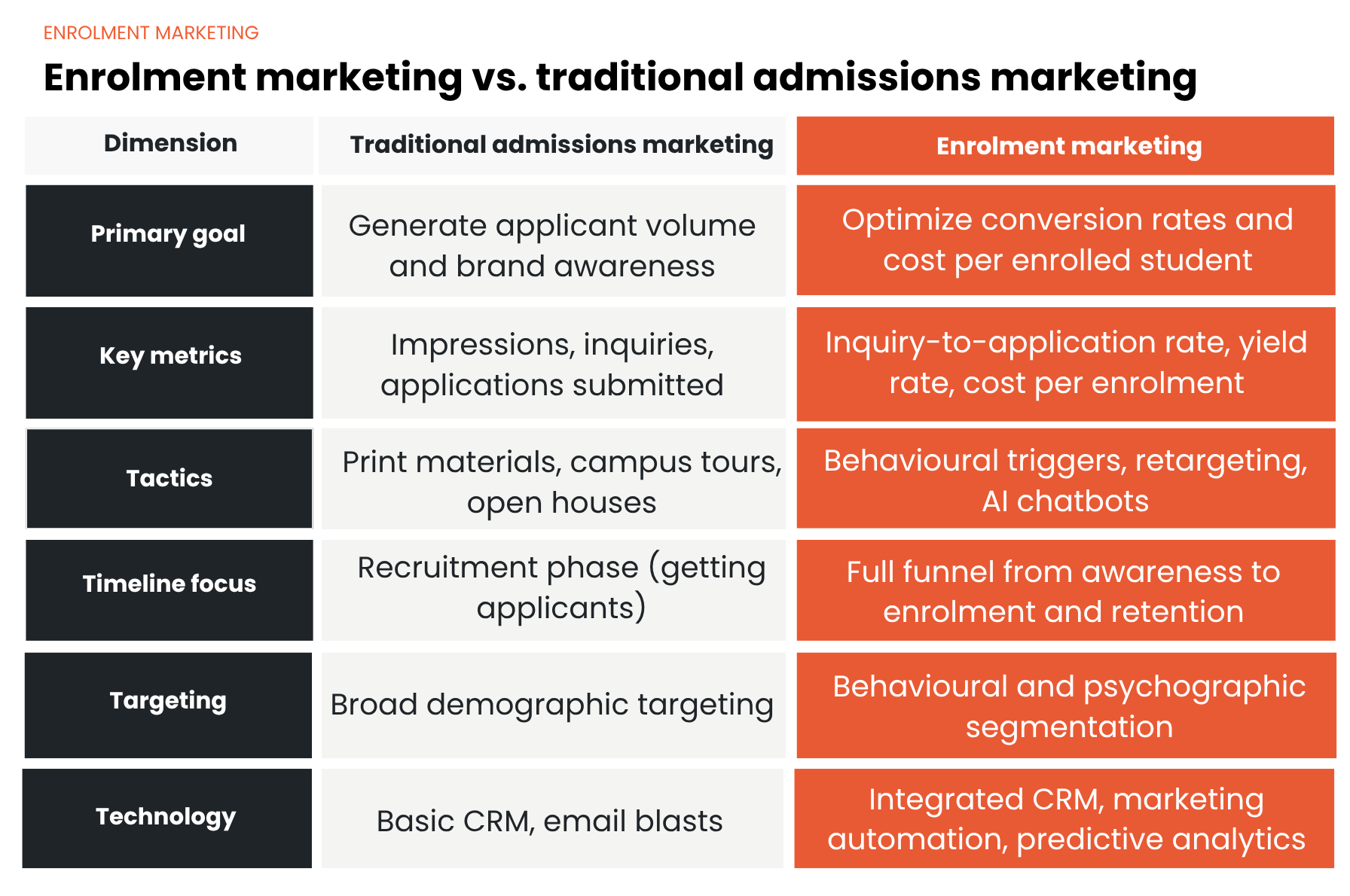
Traditional university marketing often generates a high volume of inquiries without corresponding enrolment success. Enrolment marketing addresses this gap by treating every interaction as an opportunity to move prospects toward enrolment.
For example, Noetic Marketer partnered with a faculty at an Ontario-based university to implement a full-funnel digital strategy, resulting in a 97% increase in total applications, a 40% increase in offers of admission, and a 233% increase in new student enrolments.
Why is the alignment between marketing and admissions teams critical for enrolment success?
Organizational alignment between marketing and admissions teams is critical for enrolment success because it ensures that marketing efforts generate leads that actually meet admissions criteria, creating a seamless feedback loop.
This alignment often requires campaign and customer journey audits to ensure both teams are working toward the same definitions of success. The transition from any inquiry to marketing qualified leads (MQLs) represents a fundamental shift in how institutions approach recruitment. A Marketing Qualified Lead meets specific institutional criteria, such as academic background and demonstrated intent, before being passed to the recruitment team. When marketing operates independently from admissions, the silo effect often leads to high inquiry volume but low enrolment yield.
Why is enrolment marketing critical for higher education institutions in 2026?
Enrolment marketing is critical for higher education institutions in 2026, as the enrolment cliff and shifting student expectations make precision marketing essential to institutional survival and the sustainability of long-term tuition revenue.
How do demographic challenges impact domestic student recruitment?
Demographic challenges impact domestic student recruitment by reducing the total number of high school graduates. According to the Western Interstate Commission for Higher Education (WICHE), the total number of graduates will have peaked in 2025, then enter a period of steady decline, resulting in a 13% drop by 2041. Furthermore, Nathan Grawe’s research highlights a 12-percentage-point drop in the number of 18-year-olds entering post-secondary education between 2025 and 2030. To combat this, institutions must rely on sophisticated market research to identify untapped student segments.
Why is public confidence in higher education declining?
Public confidence in higher education is declining because the steep rise in living costs and increasing tuition fees have made the financial return on a degree feel increasingly uncertain for many families. According to Ipsos research, only 48% of Canadians believe a post-secondary credential is worth the investment, while 39% of the public remain unsure of its long-term value.
This skepticism is particularly visible among Millennials, with 41% reporting that their degree was a poor financial decision, compared with just 20% of Baby Boomers. With nearly 90% of the public prioritizing affordability amid recent tuition fee increases, it’s important that enrolment marketing highlights financial aid options and features positive career outcomes that deliver tangible value.
What are the core components of an effective enrolment marketing strategy?
Effective enrolment marketing combines data-driven audience targeting & segmenting, personalized messaging, and multi-channel engagement to guide prospective students through every stage of the strategic enrolment planning funnel – from first discovery to final enrolment. Rather than operating as isolated tactics, the core components should work together as a connected system.
1. Awareness & prospect generation (top of funnel)
At the earliest stage, the goal is to attract high-intent prospects and build visibility with the right audiences.
Performance recruitment campaigns: Utilize pay-per-click advertising and social media advertising to capture active demand. Notably, 67% of students use search engines first when researching institutions, making search engine optimization (SEO) a critical component of institutional visibility.
Audience targeting & segmenting: Use behavioural and demographic data to reach the right students with relevant messaging. Segmented emails drive 30% more opens and 50% more click-throughs than generic blasts.
Multi-channel visibility: Students now discover institutions across search, social, and video. This makes an integrated presence through content marketing and social media essential for top-of-mind awareness.
2. Consideration & lead capture (mid-funnel entry)
Once an awareness strategy is established, the focus shifts to converting interest into identifiable leads.
Landing page deployment: Build high-converting, mobile-optimized pages aligned to specific programs.
Conversion points: Program guides, virtual events, and inquiry forms designed to capture intent as part of a broader conversion rate optimization (CRO) strategy.
Initial segmentation: Begin grouping prospects based on behaviour and interests to prepare for lead nurturing and campaign optimization.
3. Nurturing & engagement (mid-funnel)
Now, focus on turning interest into action through effective recruitment strategies.
Email marketing & automation: Automation delivers outsized results, accounting for only 2% of email sends but 30% of revenue.
Retargeting campaigns: Use social media advertising to re-engage users who have shown interest. Retargeting ads can perform up to 10x better than standard cold traffic ads by maintaining momentum during the long consideration phase.
AI systems & chatbots: Provide instant, on-demand support. Chatbot usage has surged by 92% over the last three years, meeting Gen Z's demand for instant answers. Learn more in our guide on how universities can use AI for marketing.
Parent engagement strategies: With roughly two-thirds of students involving their parents in decision-making, institutions must create parallel communication streams addressing cost, outcomes, and value through brand strategy & messaging.
4. Application & conversion (bottom of funnel)
At this stage, reducing friction and reinforcing confidence in decisions are key.
Personalized outreach & reminders: Targeted communications regarding application deadlines using CRM implementation and optimization.
Conversion-focused messaging: Highlight tangible outcomes and ROI to optimize your admissions process.
Streamlined processes: Ensure application experiences are simple, clear, and mobile-friendly to support the customer journey.
5. Yield & enrolment (post-acceptance)
Marketing does not stop at acceptance; this stage determines final enrolment through institutional brand building and community support.
Follow-up campaigns & retargeting: Reinforce the student’s decision and build excitement for the upcoming semester through social media management.
Community-building initiatives: Virtual events, peer connections, and onboarding content that foster a sense of belonging.
Lifecycle communication: Continued engagement from acceptance through the first day of classes, managed through marketing technology integration.
What technology and tools are essential for enrolment marketing?
An integrated tech stack anchored by CRM implementation and optimization is essential for scaling enrolment marketing and guiding prospects through the funnel.
By connecting tools across each stage, institutions can manage the full student journey from first touch to final registration.
Awareness stage: Google Ads, Meta Ads, LinkedIn Ads, and SEO tools such as SE Ranking, Surfer, and Google Search Console drive top-of-funnel visibility.
Consideration stage: Instapage, Unbounce, and Carrd support high-converting landing pages and content marketing.
Nurturing stage: HubSpot, ActiveCampaign, and tools like Intercom chatbots maintain engagement through automated and personalized communication.
Application stage: CRMs such as Slate or Salesforce Education Cloud centralize applications and streamline admissions workflows.
Yield stage: Google Analytics 4, Google Tag Manager, and Looker Studio dashboards track performance, ROI, and conversion efficiency to optimize enrolment outcomes.
How do you measure the success of enrolment marketing campaigns?
You measure the success of enrolment marketing campaigns by tracking conversion rates at each funnel stage and the cost per enrolled student, which is made possible through analytics and performance reporting.
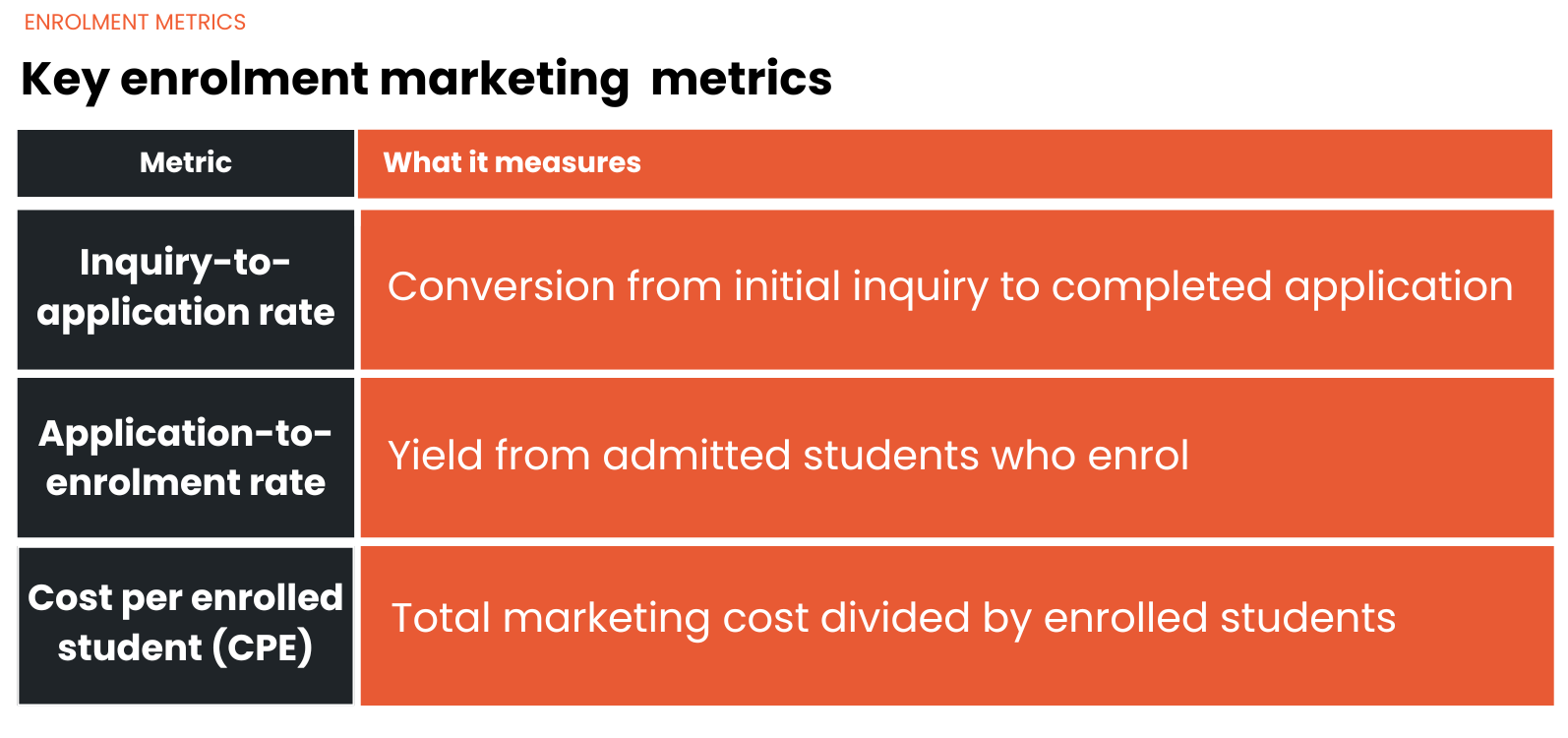
By implementing awareness-focused digital strategies with proper tracking, a Noetic Marketer project for an Ontario-based university generated over 6,000 marketing qualified leads in the first year following the launch of two new programs.
How do digital marketing strategies improve enrolment for graduate programs?
Digital marketing strategies improve enrolment for graduate programs by utilizing hyper-targeted persona data to reach working professionals who prioritize career outcomes and ROI over the general campus lifestyle.
Professional audiences require a fundamental shift from information-based messaging to identity-based messaging. Through brand strategy and messaging, institutions can position a graduate credential not just as a sequence of courses, but as a catalyst for professional transformation. This involves sophisticated audience targeting and segmenting to reach candidates based on specific job titles, years of experience, and industry-specific pain points.
What are common enrolment marketing mistakes to avoid?
The most common enrolment marketing mistakes include treating enrolment marketing as traditional advertising and failing to utilize conversion rate optimization (CRO) to fix leaky funnels.
Confusing tactics with strategy: Running isolated ads without a campaign architecture development plan produces activity but not students.
Ignoring mobile optimization: Mobile devices account for 54% of global website traffic. A poor smartphone experience creates friction that costs enrolments.
Focusing on vanity metrics: Page views and impressions do not predict enrolment success as effectively as lead quality and application starts.
Conclusion
Enrolment marketing represents a fundamental shift from volume-focused recruitment to conversion-optimized student acquisition. By treating the student journey as a series of opportunities to provide value and guide decisions, institutions achieve measurable improvements in enrolment outcomes and cost efficiency. As the 2026 enrolment cliff approaches, institutions that build enrolment marketing capabilities now position themselves for sustainability.
Boost your enrolment
Schedule a meeting with our education marketing experts today for a focused conversation about your enrolment goals and marketing opportunities.
Don’t miss our other posts on digital marketing for education.
How can boarding schools create effective marketing strategies to attract students in 2026?
How do private schools approach marketing?
What does a higher education marketing agency actually do?
What is higher education marketing, and how is it different from traditional marketing?
How Can Universities Create an Effective Higher Education Marketing Budget?
What Are 11 Valuable Strategies for Recruiting International Students?
What Are 9 Proven Strategies for Marketing Higher Education to Adults?
What Makes Student Testimonials Crucial for University Recruitment Marketing?
How Can Universities Use Video Content to Boost Student Recruitment?
What Are 5 Effective Marketing Strategies for Recruiting Undergraduate Students?
How Can Universities Use AI for Marketing?
What Are the 7 Key Challenges in Higher Education Digital Marketing and How Can They Be Solved?
Key marketing terms
Enrolment funnel: The multi-stage journey prospects move through from initial awareness to inquiry, application, acceptance, and final enrolment. Mapping this funnel is a core component of strategic enrolment planning.
Marketing qualified lead (MQL): A prospective student who meets specific institutional criteria, such as academic background, geographic location, and demonstrated intent, making them ready for direct outreach from the recruitment team.
Yield rate: The percentage of admitted students who choose to enrol at the institution. This is a critical metric for predicting final revenue and class sizes.
Melt rate: The percentage of students who deposit or accept an offer but fail to register for classes, often due to a lack of middle-funnel engagement.
Strategic enrolment planning (SEP): A data-informed process that aligns an institution’s mission, academic programs, and resources with market forces to achieve sustainable enrolment goals.
Conversion rate optimization (CRO): The systematic process of increasing the percentage of website visitors who take a desired action, such as submitting an inquiry or starting an application, by reducing friction in the user journey.
Performance recruitment campaigns: Digital advertising efforts, often utilizing PPC or social media ads, that are strictly measured against lead generation and enrolment outcomes rather than impressions or clicks.
Full-funnel marketing: An integrated strategy that addresses every stage of the student recruitment cycle, ensuring there are no gaps in communication from the first point of contact to post-enrolment advocacy.
Retargeting: A digital advertising tactic that serves ads specifically to individuals who have previously visited the institution's website but did not complete a conversion action.
Silo effect: A common institutional challenge where the marketing and admissions teams operate independently, leading to a disconnect between lead generation and actual enrolment yield.
UTM parameters: Specific tracking codes added to URLs that allow marketing teams to identify exactly which campaign, channel, or creative asset drove a specific conversion or inquiry.
Student-generated content: Authentic material created by current students, such as vlogs or testimonials, used to provide social proof and a realistic view of the campus experience.
CRM (customer relationship management): A software system used by higher education institutions to manage all interactions with prospective and current students.