How do private schools approach marketing?
By Morgan Northmore, Copywriter and Digital Marketing Coordinator at Noetic Marketer. Morgan specializes in crafting digital content and data-driven marketing strategies that help educational institutions connect with prospective families and drive measurable enrolment growth through effective search engine optimization (SEO) and social media engagement.
Key takeaways:
Trust and differentiation are foundational: Private school marketing focuses on communicating a unique institutional mission and long-term value to stand out in a crowded market.
Digital channels dominate discovery: Organic search and organic social media are among the most widely used digital tactics by private schools, with 64% reporting use of SEO and 66% reporting organic social.
Full-funnel nurturing addresses long cycles: Because the decision cycle for private education can last 12 to 36 months, schools must implement long-term lead-nurturing strategies to move families from inquiry to tour.
Strategic partnerships overcome resource gaps: Many schools operate with limited marketing resources. In fact, 37% of schools have no full-time marketing staff, which is why many institutions choose to outsource to K-12 education marketing agencies to support enrollment growth and digital strategy. (Source)
Mobile usability is a critical factor in lead retention: Globally, mobile devices account for the majority of web traffic, underscoring the importance of mobile-optimized school websites in retaining prospective families' interest.
Every year, independent schools face a recurring challenge: a graduating class leaves empty seats that need to be filled.
In an increasingly competitive landscape, where 46% of private schools report enrolment increases while 25% see declines, a strategic marketing plan is no longer optional. It is a prerequisite for institutional stability.
This guide explores how modern private schools approach marketing to engage prospective families and drive sustainable growth.
What is the core goal of private school marketing?
The core goal of private school marketing is to attract, engage, and enrol prospective students by communicating the specific value of an institution's academic programs and community experience.
Unlike traditional business marketing, which may prioritize immediate revenue, a school's success is measured by long-term outcomes such as student retention, graduation rates, and the lasting legacy of its alumni.
For most independent schools, this long-term approach involves a student-first perspective that connects education marketing research with digital tactics. By leveraging storytelling and strategic enrolment planning, schools can match the right students with the programs where they are most likely to thrive.
Why does private school marketing require a specialized approach?
Private school marketing requires a specialized approach because families are evaluating a child’s future trajectory and community fit, not just academic programs.
By building credibility and differentiation through a school’s educational philosophy, student experience, and institutional stability, marketing becomes persuasive without being high-pressure.
This strategic focus allows independent schools to highlight unique strengths such as industry partnerships, specialized STEM or arts curricula, and intimate community cultures that foster a sense of belonging.
What are the main obstacles in K-12 marketing?
The main obstacles in K-12 marketing include increased competition, long decision cycles, and limited internal resources. K-12 schools operate in a high-stakes environment where they must balance parental values with enrolment stability and long-term sustainability.
Common challenges identified in the K-12 education sector include:
Increased competition: Traditional and alternative schooling models are offering parents more options than ever before.
Market differentiation: Schools often struggle to clearly articulate what sets them apart in a crowded market.
Decision complexity: Parents are influenced by trust, reputation, and peer validation, which can lead to research phases lasting years.
Resource gaps: Approximately 37% of private schools have zero full-time marketing staff, making it difficult to manage strategy and execution simultaneously.
How are marketing budgets structured in private schools?
Marketing budgets in private schools are typically structured around lean allocations across traditional and digital channels, with 63% of schools reporting traditional budgets of $25,000 or less. The following data highlights how resources are currently distributed across the sector.
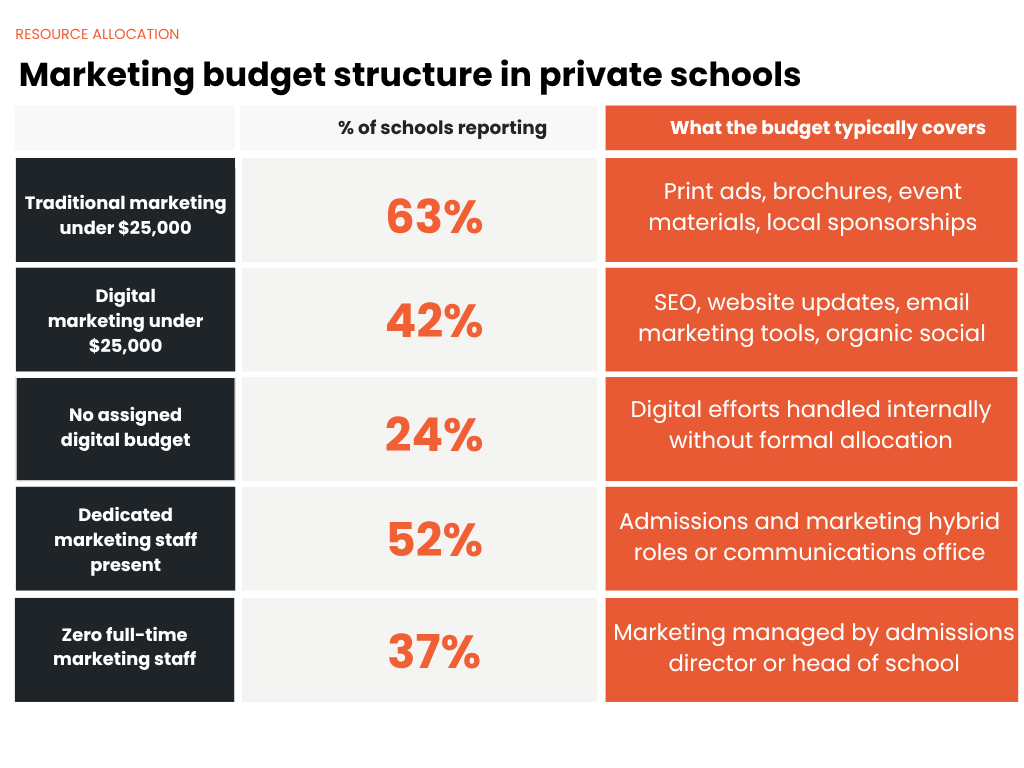
The data suggests that private school marketing is often decentralized, with digital spending frequently embedded within admissions or communications budgets rather than structured as a standalone growth function.
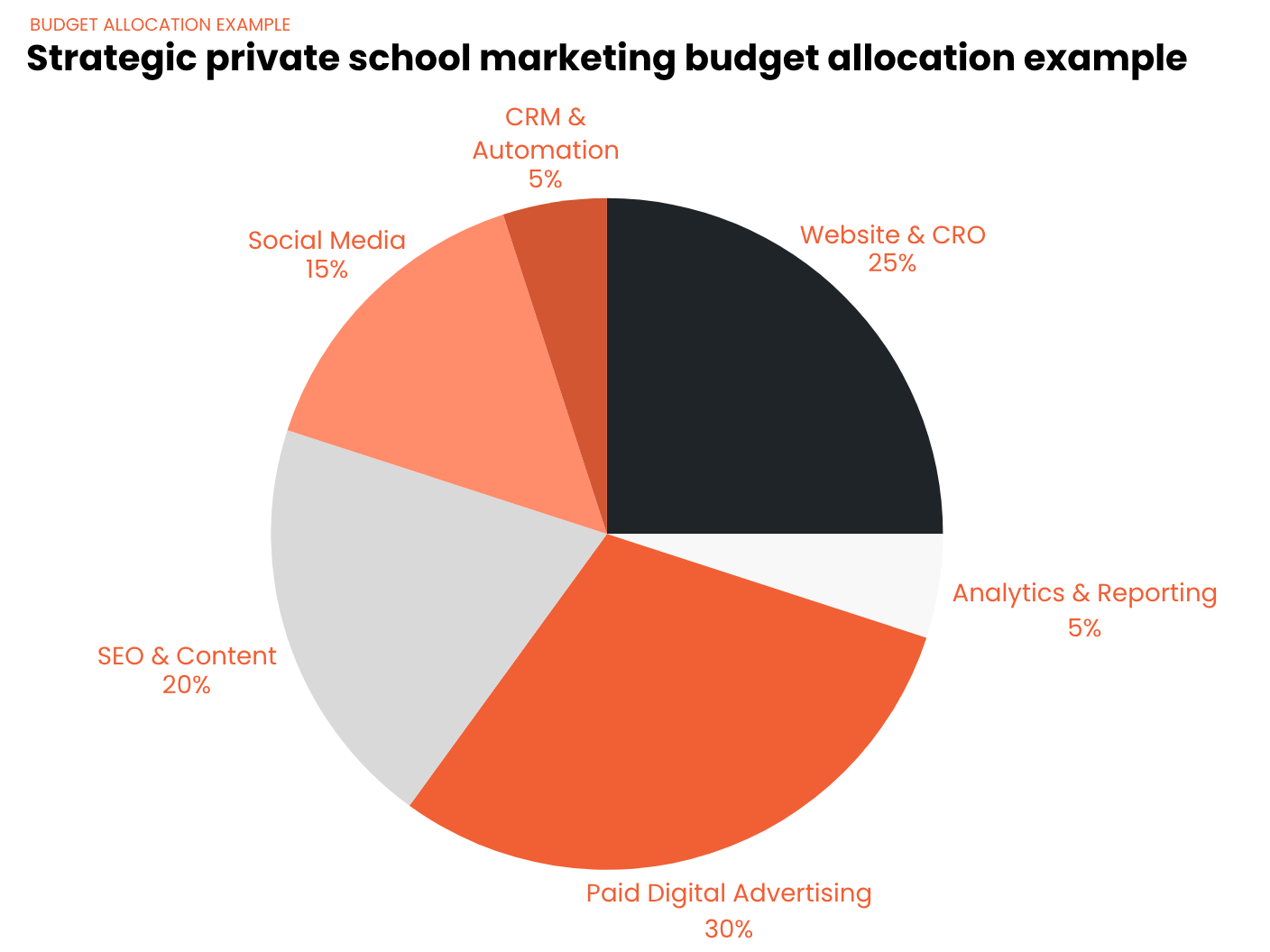
To improve efficiency, schools should move toward a more balanced and strategic budget strategy and allocation model.
What is the private school enrolment funnel?
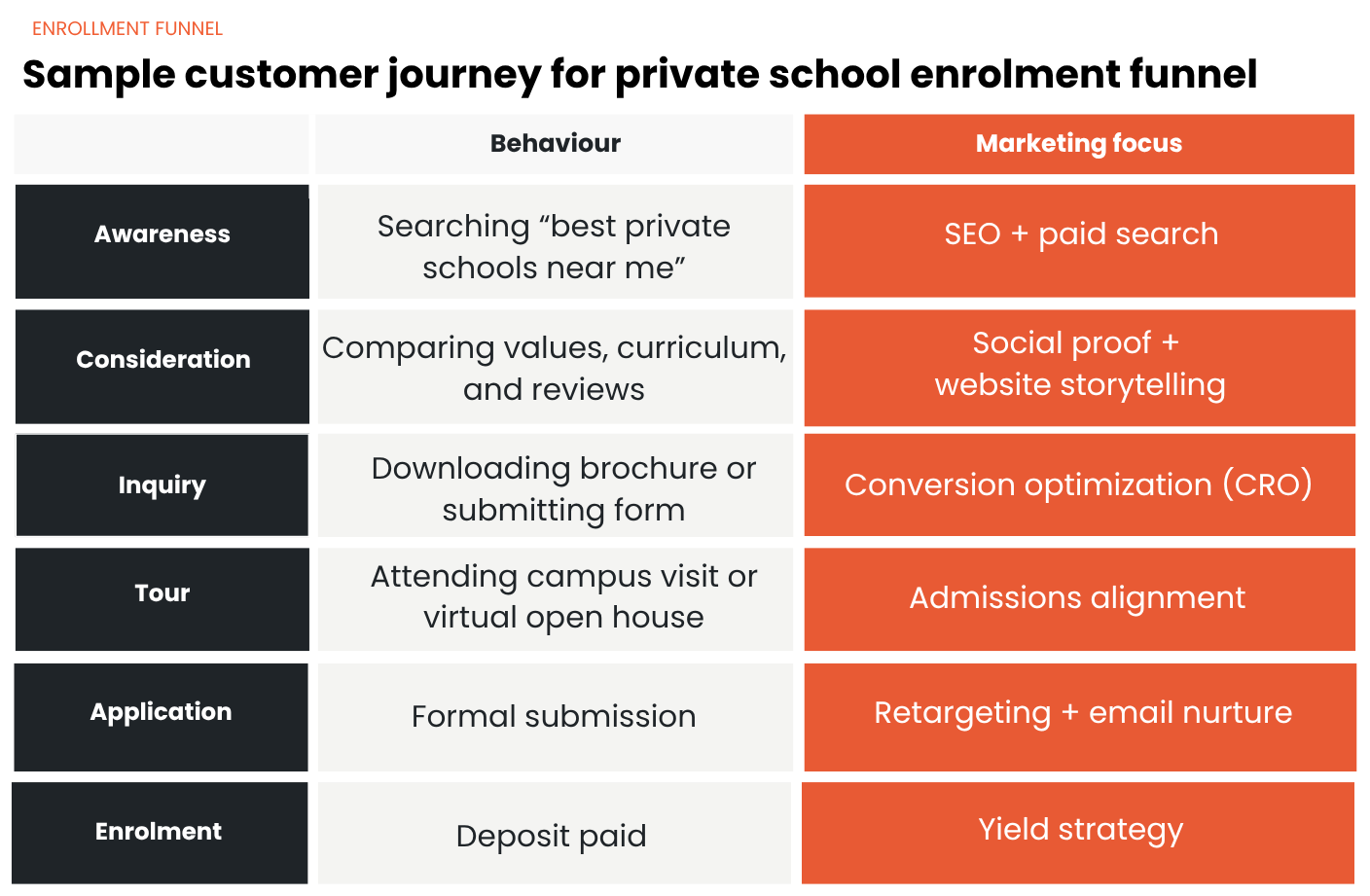
The private school enrolment funnel is a multi-stage journey that reflects how families research, evaluate, and eventually commit to an institution over multiple academic years.
Because private education is a high-investment, emotionally driven decision, the focus must be on long-term nurturing rather than on transactional marketing.
The following chart illustrates a sample customer journey through the private school enrolment funnel:
How are marketing functions structured internally in private schools?
Marketing functions in private schools are structured around available staff resources and institutional priorities, which often dictate whether the school adopts a reactive or proactive approach to recruitment.
According to the 2023 Niche report, 37% of private schools operate with zero full-time marketing and communications employees, while 52% have a dedicated staff member or office responsible for marketing.
The internal organizational model a school chooses significantly impacts its ability to manage long-term enrolment health. When marketing responsibilities are fragmented across departments, institutions often struggle to maintain a consistent brand voice or track the ROI of their budget strategy and allocation.
Internal marketing structure types and operational impacts
Admissions-led marketing: Often focuses on short-term recruitment for the current cycle, leading to transactional messaging rather than long-term brand building.
Communications-led marketing: Prioritizes brand image, public relations, and internal community updates but may lack performance-driven tactics such as PPC advertising.
Hybrid marketing and admissions office: Provides a balanced approach to the student journey but is frequently resource-constrained and prone to staff burnout.
Outsourced agency support: Offers a scalable, analytics-driven model that provides specialized expertise without the overhead of full-time internal hires.
For the K-12 education sector, this lack of specialization can lead to a misalignment between marketing efforts and admissions capacity. Without a specialist to manage analytics and performance reporting, these schools often rely on "what they’ve always done," which typically involves high-cost traditional media with unmeasurable results.
How can private schools move from a reactive to a proactive growth model?
Transitioning to a proactive model requires a clear division of labour between brand storytelling and performance recruitment. Schools that successfully scale their enrolment usually adopt one of two paths:
The hybrid expansion: Hiring a dedicated marketing coordinator to work alongside admissions to manage social media advertising and email workflows.
The strategic partnership: Engaging a specialized agency to handle the technical aspects of search engine optimization (SEO) and CRM systems while the internal team focuses on high-touch family tours and community engagement.
By choosing a structure that supports data-driven decision-making, private schools can move beyond the seasonal marketing push and build a sustainable enrolment engine that operates year-round.
What digital marketing tactics are most effective?
The most effective digital marketing tactics for private schools include a blend of search engine optimization (SEO), organic social media, and performance-driven digital advertising. Recent benchmarks indicate that organic search and organic social media are the primary drivers of inbound engagement for independent institutions.
Noetic Marketer’s case studies exemplify this blend in action: in one campaign for an Ontario university’s engineering programs, a full-funnel strategy spanning paid search, social, landing pages, and email nurture generated over 20.21% marketing qualified leads within the first year, while drastically reducing cost per enrolment.
How does organic search drive enrolment?
Organic search drives enrolment by capturing prospective families during the discovery phase when they are actively seeking educational solutions. Strategic search engine optimization (SEO) ensures that a school appears prominently for high-intent queries such as “best private schools near me.”
How can schools increase their social media presence?
Schools can increase their social media presence by showcasing authentic campus life and involving current students as brand ambassadors. To support recruitment, marketing teams should respond to comments promptly and post consistently to stay on prospective families' radar.
For more tactical ideas, see our guide on 5 marketing strategies for recruiting undergraduate students, which applies similar engagement principles to the K-12 sector.
Why is a mobile-friendly website strategy necessary?
A mobile-friendly website strategy is necessary because, globally, mobile devices account for the majority of web traffic, underscoring the importance of deploying landing pages that are mobile-optimized. If a parent cannot easily find a contact form on their phone, the institution risks losing that lead to a more accessible competitor.
How can schools build trust with families online?
Schools build trust with families online by prioritizing transparency, accessibility, and authentic storytelling. Gen Z parents and students value honesty about institutional values and academic outcomes.
For example, a Noetic Marketer campaign for an Ontario-based university successfully built trust by using a brand strategy and messaging rooted in hope and action. This approach led to a 325% increase in new students across two programs compared to the previous year.
Why is compliance and privacy critical in school marketing?
Compliance and privacy are critical in school marketing because institutions handle sensitive data belonging to families and minors. Requirements like CASL and PIPEDA influence not only messaging but also CRM systems configuration and data retention policies.
Key factors include:
Data security: Protecting minor information impacts how lead nurturing workflows are structured.
Consent management: Explicit consent is required for email marketing under CASL, impacting open rates and segmentation.
Legal standing: Adhering to the FOIP Act and PIPEDA ensures institutional stability and family trust.
How do schools measure sustainable enrolment growth?
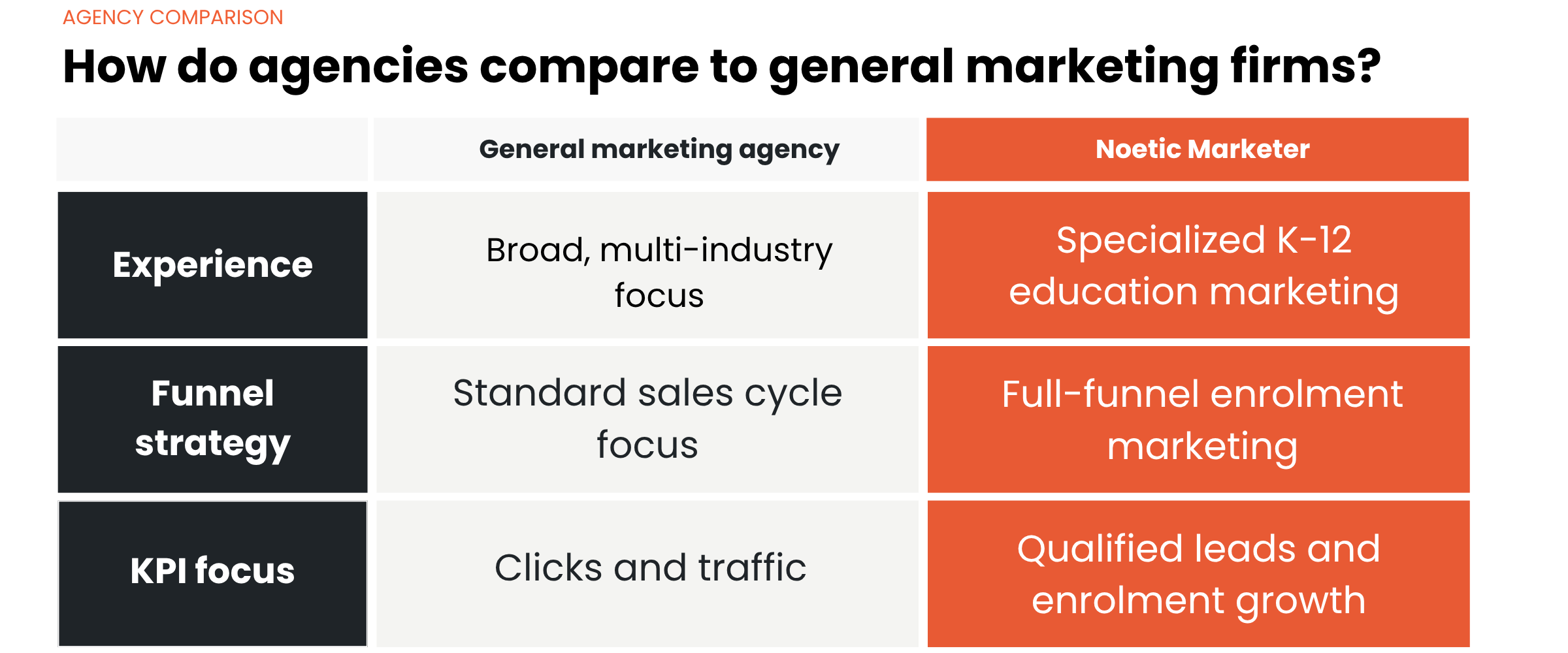
Schools measure sustainable enrolment growth by tracking metrics that link marketing investment directly to admissions outcomes, such as cost per lead (CPL) and cost per application (CPA). Transitioning from a generalist firm to a specialized K-12 education marketing agency helps schools shift focus from surface-level clicks to qualified leads.
Our work examples demonstrate how data-driven performance recruitment campaigns can stabilize year-over-year growth.
What services do marketing agencies provide to K-12 institutions?
Marketing agencies provide a comprehensive suite of services to K-12 institutions designed to stabilize enrolment and amplify institutional purpose.
By acting as a strategic partner, an agency ensures that marketing efforts are perfectly aligned with a school's admissions capacity.
Typical agency services for independent schools include:
Strategic enrolment planning: Focusing on long-term enrolment health and sustainable recruitment cycles.
Market research: Conducting deep dives into audience targeting and segmentation.
Brand strategy and messaging: Developing authentic messaging that highlights unique selling points.
Website experience and CRO: Ensuring the school's digital front door is fast and optimized to capture inquiries.
Performance recruitment campaigns: Managing full funnel advertising through PPC advertising and social media advertising.
Lead nurturing: Building automated communication workflows over the 12 to 36-month decision cycle.
CRM systems and technology support: Implementing systems like Talisma or Slate to track leads.
Analytics and performance reporting: Providing real-time visibility into campaign results.
Conclusion
Ultimately, success in private school marketing is not just about generating clicks, but about building a strategic enrolment engine that nurtures trust over several years.
By moving from a reactive, admissions-led model to a proactive, full-funnel strategy, independent schools can ensure institutional stability. Combining data-driven optimization with authentic, mission-led storytelling enables schools to compete effectively in today's complex market landscape.
Partnering with an experienced agency ensures that your unique institutional vision reaches the families most likely to thrive in your community.
Achieve your enrolment goals
Schedule a meeting with a Noetic Marketer strategist for a focused, mission-led conversation about your school’s goals and marketing opportunities.
Don’t miss our other posts on digital marketing for education.
What does a higher education marketing agency actually do?
What is higher education marketing, and how is it different from traditional marketing?
How Can Universities Create an Effective Higher Education Marketing Budget?
What Are 11 Valuable Strategies for Recruiting International Students?
What Are 9 Proven Strategies for Marketing Higher Education to Adults?
What Makes Student Testimonials Crucial for University Recruitment Marketing?
How Can Universities Use Video Content to Boost Student Recruitment?
What Are 5 Effective Marketing Strategies for Recruiting Undergraduate Students?
How Can Universities Use AI for Marketing?
What Are the 7 Key Challenges in Higher Education Digital Marketing and How Can They Be Solved?
Private school marketing glossary
Enrolment management: The strategic process of using marketing and data to meet an institution's student body goals.
Yield rate: The percentage of accepted students who ultimately choose to enrol in a program.
Generative engine optimization (GEO): The process of optimizing content to be discovered, synthesized, and cited by AI models like Gemini and ChatGPT.
Lead nurturing: The process of building relationships with prospective families at every stage of the admissions funnel.
Cost per application (CPA): The total marketing spend divided by the number of completed applications received.