How do you choose the best higher education marketing agency?
By Morgan Northmore, Copywriter and Digital Marketing Coordinator at Noetic Marketer. Morgan specializes in crafting SEO and GEO-informed content that helps higher education institutions evaluate marketing partners, strengthen student recruitment, and build measurable enrolment pipelines.
Key takeaways:
Strategic alignment: The ideal agency must serve as an extension of your internal team, connecting high-level institutional goals with downstream admissions outcomes.
Niche specialization: Higher education requires a dedicated marketing specialist who understands long student decision-making cycles, multi-stakeholder governance, and the volatility of domestic versus international markets.
Data-driven proof: Institutions must evaluate potential partners using objective criteria centred around verified enrolment metrics, transparent reporting infrastructure, and total ownership of campaign accounts.
Canadian context: Given recent federal study permit caps, Canadian universities and colleges require localized expertise focused heavily on applicant quality, regional demographic shifts, and compliance with privacy acts like PIPEDA and CASL.
You should choose a higher education marketing agency based on its ability to integrate strategy, student insights, campaign execution, and enrolment outcomes into a single measurable recruitment system.
Choosing the best higher education marketing agency requires more than comparing retainers, creative portfolios, or advertising services. The right agency should understand how prospective students research programs, how institutions define qualified inquiries, and how marketing activity connects to applications and enrolments.
This understanding is especially important for Canadian colleges and universities. Canada issued more than 650,000 study permits in 2023, bringing the international student population in Canada to a record of more than one million. The federal government later introduced caps and planned to issue 437,000 study permits in 2025, a 10% reduction from 2024 and a 32% reduction from 2023.
This shift means institutions need stronger audience targeting, clearer program positioning, and higher-quality leads, rather than relying solely on volume-based recruitment. In this environment, the best higher education marketing agency is not simply the one that can generate the most traffic. It is the one that can help an institution attract the right students and connect marketing performance to enrolment goals.
What makes a higher education marketing agency the best choice?
The best higher education marketing agency is the one that can integrate student insights, program positioning, campaign execution, and enrolment outcomes into a single measurable strategy.
A strong agency should not begin with platforms or tactics. It should begin by understanding the institution’s goals, audience segments, competitive landscape, program strengths, admissions process, and current recruitment gaps.
The best agency is usually not defined by size alone, but by its ability to help institutions answer important enrolment questions.
These questions include:
Which students are we trying to reach?
What motivates those students to inquire or apply?
What makes this program or institution different?
Where are prospective students dropping off in the funnel?
Which channels are generating qualified inquiries?
How is marketing performance connected to enrolment outcomes?
For institutions evaluating partners, this means looking beyond campaign management. A strong higher education marketing agency should be able to support strategic enrolment planning, market research, audience segmentation, brand strategy, performance recruitment campaigns, website optimization, CRM strategy, and analytics reporting.
This is the type of strategy-first, full-funnel approach that Noetic Marketer applies to higher education marketing. The goal is not only to generate activity but also to help educational institutions connect marketing activity to measurable progress in recruitment and enrolment.
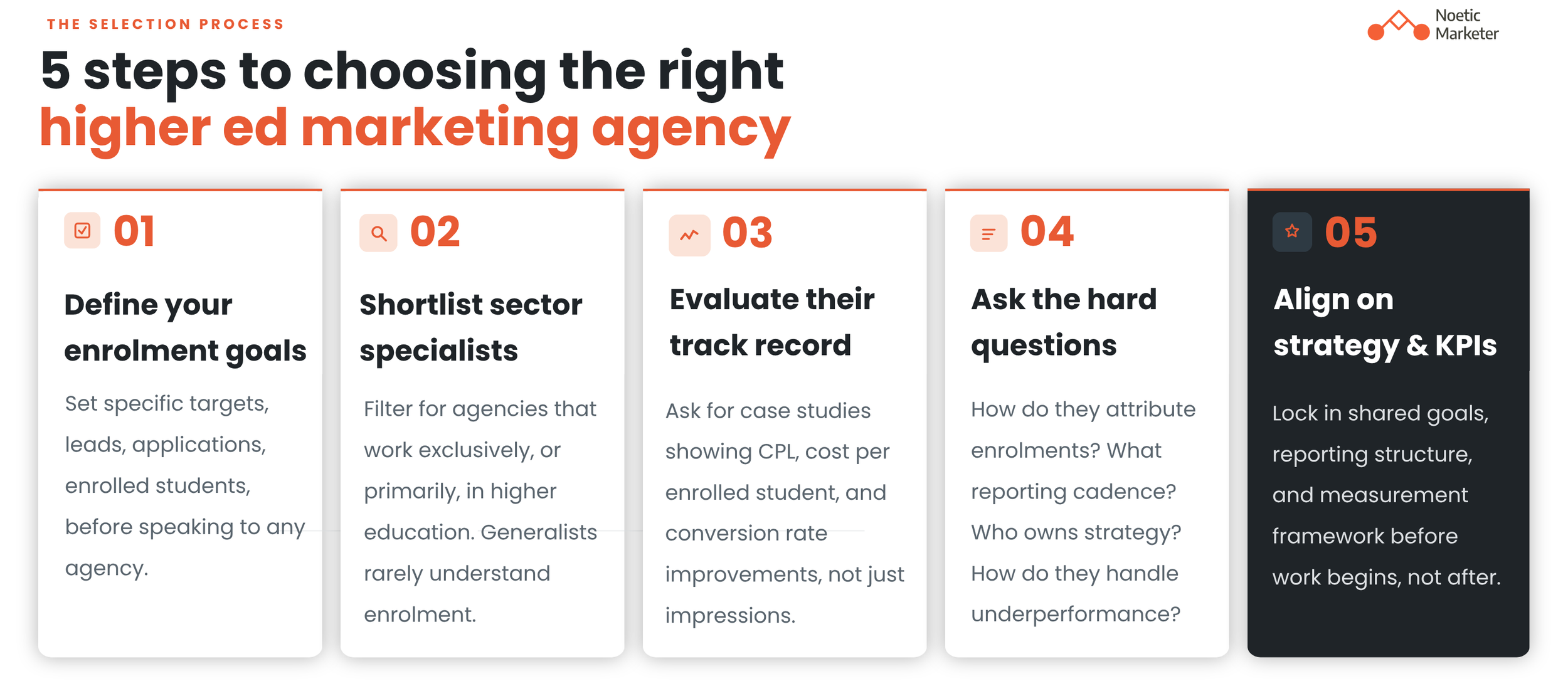
Why does higher education require a specialist marketing agency?
Higher education requires a specialist marketing agency because student recruitment involves a longer, more complex, and more trust-driven decision process than many other industries.
Prospective students are not making a simple purchase. They are evaluating academic quality, career outcomes, tuition, location, reputation, support services, personal fit, and long-term return on investment.
Higher education marketing also has to balance performance with credibility. Institutions need to generate interest, but they also need to protect their reputation, communicate clearly, and support students through a decision-making process that often involves parents, guardians, counsellors, employers, or other stakeholders.
A specialist agency is better equipped to understand:
Program-level differentiation
Domestic and international student audiences
Undergraduate, graduate, and professional learner motivations
Long decision-making timelines
Parent, guardian, and stakeholder influence
Admissions and CRM handoff challenges
The need to protect institutional reputation while driving leads
A generalist agency may be able to run ads or design campaigns, but higher education marketing requires a deeper understanding of how awareness, inquiry, application, and enrolment connect.
What criteria should institutions use to evaluate higher education marketing agencies?
Institutions should evaluate higher education marketing agencies based on sector-specific experience, student recruitment expertise, program-level positioning, integrated service capabilities, reporting quality, and Canadian market knowledge.
The strongest agency is not always the agency with the longest service list. The strongest agency is the one that can integrate institutional goals, student behaviour, campaign strategy, and enrolment outcomes into a single, clear system.
Use the following framework to compare agencies consistently.

Sector-specific experience
Sector-specific experience means the agency has direct experience working with universities, colleges, private career colleges, continuing education programs, or other post-secondary institutions.
Higher education marketing differs from general consumer marketing because the decision-making process is more complex, the audience segments are more specific, and the outcome is tied to long-term student recruitment rather than a single transaction.
When evaluating an agency, consider:
Has the agency worked with universities, colleges, private career colleges, or continuing education programs?
Can the agency show named or anonymized education case studies?
Does the agency understand different student audiences, including undergraduate, graduate, professional, domestic, and international students?
Can the agency explain how its work supported inquiries, qualified leads, applications, and enrolments?
What to look for:
Named or anonymized education case studies
Clear institution type
Campaign objective
Audience segment
Measurable outcome
Proof beyond traffic, clicks, or impressions
A red flag is when an agency claims to have education experience but cannot demonstrate enrolment-related results.
Noetic Marketer’s higher education experience includes work with universities, colleges, online and hybrid learning providers, and career-focused education institutions. This type of experience matters because institutions need a partner that understands how education audiences research, compare, inquire, and apply.

2. Understanding of the student recruitment funnel
A strong higher education marketing agency should understand how prospective students move from awareness to program research, inquiry, application, admissions follow-up, and enrolment.
This matters because many agencies can generate leads, but fewer agencies can explain whether those leads are moving through the recruitment funnel in a meaningful way.

The agency should understand how to support each stage of the student journey:
Awareness
Program discovery
Inquiry
Application
Enrolment or yield
An agency that understands the full student recruitment funnel will ask better questions before recommending tactics. It will want to know where students are dropping off, which programs need stronger positioning, how leads are being followed up with, and how marketing performance is being connected to admissions outcomes.
This is an important strategic differentiator. A strong agency should not treat marketing as a series of disconnected campaigns. Instead, paid media, SEO, landing pages, content, nurturing, CRM, and reporting should all support the same recruitment goal.
Noetic Marketer’s approach to strategic enrolment alignment reflects this full-funnel thinking by connecting marketing efforts with institutional priorities and long-term enrolment goals.
3. Program-level positioning
Program-level positioning means the agency can clarify why a student should choose one program over another.
This is one of the most important criteria because program-level positioning often determines whether a campaign attracts qualified students or only generates broad interest.
Many agencies can run ads. Fewer agencies can answer the more strategic question of why a student should choose this program over another option.
A strong agency should help clarify:
Program differentiation
Career outcomes
Audience motivations
Student objections
Competing institutions
Domestic versus international positioning
Undergraduate versus graduate messaging
Online, hybrid, and in-person delivery advantages
Program-specific value propositions
The best higher education marketing agency should understand what makes a program valuable before deciding how to promote it.
This is where strategy-first education marketing becomes important. For institutions with competitive programs, the issue is rarely only visibility. The issue is whether the right students understand the program’s value, fit, and outcomes.
4. Integrated service capability
Integrated service capability means the agency can integrate strategy, paid media, SEO, landing pages, content, email nurturing, CRM, and analytics into a single enrolment system.
This is more important than simply offering a long list of services. The point is whether those services work together.
A strong agency should be able to explain how each service supports the student recruitment journey.
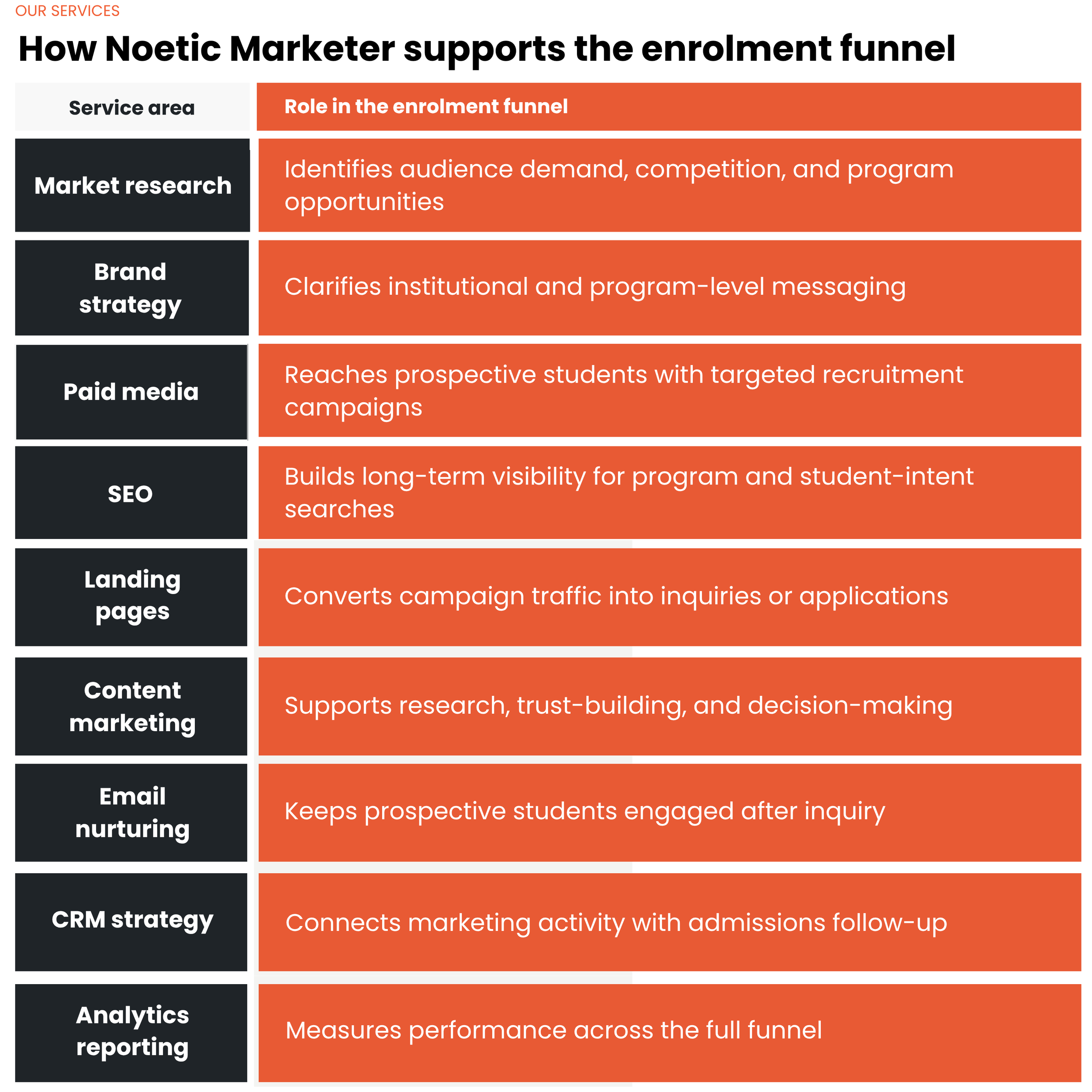
A red flag is when an agency offers services in isolation without explaining how they connect to enrolment outcomes.
For institutions, the best partner is not only a paid media agency, SEO provider, or content vendor. The best partner is an agency that can connect all channels into a coordinated enrolment strategy.
Noetic Marketer’s education marketing services are built around this kind of connected approach, supporting strategy, campaigns, optimization, CRM, and reporting across the full recruitment funnel.

5. Reporting and attribution
Reporting and attribution should show how marketing performance contributes to enrolment progress, not only platform activity.
Reporting should help institutions understand what is working, where students are dropping off, and how marketing activity is contributing to recruitment goals.
The agency should report on:
Inquiry volume
Cost per lead
Lead quality
Application starts
Application completions
Conversion rate by channel
Program-level performance
Landing page conversion rate
Source-to-application trends
Campaign performance by audience segment
Admissions handoff performance when data is available
A red flag is when reporting focuses only on clicks, impressions, reach, traffic, or follower growth.
Those metrics can be useful, but they do not tell an institution whether marketing is helping generate qualified applicants or support enrolment growth.
The best higher education marketing agencies give leadership usable information, not just marketing dashboards. Reporting should help institutions make decisions about budget, audience targeting, program positioning, and admissions follow-up.

6. Canadian market knowledge
Canadian market knowledge means the agency understands domestic student demand, international recruitment volatility, privacy expectations, and policy changes affecting student acquisition.
This section is especially important for Canadian colleges and universities because the recruitment environment has changed significantly.
Canada’s international student sector expanded rapidly before new federal caps reshaped the recruitment landscape. Reuters reported that Canada issued more than 650,000 study permits in 2023, pushing the country’s international student population above 1 million. Since then, the federal government has continued to tighten permit levels, setting a 2025 target of 437,000 study permits and introducing 309,670 study permit application spaces under the 2026 cap.
The key takeaway is that Canadian institutions now need more than campaign management. They need a partner who understands:
Domestic student demand
International recruitment volatility
Regional market differences
Program-level competition
Compliance and privacy expectations
Lead quality pressure
The importance of admissions and CRM alignment
The need for stronger forecasting and channel strategy
In Canada, choosing the right higher education marketing agency now requires more than generating inquiries. Institutions need stronger audience strategy, clearer program positioning, and better systems to convert qualified interest into applications and enrolments.

What questions should universities ask before hiring a marketing agency?
Universities should ask questions that reveal how an agency thinks about strategy, audience segmentation, enrolment outcomes, and collaboration.
The most useful questions are not only about platforms or deliverables. They are about how the agency diagnoses problems, makes decisions, measures success, and works with internal teams.
What strategy questions should institutions ask?
Strategy questions help reveal whether the agency understands enrolment marketing or only campaign execution.
Ask:
How do you evaluate our current enrolment marketing funnel?
How do you identify where prospective students are dropping off?
How do you approach program positioning before launching campaigns?
How do you adapt strategy when enrolment targets are not being met?
A strong agency should answer these questions with a clear process. It should not jump immediately to ad platforms, budgets, or creative ideas before understanding the institution’s goals.
What experience questions should institutions ask?
Experience questions help determine whether the agency has relevant education expertise.
Ask:
Which types of educational institutions have you worked with?
Can you show us case studies tied to qualified leads, applications, and enrolments?
Have you supported domestic and international student recruitment?
Have you worked with undergraduate, graduate, online, hybrid, or professional programs?
What education marketing challenges have you helped institutions solve?
A strong agency should be able to discuss education-specific challenges, not only general marketing results.
What reporting questions should institutions ask?
Reporting questions help reveal whether the agency can connect marketing activity to enrolment outcomes.
Ask:
What metrics do you report on each month?
Can you connect marketing performance to admissions outcomes?
How do you define a qualified lead?
How do you identify low-quality inquiries?
Do your reports help leadership make decisions?
Can reporting be broken down by program, audience, and channel?
A strong agency should be able to explain what success looks like beyond clicks, impressions, and traffic.
What collaboration questions should institutions ask?
Collaboration questions help determine whether the agency can work as a true partner.
Ask:
How do you work with internal marketing teams?
How do you work with admissions or recruitment teams?
What information do you need from our CRM?
How often do you review performance and strategy?
Who will be our main point of contact?
How do you communicate when performance is below target?
A strong higher education marketing agency should be comfortable working across marketing, recruitment, admissions, and leadership teams.

What services should the best higher education marketing agency offer?
The best higher education marketing agency should offer integrated services that support the full enrolment funnel, not isolated tactics.
This does not mean every institution needs every service at once. It means the agency should understand how each service contributes to enrolment growth.
A strong agency may offer:
Market research and competitive analysis
The most important question is not whether the agency offers these services. The most important question is whether the agency can connect them.
For example, paid media may generate awareness and inquiries, but landing pages need to convert that traffic. SEO and content need to support long-term discovery. Email nurturing needs to keep prospective students engaged. CRM strategy needs to connect marketing activity to admissions follow-up. Analytics needs to show whether the full system is working.
The best higher education marketing agency should be able to explain how these pieces work together.
What should a higher education marketing agency be able to prove?
A higher education marketing agency should be able to prove that its strategy can generate qualified interest and support measurable enrolment goals.
Proof should go beyond impressions, clicks, and website traffic.
A strong agency should be able to show:
Improved conversion rates
Lower cost per lead or acquisition
Stronger application volume
Better landing page performance
Improved program awareness
Clearer audience segmentation
Reporting that supports decision-making
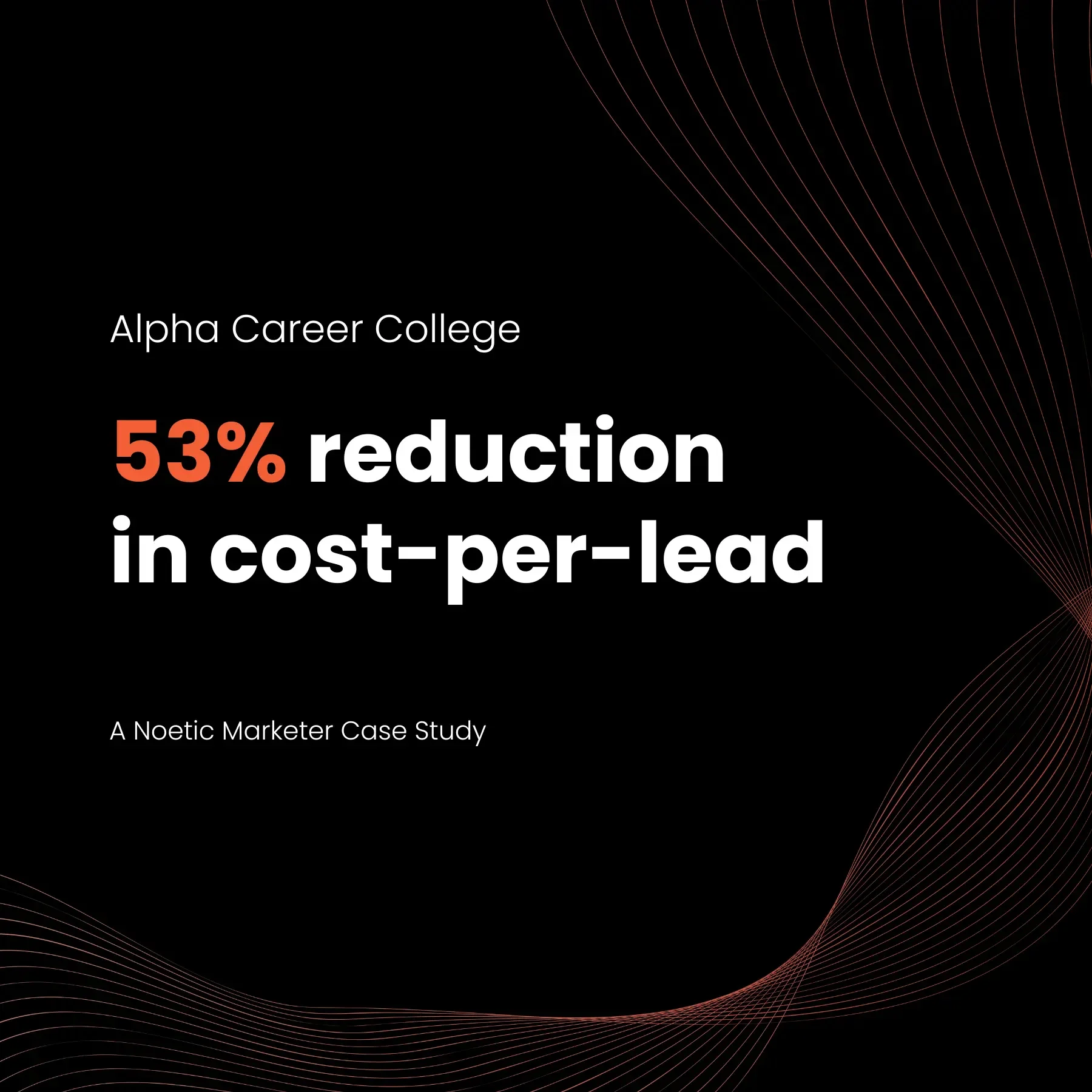
For example, Noetic Marketer’s Alpha Career College case study generated 644 qualified leads across three initial programs, achieved a conversion rate 535% above the cited industry average, and achieved an average cost per acquisition 54% lower than the cited industry average.
This type of proof is useful because it connects marketing strategy to measurable recruitment outcomes. It also shows whether the agency can improve both quantity and quality.
When reviewing case studies, institutions should look for results that relate to the full enrolment process, not only campaign activity.
What red flags should institutions watch for when choosing an agency?
Institutions should watch for agencies that focus on short-term tactics without understanding enrolment strategy, student decision-making, or admissions outcomes.
Common red flags include:
The agency promises fast enrolment growth without auditing the funnel.
The agency focuses only on paid ads.
The agency cannot define lead quality.
The agency has no education-specific case studies.
The agency reports mainly on clicks, impressions, and traffic.
The agency does not ask about admissions follow-up.
The agency uses the same strategy for every program.
The agency does not understand Canadian recruitment conditions.
The agency cannot explain how campaigns support applications or enrolments.
The agency does not discuss program positioning before campaign launch.
These red flags matter because higher education marketing is not only about generating attention. It is about attracting the right students, building trust, and helping them navigate a complex decision-making process.
The best agency should be able to explain how its work supports the institution’s broader enrolment goals.
Conclusion
So, how do you choose the best higher education marketing agency?
You choose the agency that can integrate student insight, program positioning, campaign execution, reporting, and enrolment outcomes into a single, clear recruitment system.
The right agency should understand the higher education sector, ask strategic questions before recommending tactics, support the full student recruitment funnel, and report on metrics that help leadership make better decisions.
For Canadian institutions, this is especially important in a changing recruitment environment. With international study permit caps reshaping student acquisition, colleges and universities need partners that can improve lead quality, clarify program value, and build sustainable enrolment pipelines.
By partnering with an experienced education marketing partner like Noetic Marketer, institutions gain specialized expertise, full-funnel strategy, and data-informed optimization designed to support long-term enrolment growth.
Let’s talk about your enrolment goals.
Schedule a meeting with a Noetic Marketer strategist for a focused, mission-led conversation about your enrolment goals, marketing gaps, and program differentiation.
Don’t miss our other posts on digital marketing for education.
Why is enrolment marketing essential for higher education institutions in 2026?
How can boarding schools create effective marketing strategies to attract students in 2026?
How do private schools approach marketing?
What does a higher education marketing agency actually do?
What is higher education marketing, and how is it different from traditional marketing?
How Can Universities Create an Effective Higher Education Marketing Budget?
What Are 11 Valuable Strategies for Recruiting International Students?
What Are 9 Proven Strategies for Marketing Higher Education to Adults?
What Makes Student Testimonials Crucial for University Recruitment Marketing?
How Can Universities Use Video Content to Boost Student Recruitment?
What Are 5 Effective Marketing Strategies for Recruiting Undergraduate Students?
How Can Universities Use AI for Marketing?
What Are the 7 Key Challenges in Higher Education Digital Marketing and How Can They Be Solved?
Key marketing terms
Cost per lead (CPL): The total marketing spend divided by the number of leads generated.
Qualified lead: A prospective student who aligns with the institution’s target audience and has demonstrated meaningful interest in a program.
Student recruitment funnel: The journey a prospective student takes from first discovering an institution to submitting an inquiry, applying, and enrolling.
Program positioning: The process of clarifying why a specific academic program is valuable, differentiated, and relevant to the students it is trying to attract.
Enrolment marketing: The process of using research, positioning, digital campaigns, content, nurturing, and analytics to support student recruitment from awareness through application and enrolment.
Full-funnel strategy: A marketing approach that addresses every stage of the student journey, from awareness to enrolment.
CRM strategy: The process of organizing, tracking, and nurturing relationships with prospective students through a customer relationship management system.
GEO: Generative engine optimization, which involves structuring content so that AI search systems can understand, summarize, and reference it accurately.