How does paid advertising drive student applications for higher education?
By Morgan Northmore, Copywriter and Digital Marketing Coordinator at Noetic Marketer. Morgan specializes in developing data-driven enrolment marketing strategies that help higher education institutions convert prospective learners into registered students through full-funnel digital optimization and institutional storytelling.
Key takeaways:
Enrolment visibility: High-impact visibility is driven by a full-funnel digital strategy that ensures program-specific messages reach prospective students at the exact moment of consideration, rather than relying solely on paid spend.
Integrated digital strategy: Digital channels such as Google, Meta, and LinkedIn work most effectively when integrated into a cohesive enrolment plan that optimizes reach across diverse demographic and professional audiences.
Nurturing & conversion: A deliberate focus on remarketing and nurturing guides prospective students through their decision journey, re-engaging those with high interest to drive lower-cost conversions.
Proven results: Noetic Marketer achieved a 919% increase in conversion rate and a 30% reduction in cost per lead for Alpha Career College between 2021 and 2024 through full-funnel optimization.
Effective enrolment growth is built around the student decision journey, leveraging digital channels to create visibility and conversion. Paid advertising is one component of this, but it must be integrated into a cohesive framework that aligns ad channels, messages, and budgets with where prospective students are in their research process.
What is paid advertising in higher education?
Paid advertising in higher education is a form of digital marketing where institutions pay to place ads on search engines, social media platforms, and display networks to reach prospective students at specific stages of their research and decision-making process.
Unlike organic content, which builds visibility gradually over time, paid advertising generates immediate exposure for targeted audiences. This makes it particularly effective during high-stakes recruitment windows such as application season, program launches, and deadline reminders.
Paid advertising in higher education typically includes:
Paid search: Acts as a high-intent capture channel within the digital ecosystem, placing program-specific ads in front of students actively researching education options.
Social media advertising: Serves to extend reach and engagement across the broader digital framework by targeting specific demographics on Meta and LinkedIn.
Display advertising: Builds early-funnel brand awareness across content networks to introduce the institution to potential students.
Video advertising: Utilizes engaging narrative content on platforms like YouTube to showcase the institutional story as part of an integrated strategy.
Remarketing: A critical nurturing tool within the larger ecosystem to re-engage prospective students who have not yet converted.
Each channel serves a distinct role in the student journey. The most effective strategies coordinate all of them toward the same enrolment goal.
How is paid advertising different from organic marketing in higher education?
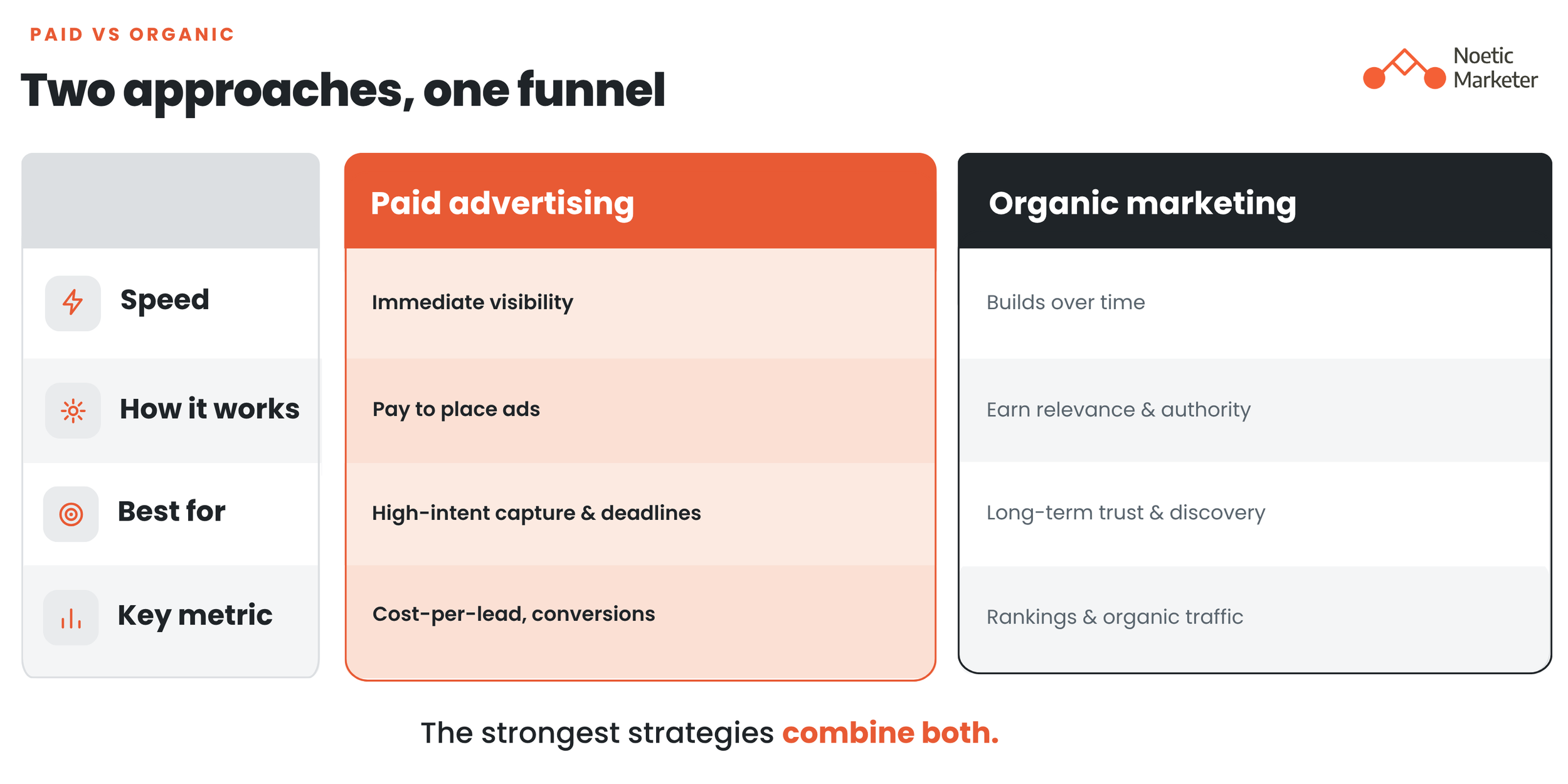
Paid advertising differs from organic marketing in higher education because it generates targeted, immediate visibility in exchange for ad spend, whereas organic strategies such as search engine optimization and content marketing build visibility over time through relevance and authority.
Both approaches serve the enrolment funnel, but they operate on different timelines. Organic content builds long-term trust and supports student research throughout the decision cycle. Paid advertising intercepts students at specific, high-intent moments and moves them toward a defined action.
According to InfoTrust, 67% of prospective students use search engines as their first source of information about higher education institutions. Paid search advertising puts an institution's programs directly in front of students at that moment of active interest, before organic results appear or competitors capture their attention.
The strongest higher education marketing strategies combine both approaches. Organic content supports long-term discovery and credib
ility, while performance recruitment campaigns capture demand in real time.
How does a paid advertising strategy drive student applications?
A paid advertising strategy drives student applications by delivering the right message to the right audience at the right stage of their decision-making process, using data to continuously improve audience targeting, creative, and conversion performance.
The most effective paid strategies in higher education are built around the full student journey from awareness through to enrolment. Each stage requires different platforms, different messages, and different success metrics.
What does a full-funnel paid advertising strategy look like in higher education?
A full-funnel paid advertising strategy in higher education maps ad campaigns to each stage of the student recruitment process, ensuring that strategic messaging, budget, and measurement align with where a prospective student is in their decision.
The four stages of a paid media funnel for higher education are:
Awareness: Campaigns at this stage introduce a program or institution to prospective students who may not yet be actively searching. Display ads, video ads, and social media platforms work well here because they reach broad, interest-based audiences. Success is measured through reach, impressions, and video views.
Consideration: At this stage, prospective students are comparing options, reading program details, and weighing fit. Paid search ads targeting program-specific queries and remarketing ads that keep an institution top of mind are most effective. Success is measured through landing page visits and inquiry starts.
Decision: Students at this stage are close to applying. Decision-stage ads focus on clear calls to action, application deadline reminders, and landing pages optimized for conversions. Success is measured by inquiry submissions, application starts, and cost per lead.
Enrolment: After a student has applied, paid advertising supports yield by reinforcing the student's choice and building anticipation. Enrolment-stage ads are measured through application completions and deposit confirmation rates.
Each stage requires tailored ad creative, distinct success metrics, and deliberate budget allocation. A campaign measured only at the awareness stage tells an institution nothing about its impact on applications.
What role does audience targeting play in paid advertising for higher education?
Audience targeting determines whether paid ads reach prospective students likely to apply or a broad audience that generates clicks but no conversions.
Deep audience targeting and segmentation allow institutions to define their ideal student by demographics, academic background, career stage, geography, and online behaviour. For graduate programs, this often means targeting professionals by job title or industry. For undergraduate programs, it means understanding which search queries and online behaviours signal active program research.
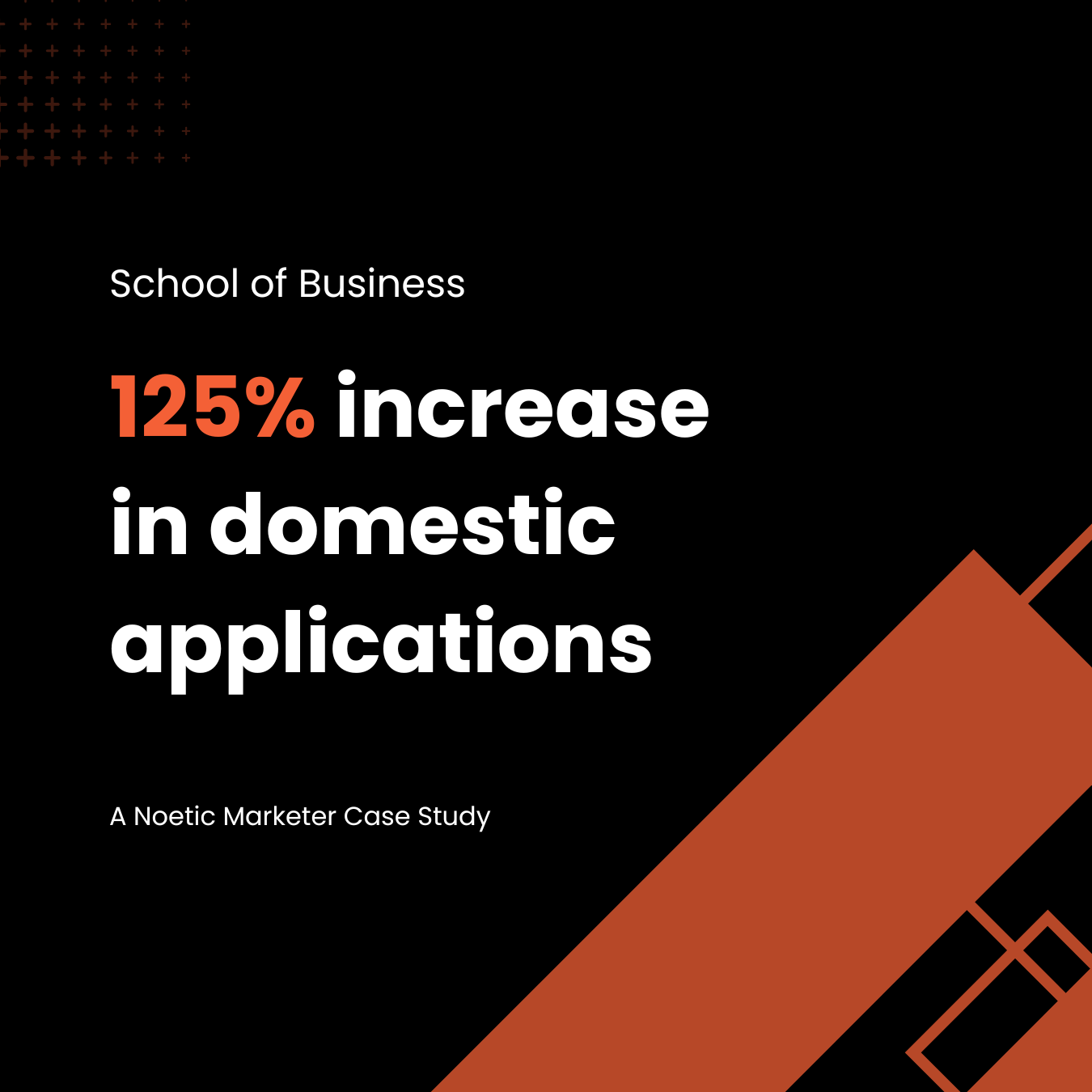
When Noetic Marketer ran a focused four-month campaign for an Alberta-based business school targeting mid-career healthcare professionals, persona-driven segmentation across LinkedIn and Meta enabled the campaign to achieve a cost-per-lead that was 63% lower than the industry benchmark for graduate programs while increasing domestic applications by 125%.
Which paid advertising channels work best for student recruitment?
The best paid advertising channels for student recruitment depend on the program type, target audience, and stage of the student journey. Google, Meta, and LinkedIn are the most widely used and consistently effective platforms for higher education.

How does Google Ads support university student recruitment?
Google Ads supports university student recruitment by capturing high-intent search demand, placing program-specific ads in front of students who are actively searching for institutions, comparing programs, or researching next steps in the admissions process.
Google Search campaigns are most effective for capturing active demand. Targeting specific search terms puts a program in front of students at a critical moment in their research. Google also supports display and YouTube campaigns for building broader program awareness among students who have not yet begun an active search.
Paid search and search engine optimization complement each other in the enrolment funnel. SEO builds long-term organic presence while Google Ads captures demand that organic results alone may not reach, particularly for new programs or highly competitive program categories.
How does Meta advertising support student enrolment campaigns?
Meta advertising supports student enrolment campaigns by enabling broad audience reach at a relatively low cost per lead, with strong performance on interest-based and lookalike targeting.
Meta is particularly effective for program awareness and lead generation.
Video ads are among the most effective formats on Meta for higher education. Authentic short-form video content, including student testimonials, program previews, and faculty introductions, tends to outperform polished promotional ads because it mirrors how prospective students naturally consume content. User-generated content and real student experiences build the kind of credibility that influences decisions.
When Noetic Marketer ran targeted Meta campaigns for Alpha Career College, continuous testing of creative and AI-generated lookalike audiences drove a 919% improvement in conversion rate and a 30% reduction in cost per lead between 2021 and 2024. The campaigns used program-specific landing pages and emotionally driven messaging focused on career outcomes and pathways.
How does LinkedIn Ads support graduate program recruitment?
LinkedIn Ads supports graduate program recruitment by enabling professional-level targeting to reach prospective students by job title, industry, years of experience, and company type.
For programs designed for working professionals, such as MBAs, graduate certificates, and continuing education credentials, LinkedIn's targeting precision is particularly valuable. Prospective students for these programs are not typically reached through demographic or interest-based targeting alone. They are reached by identifying where they are in their career and what professional advancement they are pursuing.
LinkedIn is most effective when combined with Meta for graduate recruitment. LinkedIn drives precision targeting of qualified professionals. Meta provides cost-efficient reach that amplifies awareness across a broader audience. Together, they support a strategy that generates both qualified leads and broad program visibility.
When Noetic Marketer ran a multi-platform campaign for a leading Ontario faculty of engineering's graduate programs, an integrated approach across Google, LinkedIn, and Meta generated 6,000+ marketing-qualified leads in the first year of launching two new programs.
What is remarketing, and how does it help recover incomplete applications?
Remarketing is a form of paid advertising that shows ads specifically to prospective students who have already visited an institution's website or landing page but have not yet completed a desired action, such as submitting an inquiry or starting an application.
Remarketing campaigns are highly efficient in higher education because they focus budget on warm audiences who have already shown intent. Students who have visited a program page, viewed an info session, or started an inquiry form have demonstrated meaningful interest. Re-engaging them with relevant messaging addresses common hesitation points such as program fit, cost, or application timing.
Remarketing ads designed for the decision stage, including deadline reminders, student testimonials, and simplified program summaries, are particularly effective at converting hesitant prospects into applicants. They also support the enrolment stage by reinforcing the decision for students who have applied but not yet confirmed.

How should institutions structure paid advertising campaigns for student recruitment?
Institutions should structure paid advertising campaigns by mapping channels, budgets, and creative assets to specific stages of the student journey, rather than running a single undifferentiated campaign across all platforms.
A well-structured campaign typically begins with market research and persona development. Understanding who the ideal student is, what motivates them, what obstacles they face, and how they search informs every decision that follows, from platform selection to ad copy.
From there, the campaign architecture should define separate ad groups or campaigns for each stage of the funnel, each target audience segment, and each program being promoted. Keeping these elements distinct allows performance data to be read clearly and acted on without one segment's results obscuring another's.
Campaign architecture and funnel design are among the most important foundations of an effective paid media strategy. An institution that builds a clear campaign structure from the start will be better positioned to identify what is working, what is not, and where to reallocate budget.
Continuous A/B testing of ad creative, landing page copy, and audience parameters is also essential. The paid advertising strategies that deliver strong results over time are those that treat each campaign cycle as an opportunity to improve on the last through tools like AI.
How do you measure the performance of paid advertising in higher education?
You should measure paid advertising performance in higher education against enrolment-focused metrics such as cost-per-lead, application starts, conversion rate, and cost-per-enrolled student, not against surface metrics such as impressions, clicks, or reach alone.
The metrics that matter most vary by campaign stage.

Reporting on only one of these stages gives an incomplete picture. An institution that tracks only application starts may miss a high drop-off rate at the deposit stage. An institution tracking only cost-per-click is measuring ad efficiency but not enrolment impact.
For a broader view of how marketing measurement connects to enrolment outcomes across the full funnel, our blog “Why enrolment marketing is essential for higher education institutions” outlines the core components of a performance-driven strategy.
Why is landing page quality critical to paid advertising results?
Landing page quality is critical to paid advertising results because even a well-targeted, well-crafted ad will underperform if the page it drives to fails to clearly communicate value, address prospective students' concerns, and make the next step easy to complete.
A purpose-built landing page for a paid campaign should answer the question raised in the ad, provide enough program detail to help a prospective student feel confident, remove unnecessary navigation that could pull visitors away from the conversion goal, and include a single, clear call to action.
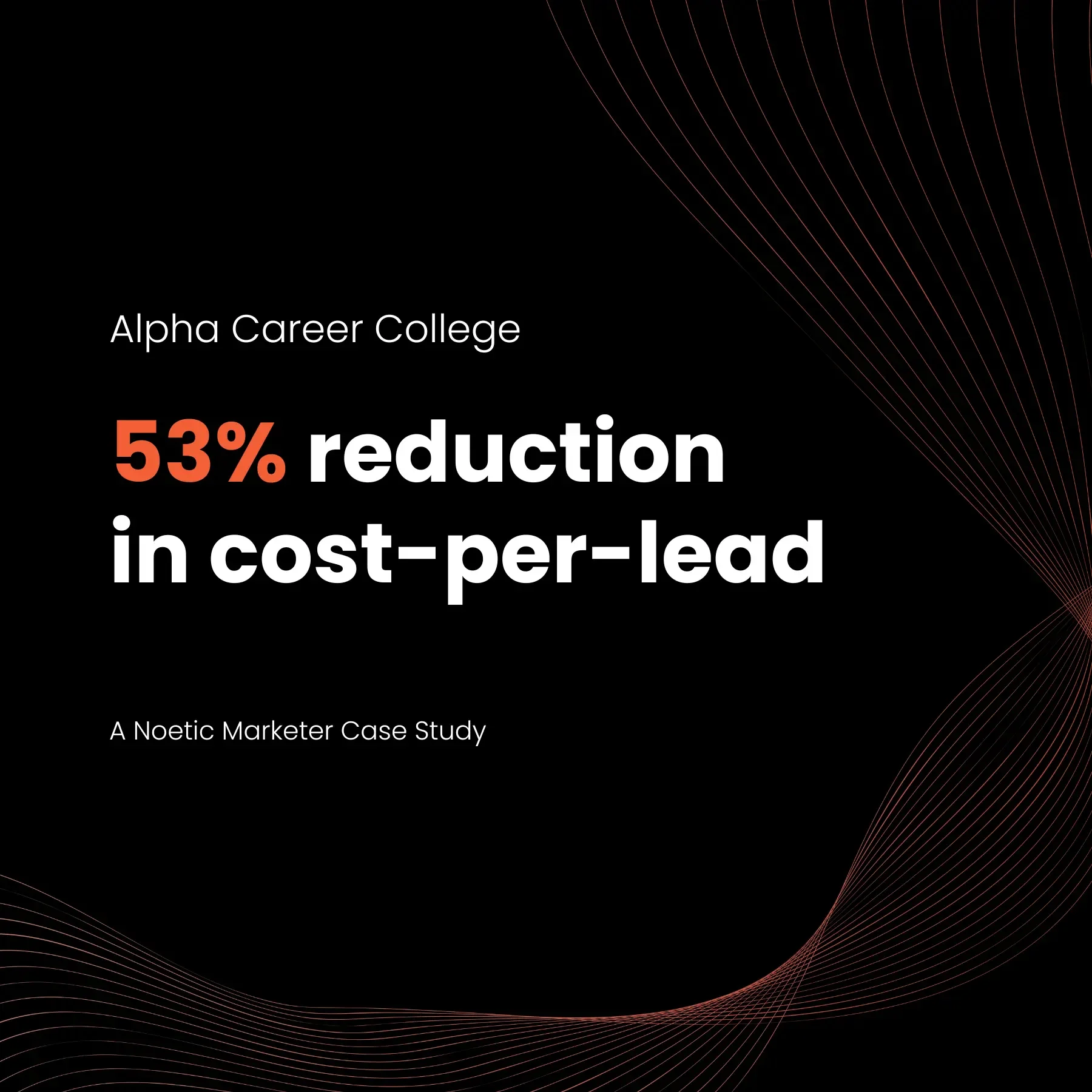
When Noetic Marketer developed mobile-optimized landing pages for Alpha Career College, the pages used persuasive copy, simplified inquiry forms, and outcome-focused messaging. These landing pages worked in direct coordination with the Meta ad campaigns, and their conversion rate optimization (CRO) was a key contributor to the overall results achieved across the engagement.
Conclusion
Paid advertising drives student applications when it is built around the student journey, supported by precise audience targeting, and measured against outcomes that connect directly to enrolment. The institutions that generate consistent results from paid media are not necessarily those with the largest budgets. They are the ones with the clearest strategy for each stage of the funnel and the discipline to optimize against what actually matters.
For institutions looking to understand how paid advertising fits into a broader recruitment strategy, Noetic Marketer's higher education digital marketing services outline the full-funnel approach that supports each client engagement from strategy through to measurement.
Strengthen your student recruitment strategy
Schedule a meeting with our education marketing experts today for a focused conversation about your enrolment goals and marketing opportunities.
Don’t miss our other posts on digital marketing for education.
How do you choose the best higher education marketing agency?
Why is enrolment marketing essential for higher education institutions in 2026?
How can boarding schools create effective marketing strategies to attract students in 2026?
How do private schools approach marketing?
What does a higher education marketing agency actually do?
What is higher education marketing, and how is it different from traditional marketing?
How Can Universities Create an Effective Higher Education Marketing Budget?
What Are 11 Valuable Strategies for Recruiting International Students?
What Are 9 Proven Strategies for Marketing Higher Education to Adults?
What Makes Student Testimonials Crucial for University Recruitment Marketing?
How Can Universities Use Video Content to Boost Student Recruitment?
What Are 5 Effective Marketing Strategies for Recruiting Undergraduate Students?
How Can Universities Use AI for Marketing?
What Are the 7 Key Challenges in Higher Education Digital Marketing and How Can They Be Solved?
Key marketing terms
Paid advertising: Digital marketing in which an institution pays to place ads on search engines, social media platforms, or display networks to reach a defined audience. Unlike organic content, paid advertising generates immediate visibility in exchange for ad spend.
Pay-per-click (PPC): A form of advertising in which the advertiser pays each time a user clicks an ad. PPC campaigns on Google allow institutions to appear at the top of search results for specific student search queries.
Remarketing: A paid advertising tactic that shows ads to users who have already visited an institution's website or landing page. Also called retargeting, remarketing focuses budget on warm audiences who have already demonstrated intent.
Cost-per-lead (CPL): The total amount spent on a campaign divided by the number of qualified leads generated. In higher education, a lower CPL typically indicates more efficient audience targeting and stronger landing page performance.
Marketing qualified lead (MQL): A prospective student who meets the institution's defined criteria for academic fit, geographic region, or program intent, and has demonstrated meaningful interest through an action such as submitting an inquiry form.
Conversion rate: The percentage of ad clicks or landing page visits that result in a desired action, such as submitting an inquiry or starting an application. Conversion rate is one of the most important performance indicators for a paid campaign in higher education.
Lookalike audience: A targeting strategy on platforms like Meta that identifies new users who share behavioural and demographic characteristics with an existing list of prospects or enrolled students, allowing campaigns to expand reach to qualified new audiences.
Full-funnel strategy: A paid advertising approach that maps campaigns, messages, and metrics to every stage of the student recruitment process, from initial awareness through to enrolment.
Landing page: A purpose-built web page designed to receive paid campaign traffic and convert visitors into leads or applicants. Effective higher education landing pages answer the question raised in the ad and present a single, clear call to action.
Ad creative: The visual and written components of a paid ad, including images, video, headlines, and body copy. In higher education, brand strategy & messaging that reflects authentic student experiences and specific program outcomes typically outperform generic institutional messaging.