How can universities build SEO content for AI search engines?
By Morgan Northmore, Copywriter and Digital Marketing Coordinator at Noetic Marketer. Morgan researches how AI search tools are changing the college search process and helps higher education institutions structure website content that earns visibility in AI-generated search results.
Key takeaways:
Defining AI visibility: AI SEO for higher education means being recommended in an AI response to broad research questions, such as "what are the best nursing programs in Ontario."
AI usage in student search: Nearly half of prospective students (46%) use AI to explore college options, while 50% use AI tools at least weekly, according to research from UPCEA and Search Influence.
Evolution of SEO: Generative engine optimization (GEO) and answer engine optimization (AEO) build on search engine optimization rather than replacing SEO.
Long-tail positioning: Long-tail, topic-specific content lets an institution claim expertise on the exact questions prospective students ask AI tools, rather than competing only on broad, generic terms.
The value of tracking visibility: Institutions that actively track their AI search visibility are better positioned than those relying on traditional SEO alone.
Prospective students researching universities are not only asking AI tools about a specific school. Many start with broad research questions, such as “what are the best nursing programs in Ontario” or how to choose between two similar degree options, queries that never mention an institution by name.
AI visibility is the practical response to that shift: ensuring an AI tool names an institution when it matters most. This layer of search engine optimization raises a clear question for higher education marketing: how can universities position themselves so AI systems choose to name them?
What is AI visibility for higher education?
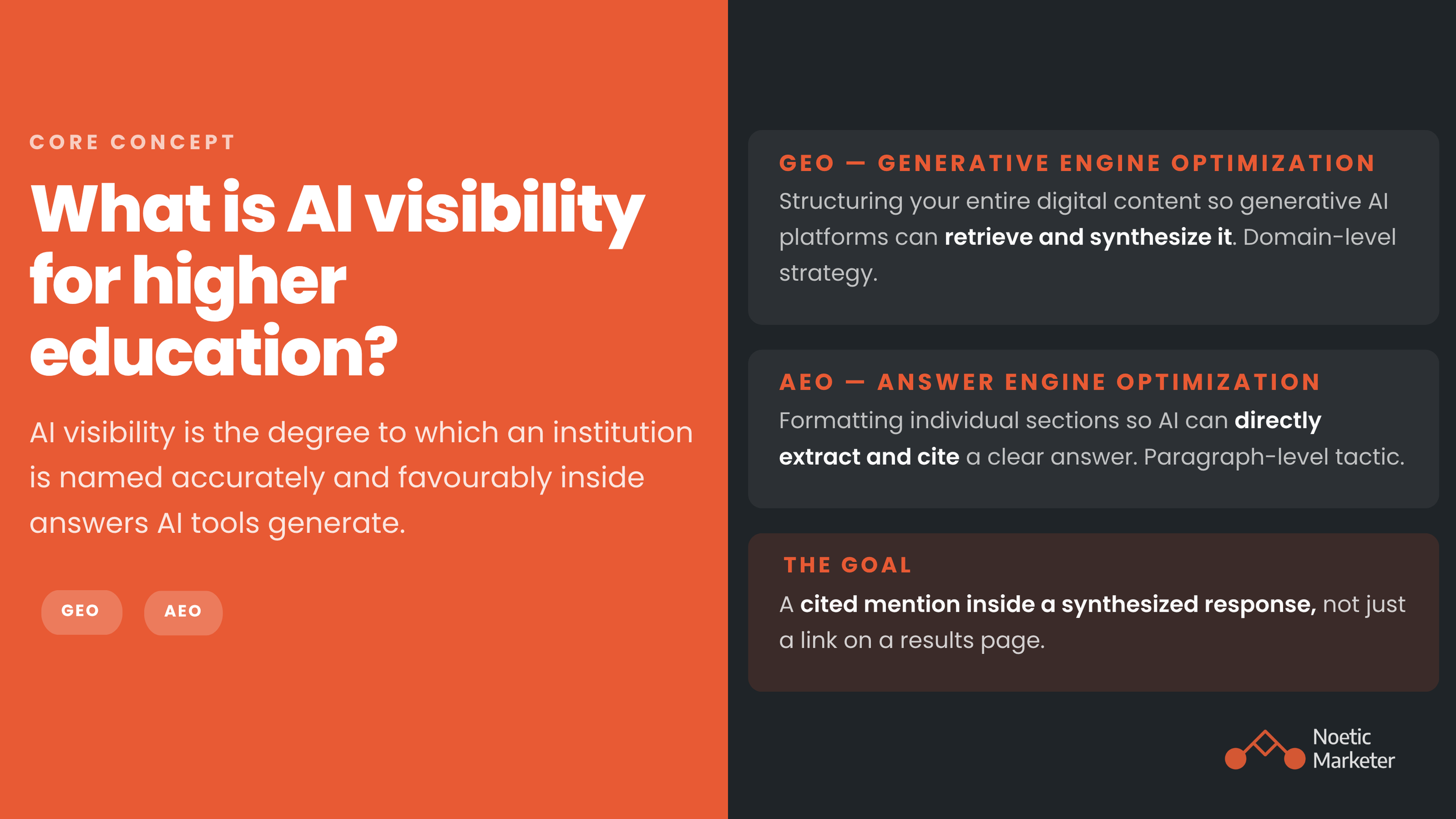
AI visibility is the degree to which an institution is named accurately and favourably inside answers AI tools generate, both for direct brand questions and for broader research questions that do not mention the school. Often described as AI SEO, AEO, or GEO, AI visibility focuses on securing a cited mention inside a synthesized response rather than simply earning a link on a search results page.
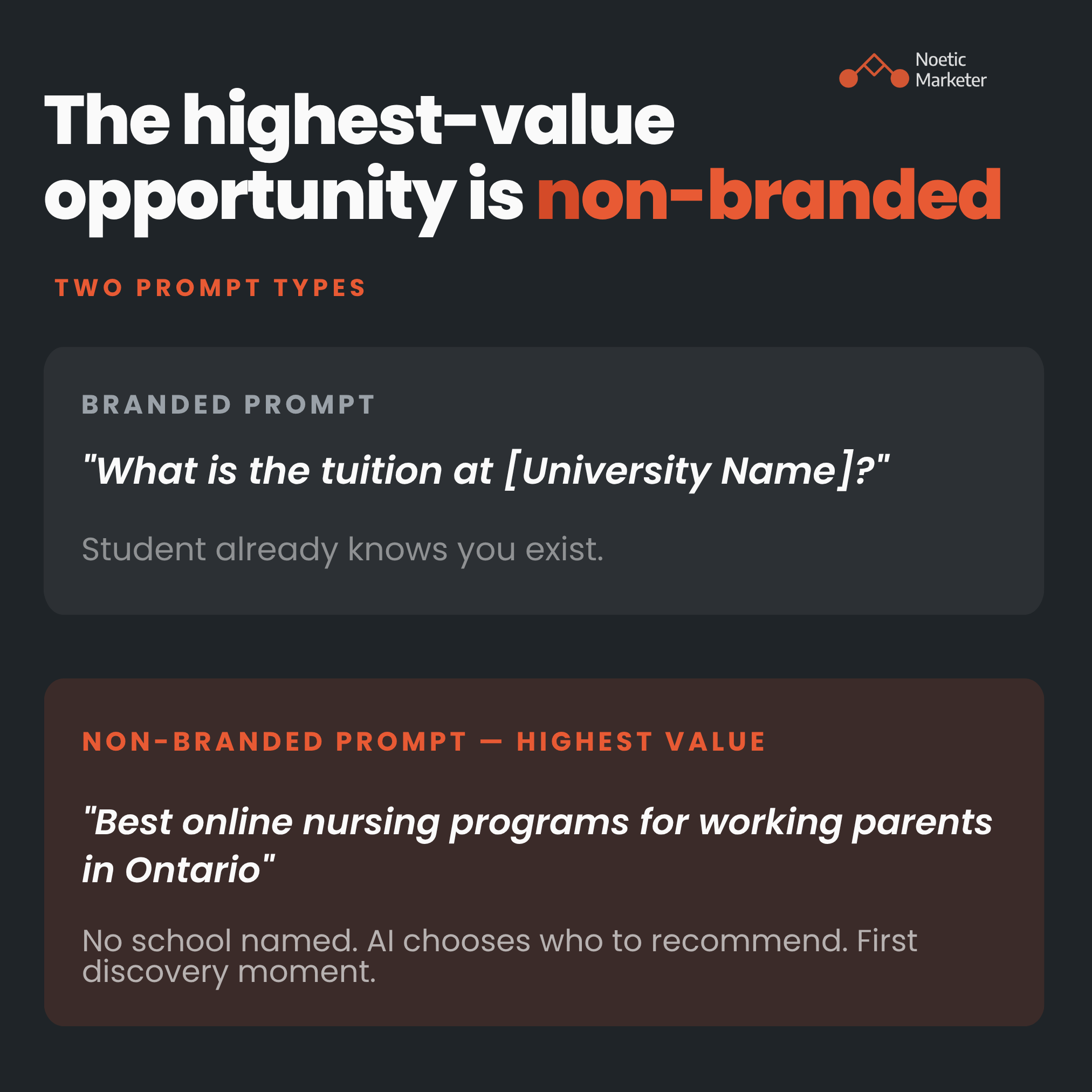
Higher education marketers separate prospective student prompts into two distinct types:
Branded prompt: Names an institution directly, such as “what is the tuition at [institution name]?”
Non-branded prompt: Describes a need without naming any school, such as “what are the best online nursing programs for working parents?”
Non-branded prompts represent the highest-value opportunities for AI visibility, as these moments allow an institution to enter a prospective student's consideration set for the first time.
For higher education institutions, traditional SEO practices remain necessary, but an AI system requires specific evidence and clear program positioning to select an institution for its generated recommendations.
How is AI visibility different from traditional SEO, and how do the two work together?
AI visibility differs from traditional SEO because it optimizes for being named inside a generated answer rather than for ranking a page. Still, the two are not competing strategies, since a strong SEO foundation can carry directly into AI visibility.
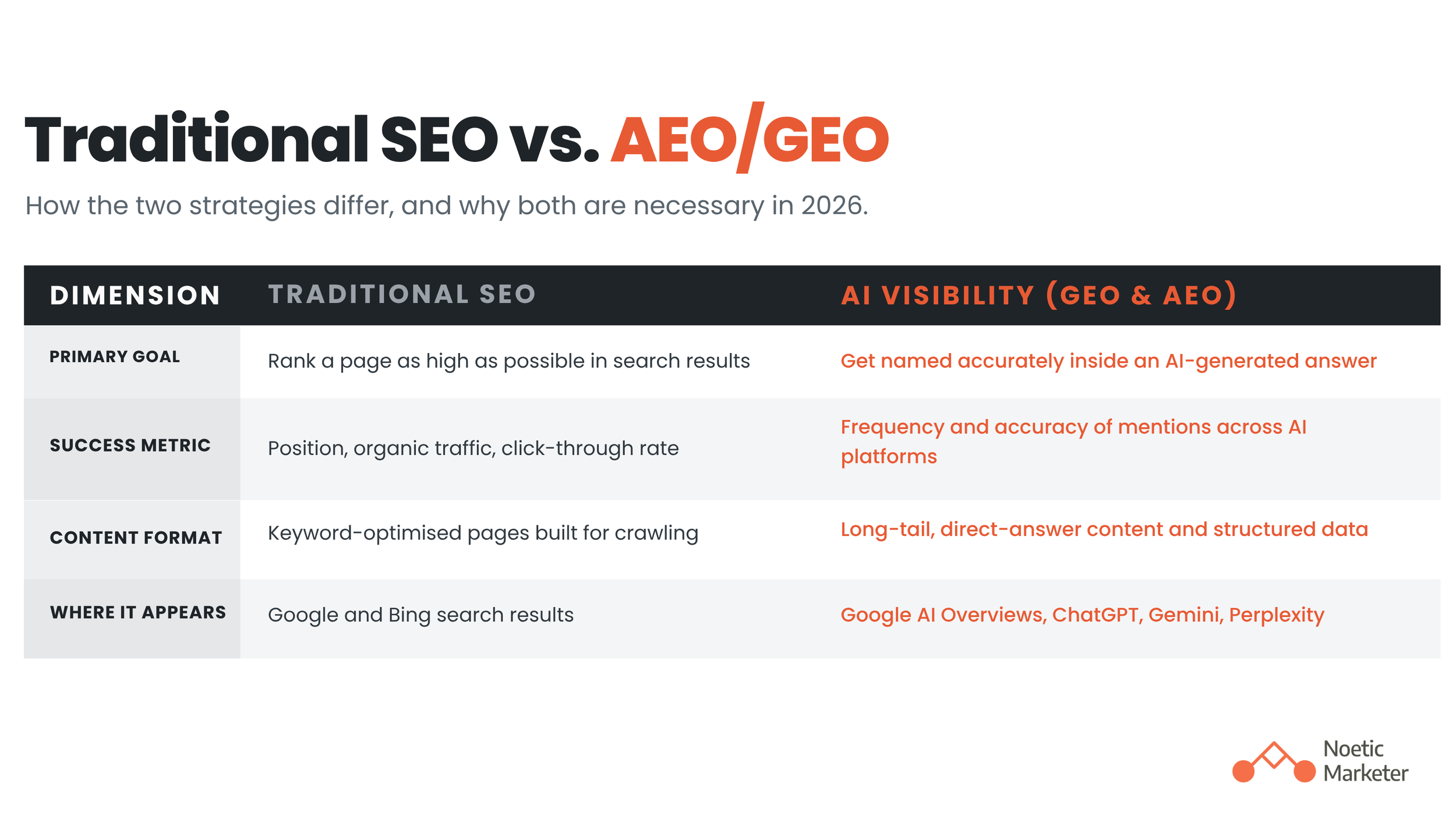
SEO and AI visibility reinforce each other rather than replace one another. An institution with strong technical SEO, fast pages, clean site structure, and consistent search engine optimization gives AI systems the same well-organized source material that traditional search engines already reward, and that SEO foundation carries over into AI-generated answers.
What it does not do on its own is guarantee a mention. Earning that mention takes a deliberate AI visibility strategy on top of good SEO, not a replacement for it.
Why is it important that AI answers broad research questions, not just questions about a specific school?
AI must answer broad research questions because most prospective student research begins with non-branded queries before a specific institution is ever considered.
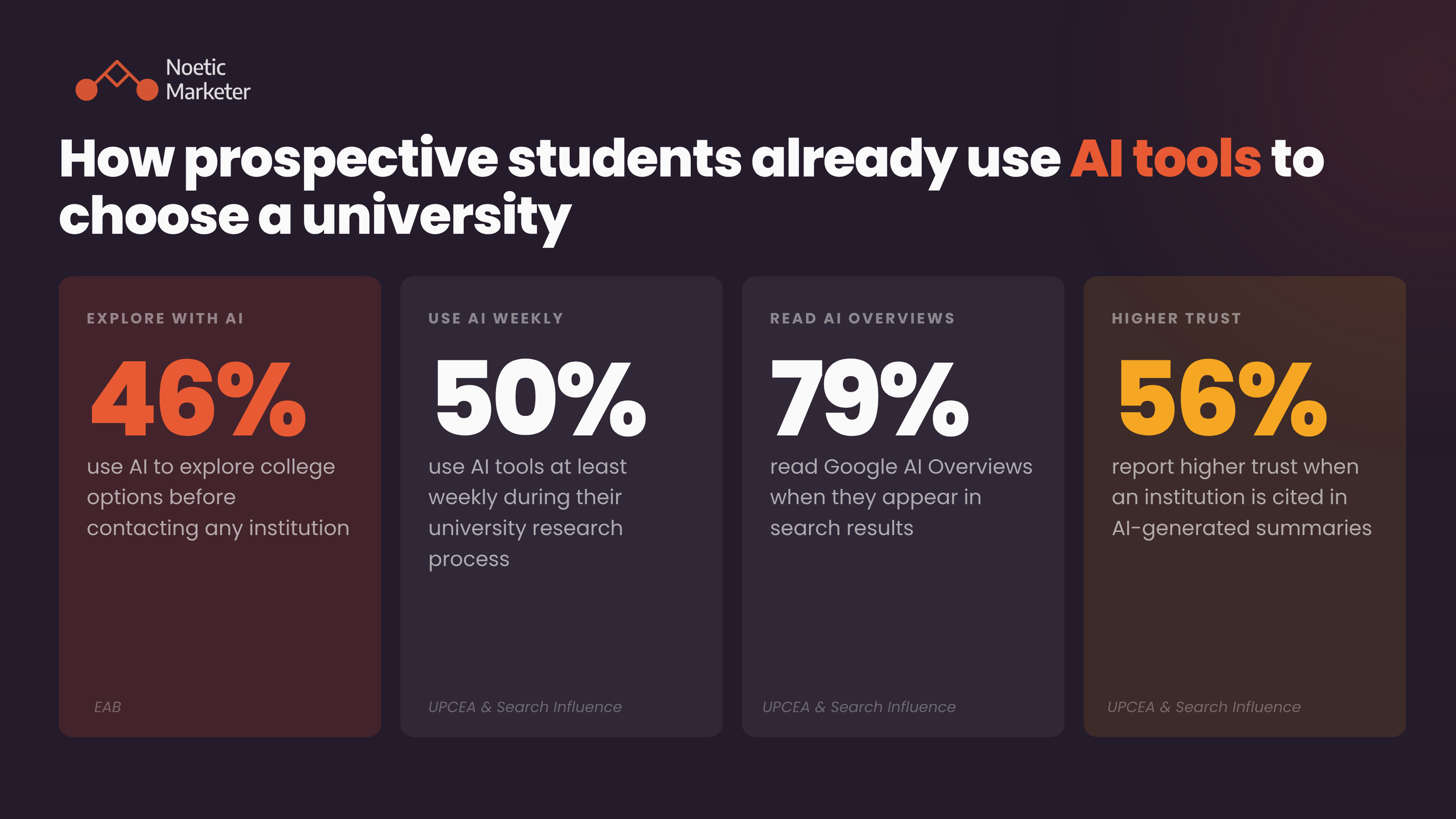
According to research from EAB, 46% of prospective students use AI tools to explore college options. Separate research from UPCEA and Search Influence indicates that 50% of prospective students use AI tools at least weekly, 79% read Google AI Overviews when they appear, and 56% report higher trust in an institution when it appears cited in those summaries.
Non-branded research represents the largest growth area in higher education recruitment. A prospective student is far more likely to ask an AI tool a broad intent question like what are the best engineering programs in BC than to ask about a school they have not discovered yet. Addressing these broad queries allows institutions to capture prospective student interest during the initial discovery phase.
How much does page-one visibility matter in an AI-driven search world?
Page-one search visibility remains critical because traditional search rankings directly feed the source material AI search engines use to generate recommendations. Research indicates that 82% of prospective students say they are more likely to consider a program that appears on the first page of search results. Because generative search models rely heavily on top-ranking indexed content, maintaining strong organic rankings remains a prerequisite for earning AI citations.
What is generative engine optimization (GEO) and how does it relate to answer engine optimization (AEO)?
Generative engine optimization (GEO) is the overarching strategy of structuring an institution's complete digital content so that generative AI platforms can retrieve and synthesize it. In contrast, answer engine optimization (AEO) is the tactical practice of formatting individual content sections to answer specific questions directly.
GEO works at the domain and content strategy level. It builds broad authority across an institution's website, program pages, and external media. AEO works at the paragraph level, structuring headers and opening sentences so an AI tool can extract a clear fact or summary.
When implemented together, these strategies yield measurable growth. In a targeted higher education campaign launched and managed by Noetic Marketer, pairing structured data and clear program positioning with generative engine optimization drove a 38x growth in AI search visibility across ChatGPT, Gemini, and Google AI Overviews.
How do universities give AI systems a clear position, not just information?
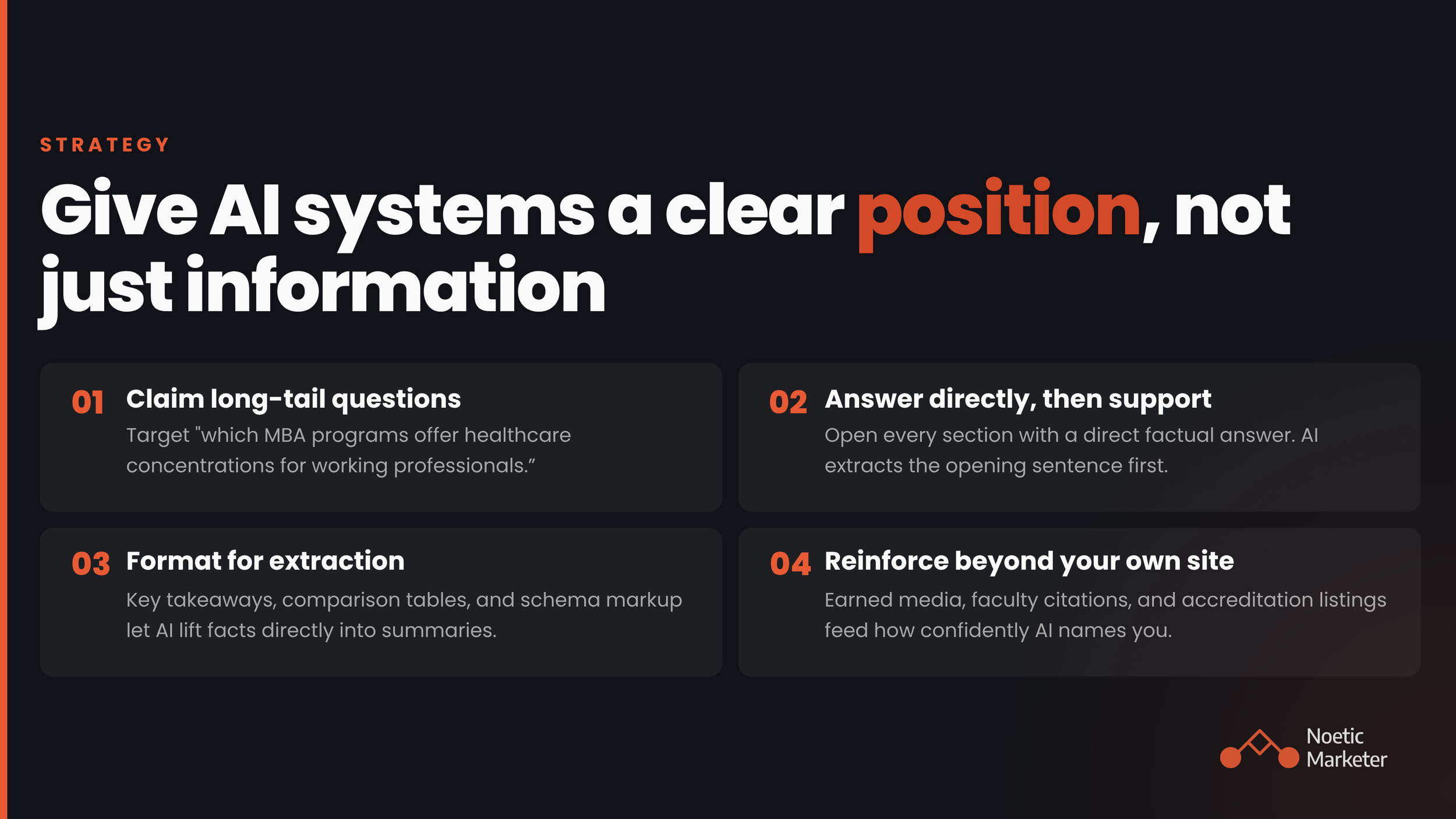
Universities give AI systems a clear position by claiming authority on specific, long-tail questions and supporting that content with structured data and verified external evidence.
Claim authority on specific, long-tail questions. A short-tail term like MBA attracts excessive competition. A long-tail question such as whichMBA programs offer healthcare concentrations for working professionals reflects how prospective students prompt AI tools and creates a focused space to earn citations.
Answer real questions directly, then support the answer. Open every section with a direct, factual answer to the question posed in the heading above it. AI systems extract that opening sentence as a standalone answer, so a vague lead-in gets skipped in favour of a competitor's clearer one.
Format supporting content so AI systems can extract it easily. Key takeaway sections, glossaries, and comparison tables let an AI system lift a fact directly into a summary instead of interpreting a full paragraph. Structured data gives the same information in a machine-readable form. Integrating student testimonials provides the social proof that AI search engines value.
Reinforce that position beyond the institution's own website. AI systems weigh whether an institution is described the same way across independent sources, not only on its own domain. Earned media coverage, faculty research citations, review platforms, and accreditation or association listings all feed into how confidently an AI system names an institution. Demonstrating faculty expertise through these channels is essential.
Keep the technical SEO foundation strong. Fast, well-structured, crawlable pages remain the base layer that both traditional search engines and AI systems draw from, so gaps in technical SEO limit AI visibility just as much as they limit traditional rankings. Utilizing the right digital marketing tools can help streamline these optimizations.
What information should a program page include to answer prospective student questions?
A program page should include comprehensive details on program curriculum, admission requirements, tuition fees, length, and career outcomes, as these represent the core attributes AI models extract to answer prospective student queries.
A well-built program page typically answers:
Program basics: Overview of degree focus, typical student, delivery format (online, hybrid, or in-person), and completion timelines.
Admissions: Clear application criteria, prerequisite lists, deadlines, and tuition costs.
Outcomes: Specific graduate success metrics, including employment rates, top hiring sectors, and average starting roles.
Faculty: Profiles of faculty members teaching in the program, highlighting their academic credentials and professional expertise.
How can universities find out what AI is already saying about them?
Universities find out what AI is already saying about them by deliberately testing both branded and non-branded prompts across multiple AI tools and reviewing the results the same way a prospective student would encounter them.
Test branded prompts first. Ask an AI tool direct questions that name the institution, such as “what is the average class size at [institution name]”, across a few different platforms, since each one draws from different sources and can describe the same institution differently.
Test non-branded prompts next. Ask the same broad questions a prospective student would ask without naming any institution, such as what are the best community colleges for transfer students in Ontario, and note which institutions the AI names, in what order, and why.
Ask what a competitor has that you do not. When a competing institution appears ahead of yours, it is reasonable to ask an AI tool what it based that answer on and what information appears to be missing about your institution. Treat the answer as a list of content gaps to close, not a ranking to dispute.
Check what is actually being said, not only whether you appear. Being mentioned is not automatically a good outcome. Confirm whether the details given are accurate, current, and described favourably, since an AI tool can just as easily surface outdated or unflattering information as it can a strong answer.
Repeat the check across platforms and over time. AI models update frequently, and results can shift by platform, prompt wording, and month, so a single check only shows a snapshot.
The most important part of this process is staying factual. AI systems reason from available evidence rather than a fixed leaderboard, so the goal is never to argue with an AI tool about a competitor’s ranking. Instead, focus on identifying specific gaps, such as outdated statistics, missing outcomes figures, or under-explained program details, that allow a competitor to provide a clearer answer. Then, close those gaps by creating accurate, authoritative content of your own.
How can institutions measure their visibility in AI-generated search results on an ongoing basis?
Institutions can measure their visibility on an ongoing basis by turning the kind of prompt testing described above into a regular habit rather than a one-time check, since most institutions still lack a formal way of tracking this.
Just over half of institutions (56.7%) believe their institution appears in AI-generated answers. Yet, many do not actively monitor it, and 13.3% are unsure whether they appear at all, according to a fall 2025 snap poll of UPCEA member institutions. That gap between assumption and confirmation is where visibility problems tend to hide.
Reviewing how AI systems describe an institution's programs on a regular schedule, alongside the same reporting used to measure the ROI of higher education marketing, gives marketing teams a factual basis for deciding where AI visibility investment is needed most.
Conclusion
AI visibility does not replace the search engine optimization work universities have already invested in. It extends that work into a new layer of discovery where the reward is not a ranking position but a mention inside an AI-generated answer, often for a question that never named the institution in the first place. Practicing AI SEO gives AI systems the clearest possible reason to name them. These strategies help capture a prospective student's attention early in the process.
Strengthen your higher education marketing strategy
Schedule a meeting with our higher education marketing experts today for a focused conversation about your enrolment goals and marketing opportunities.
Don’t miss our other posts on digital marketing for education.
How do you measure ROI in higher education marketing?
How does paid advertising drive student applications for higher education?
How do you choose the best higher education marketing agency?
Why is enrolment marketing essential for higher education institutions in 2026?
How can boarding schools create effective marketing strategies to attract students in 2026?
How do private schools approach marketing?
What does a higher education marketing agency actually do?
What is higher education marketing, and how is it different from traditional marketing?
How Can Universities Create an Effective Higher Education Marketing Budget?
What Are 11 Valuable Strategies for Recruiting International Students?
What Are 9 Proven Strategies for Marketing Higher Education to Adults?
What Makes Student Testimonials Crucial for University Recruitment Marketing?
How Can Universities Use Video Content to Boost Student Recruitment?
What Are 5 Effective Marketing Strategies for Recruiting Undergraduate Students?
How Can Universities Use AI for Marketing?
What Are the 7 Key Challenges in Higher Education Digital Marketing and How Can They Be Solved?
AI SEO glossary
AI SEO / AI visibility: The practice of positioning and structuring website content so AI search engines and generative AI tools name an institution accurately.
Branded prompt: A question posed to an AI tool that names a specific institution directly, such as what is the tuition at a specific university.
Non-branded prompt: A question posed to an AI tool that describes a need or comparison without naming any specific institution.
Generative engine optimization (GEO): The practice of structuring an entire content strategy so generative AI platforms can retrieve and synthesize accurate information about higher education institutions.
Answer engine optimization (AEO): The practice of formatting an individual section of content so it directly and completely answers one question, making it easy for an AI system to quote or cite on its own.
Structured data (schema markup): Machine-readable code added to a webpage that explicitly labels its content. Structured data is essential for search engines and AI systems.
E-E-A-T: A framework, standing for experience, expertise, authoritativeness, and trust, used to describe the signals search engines and AI systems look for when judging whether content is credible.