How do charter schools approach marketing?
By Morgan Northmore, Copywriter and Digital Marketing Coordinator at Noetic Marketer. Morgan writes about enrolment marketing across the K-12 and higher education sectors, with a focus on how schools build trust with prospective families through community engagement, website design, and digital strategy.
Key takeaways:
Proactive recruitment: Charter school marketing differs from traditional public school marketing because charter schools must actively recruit prospective families rather than rely on automatic district enrolment.
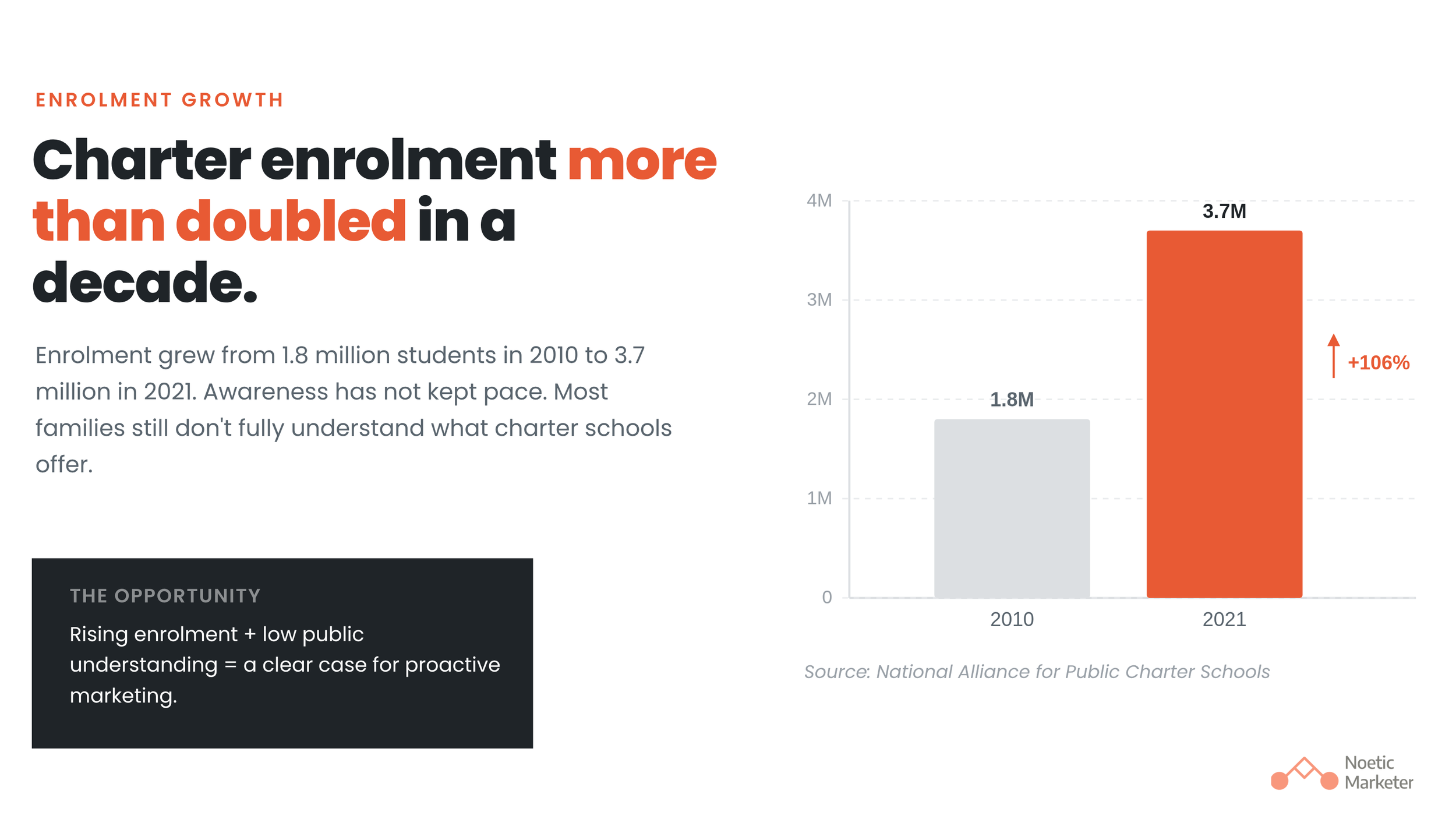
Rising enrolment: Charter school enrolment nearly doubled from 1.8 million to 3.7 million students between 2010 and 2021, according to the National Center for Education Statistics, yet many parents still do not fully understand what charter schools offer.
Importance of word of mouth: Word-of-mouth referrals from current families are often a charter school's strongest trust-builders, but they work best when amplified by a proactive digital strategy that reaches families beyond your immediate network.
Digital presence: A mobile-friendly website and a strong local SEO presence are essential, since most prospective families now research schools on a smartphone before ever visiting in person.
Charter schools operate under a different set of rules than the school down the street. Because enrolment is not guaranteed by address or catchment area, a charter school's growth depends directly on how well it communicates its value to prospective families. That reality shapes nearly every marketing decision charter schools make, from the first community event to the final enrolment form.
What is charter school marketing?
Charter school marketing is the ongoing process of communicating a charter school's educational philosophy, teaching methods, and academic track record to prospective families to meet enrolment goals. Unlike district schools, charter schools are independently operated public schools that receive public funding but are not assigned a base of students by geographic boundary.
Because a charter school's funding is tied to how many students actually enrol, marketing efforts are a functional necessity rather than a branding exercise. Many charter schools treat marketing as an extension of their educational philosophy, using it to explain what makes their approach different and who it is designed to serve.
How is charter school marketing different from marketing a traditional public school?
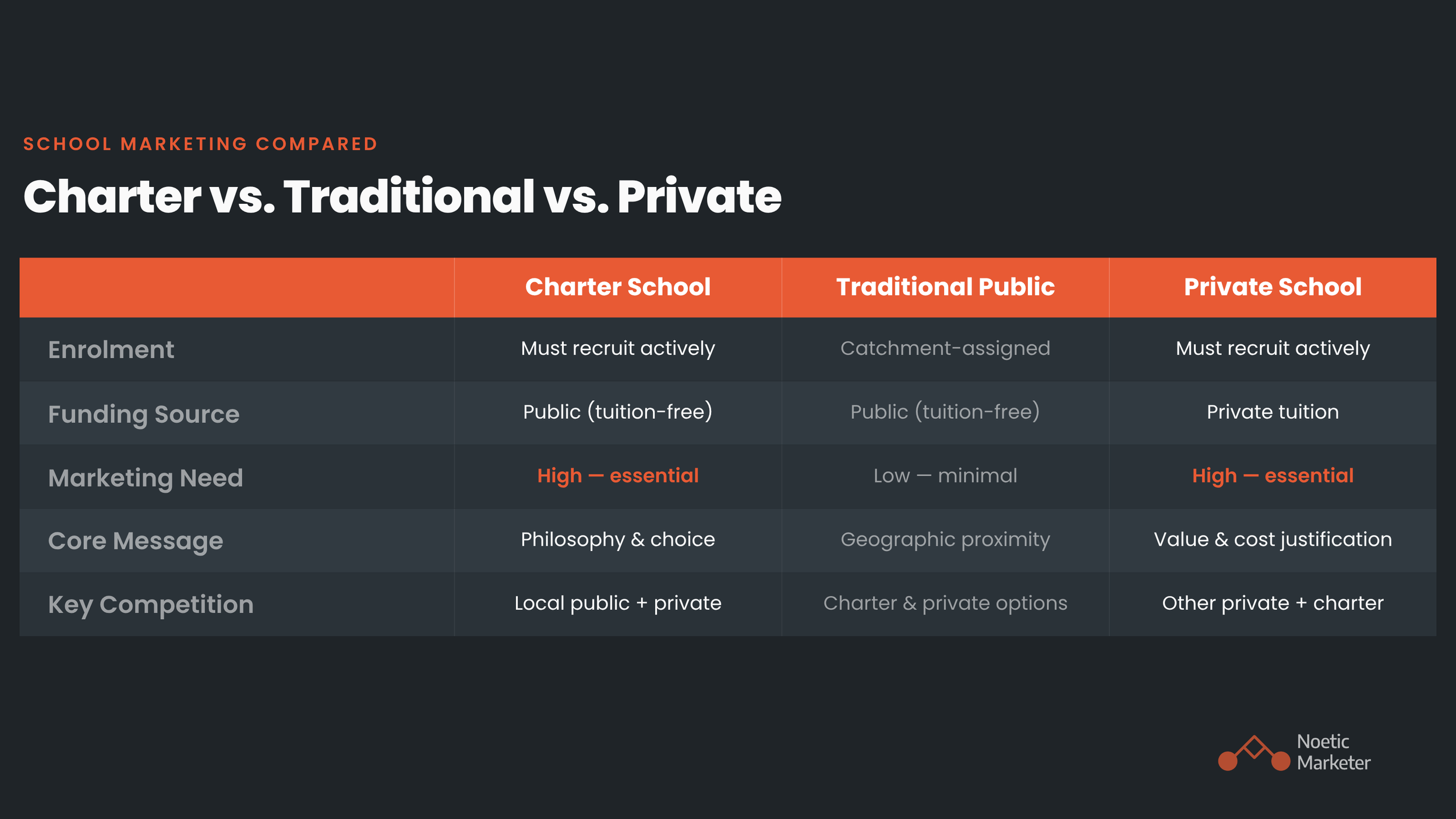
Charter school marketing differs from traditional public school marketing because charter schools must actively recruit every student who enrols. In contrast, traditional public schools receive most students automatically based on where they live. This single difference changes almost everything about how a charter school plans its marketing strategy.
District schools generally do not compete for enrolment in the same way, since families within a catchment area are assigned to their local school by default. Charter schools, along with private schools, must instead build awareness, earn trust, and give families a clear reason to choose them over the traditional public school option.
How does charter school marketing differ from private school marketing?
Charter school marketing differs from private school marketing mainly in funding and access, since charter schools are tuition-free and publicly funded, while private schools rely on tuition and must justify that cost to families. Both charter and private schools compete for enrolment and need a strong brand identity, but a charter school's marketing centres on educational philosophy and choice rather than cost justification.
For a closer look at how independent institutions approach this challenge, see Noetic Marketer's guide on how private schools approach marketing, which covers many of the same trust-building principles from a tuition-based perspective.
Why do charter schools need a clear marketing strategy?
Charter schools need a clear marketing strategy because most families still do not understand what a charter school actually is or how it differs from other school options. According to the National School Choice Awareness Foundation's January 2025 survey, 60 percent of parents considered sending a child to a different school last year, and 51 percent said they wish they had more information about the schooling options available to them. Together, this points to a visibility problem rather than a demand problem.
Charter schools must educate families about their options before they can ever attract students. A school with no visibility has no enrolment opportunity, regardless of the quality of education it provides. This is why consistent marketing, delivered year-round rather than in a short seasonal push, tends to outperform sporadic campaigns.
How long is the family decision-making window for charter school enrolment?
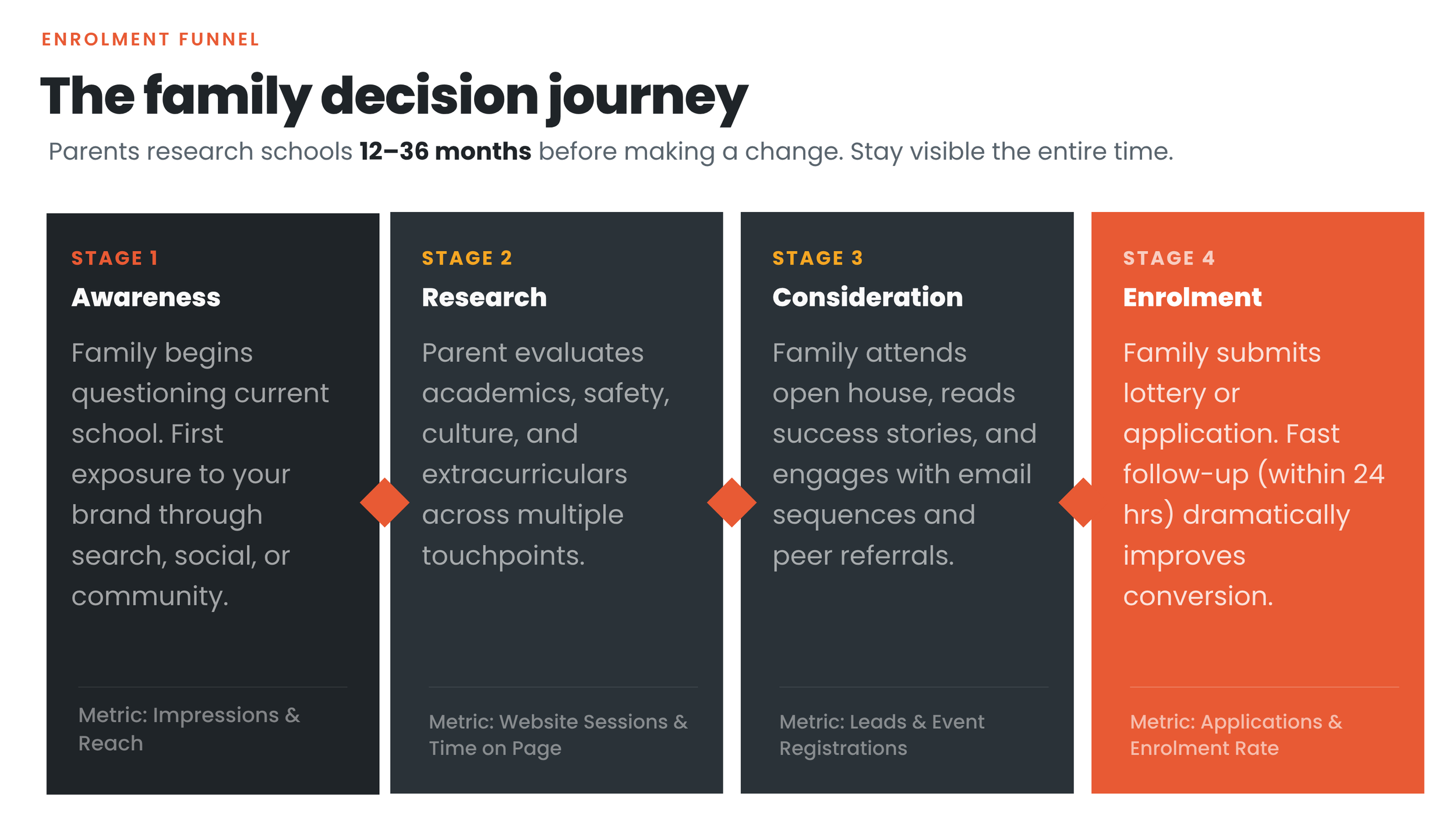
The family decision-making window for charter school enrolment typically spans 12 to 36 months, as parents begin researching educational alternatives well before a major grade-level transition. During this extended research phase, prospective families evaluate academic performance, school safety, culture, and extracurricular opportunities across multiple digital and community touchpoints.
A multi-year research timeline means charter schools must sustain a continuous marketing presence. Key benefits of maintaining year-round visibility throughout this decision window include:
Early brand consideration: Reaching families when they first begin questioning their current school placement.
Sustained engagement: Nurturing parent interest across consecutive application and open house cycles.
Reduced application friction: Answering common admissions and lottery questions long before the final application deadline.
What is the most important marketing asset for a charter school?
The most important marketing asset for a charter school is word of mouth from its current families, since trust between parents carries immense weight. Many charter schools formalize this through parent ambassador programs, where current families are equipped to share their honest experience with prospective parents in their community.
However, organic word of mouth only reaches families within your current network. To maximize its impact, charter schools must package and amplify these parent experiences through digital channels, using authentic student testimonials, landing page social proof, and targeted social media advertising to reach prospective families who have not yet heard about the school.
How do parent ambassador programs strengthen charter school recruitment?
Parent ambassador programs strengthen charter school recruitment by giving prospective families direct access to authentic, first-hand experiences from trusted peers. When current parents actively advocate for a school, it validates institutional claims and builds social proof within local communities.
Key components of an effective parent word-of-mouth strategy include:
Parent ambassador programs: Structured referral efforts that turn enrolled families into a school's most credible spokespeople.
Success story features: Short profiles of current or graduated students that demonstrate real outcomes tied to the school's educational philosophy.
Word-of-mouth referrals: Informal recommendations from current families that often carry more influence than a school's own advertising.
How do charter schools build trust with prospective families?
Charter schools build trust with prospective families through consistent proof points, authentic messaging, and clear communication, delivered across multiple touchpoints over time. Parents need to trust a school before they will enrol their child, and that trust is rarely built through a single interaction.
A charter school's track record, including academic outcomes, special programs, and how it supports students, gives families concrete reasons to believe the school's educational philosophy in practice rather than in theory. Schools that communicate this track record consistently, rather than only during open enrolment periods, tend to build the strongest reputations in their community.
What role do school events and community partnerships play in charter school enrolment?
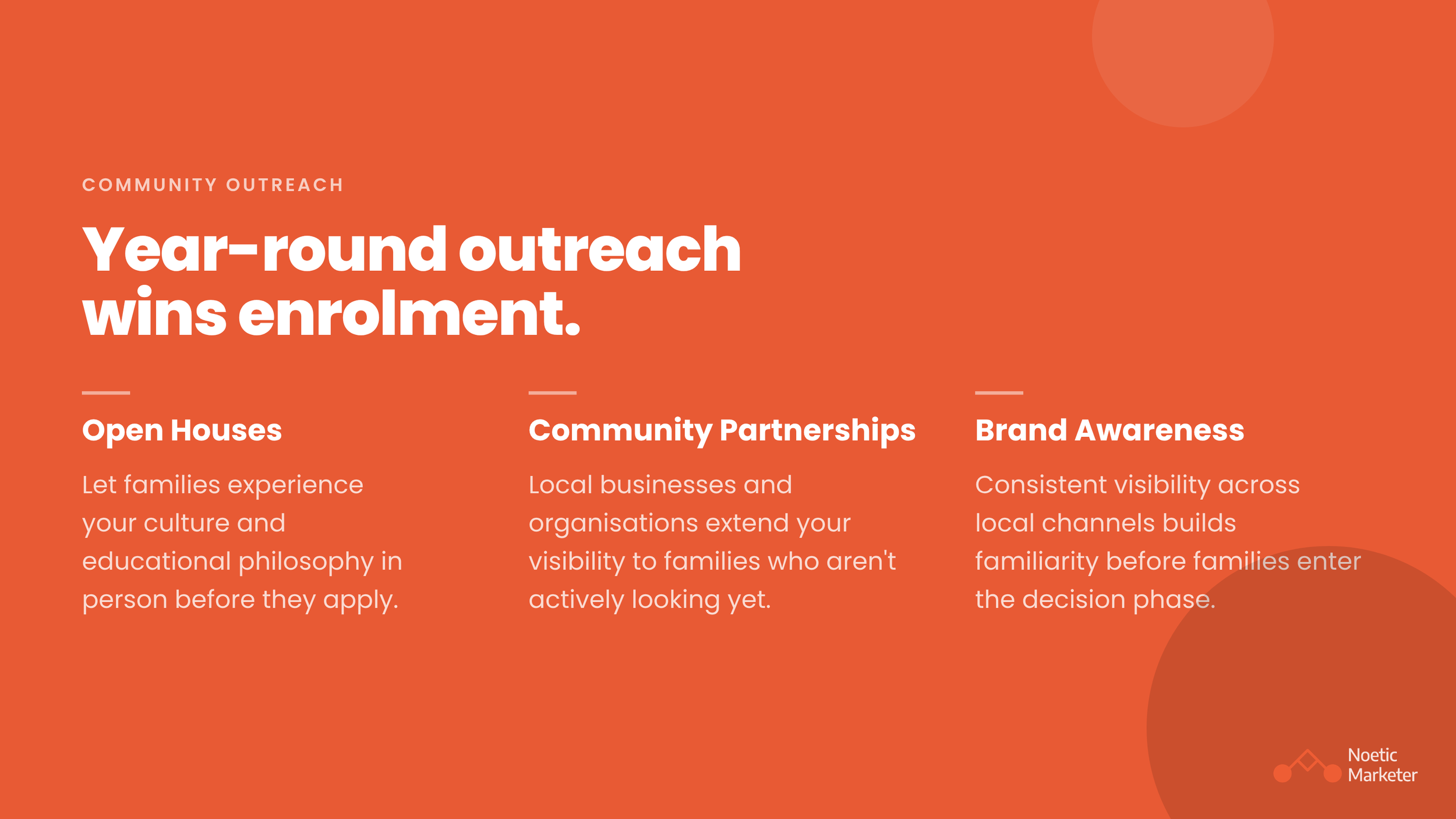
School events and community partnerships play a central role in charter school enrolment by giving prospective families an in-person opportunity to evaluate the school before applying. Open houses remain one of the most effective enrolment activities available to charter schools, since they let families experience the culture and educational philosophy directly rather than through a brochure.
Partnerships with community organizations and local businesses extend a charter school's visibility beyond families who are already looking. Charter schools that engage in community outreach year-round, rather than only during enrolment season, tend to stay top of mind when a family begins considering a change.
Noetic Marketer's guide on boarding school marketing strategies outlines a similar year-round approach to community building, which applies just as well to a charter school's local outreach efforts.
What impact does brand awareness marketing have on building trust for educational institutions?
Brand awareness marketing builds trust for educational institutions by establishing a visible, reliable presence in the community before prospective families enter the active decision-making phase. When parents consistently see an institution's mission and academic outcomes represented in local channels, they become familiar with the school and more confident in its credibility.
How do charter schools reach prospective families online?
Charter schools reach prospective families online through a combination of a mobile-friendly website, local SEO, social media management, and digital advertising.
Why does local SEO matter for charter school enrolment?
Local SEO matters for charter school enrolment because most families begin their research with a geographically specific search, such as looking for the best schools near them. A charter school that is not visible in local search results is effectively invisible to families who are actively looking for exactly what it offers.
Beyond organic search, many charter schools also use pay-per-click advertising and social media advertising to reach families interested in a specific educational approach, whether that is a STEM focus, an arts-based program, or a particular teaching method. Modern institutions are also leveraging interactive inquiry forms and personalized landing page deployment to enhance the digital enrollment experience.
How does email marketing support the charter school admissions process?
Email marketing supports the charter school admissions process by keeping interested families informed and engaged over the months it typically takes them to decide. Since parents often research schools 12 to 36 months before enrolling, a well-timed email sequence can answer common questions and keep the school visible throughout that decision window.
Response speed matters just as much as content. Schools that respond to inquiries within 24 hours generally see a meaningfully better chance of converting that interest into an application, since a slow response can signal disorganization to a family that is comparing several options at once.
How does automated lead nurturing improve enrolment conversion rates for schools?
Automated lead nurturing improves enrolment conversion rates for schools by systematically guiding interested families from initial inquiry to completed application using targeted, timely communication. By sending personalized email sequences based on a family's specific grade level or academic interest, schools eliminate decision friction and keep prospects engaged.
In a full-funnel digital recruitment campaign executed by Noetic Marketer for a specialized post-secondary institution, implementing structured lead nurture sequences and automated follow-ups helped generate a 97% year-over-year increase in qualified leads and a 325% increase in new student enrolment. Applying automated nurturing workflows ensures charter schools convert prospective inquiries into completed lottery or admission forms.
How can a marketing agency support charter school enrolment goals?
A marketing agency supports charter school enrolment goals by combining strategic planning, brand messaging, and performance-driven digital advertising tactics into a single, coordinated plan. Many charter schools operate with limited internal marketing staff, which makes it difficult to manage strategy, content, and advertising at the same time.
Agency support for charter schools typically includes:
Strategic enrolment planning: Aligning marketing activity with enrolment goals, market research, and budget strategy.
Brand strategy and messaging: Clarifying a school's educational philosophy and value proposition so it is easy for families to understand.
Search engine optimization (SEO): Improving local visibility so the school appears when families search for options nearby.
Social media advertising: Reaching specific family segments with targeted messaging and creative.
Lead nurturing and campaign optimization: Guiding families from inquiry to completed enrolment through email and CRM workflows.
Noetic Marketer's work with schools and academic institutions reflects this full-funnel approach, applying the same strategic enrolment principles used across the K-12 education sector to help more charter schools reach their enrolment goals.
Conclusion
Charter schools cannot rely on an assigned catchment area to fill their seats, which makes marketing a core part of long-term success rather than an optional add-on. The schools that grow consistently are the ones that combine an authentic educational philosophy with year-round visibility, both in their community and online.
Word of mouth from current families remains the most powerful proof point a charter school has, but it works best when it is supported by a clear digital presence, consistent outreach, and a fast response to every family that reaches out.
Reach more prospective families
Ready to accelerate your enrolment growth? Schedule a meeting with our education marketing experts today for a focused conversation about your enrolment goals and marketing opportunities.
Don’t miss our other posts on digital marketing for education.
How can universities build SEO content for AI search engines?
How do you measure ROI in higher education marketing?
How does paid advertising drive student applications for higher education?
How do you choose the best higher education marketing agency?
Why is enrolment marketing essential for higher education institutions in 2026?
How can boarding schools create effective marketing strategies to attract students in 2026?
How do private schools approach marketing?
What does a higher education marketing agency actually do?
What is higher education marketing, and how is it different from traditional marketing?
How Can Universities Create an Effective Higher Education Marketing Budget?
What Are 11 Valuable Strategies for Recruiting International Students?
What Are 9 Proven Strategies for Marketing Higher Education to Adults?
What Makes Student Testimonials Crucial for University Recruitment Marketing?
How Can Universities Use Video Content to Boost Student Recruitment?
What Are 5 Effective Marketing Strategies for Recruiting Undergraduate Students?
How Can Universities Use AI for Marketing?
What Are the 7 Key Challenges in Higher Education Digital Marketing and How Can They Be Solved?
Charter school marketing glossary
Charter school: A publicly funded school that operates independently of a traditional school district under a charter, or contract, that outlines its educational philosophy and performance goals.
Authorizer: The state agency, school district, or institution responsible for approving and overseeing a charter school's charter contract.
Enrolment lottery: A random selection process used to admit students when a charter school receives more applications than it has available seats.
Parent ambassador program: A structured effort that equips current families to represent a school's experience to prospective families, often through referrals and shared success stories.
Local SEO: The practice of optimizing a school's online presence so it appears in geographically relevant search results, such as searches for schools near a specific city or neighbourhood.
Full-funnel marketing: An integrated marketing strategy that addresses every stage of the student recruitment journey, from top-of-funnel brand awareness to bottom-of-funnel enrolment conversion.
Cost-per-enrolment: A key financial metric that measures the total marketing and advertising spend required to acquire a single enrolled student, helping schools measure ROI.
Lead nurturing: The automated process of building relationships with prospective families by providing relevant, timely content at each stage of the admissions decision-making process.
Conversion rate optimization (CRO): The practice of systematically testing and refining website landing pages and inquiry forms to increase the percentage of visitors who complete an application or request information.