How can universities build brand trust with prospective students in 2026?
By Morgan Northmore, Copywriter and Digital Marketing Coordinator at Noetic Marketer. Morgan specializes in crafting digital content and social media strategies that help higher education institutions, career colleges, and private schools connect with prospective learners and drive enrolment growth.
Key takeaways:
Strategic definition: Education branding is the strategic definition and consistent communication of an institution's core identity, values, and academic value proposition.
Brand trust & anxiety reduction: Building brand trust requires reducing prospective student decision anxiety by providing financial transparency, clear career outcomes, and authentic student proof.
Sector-specific strategy: Education branding strategy varies significantly across sectors, requiring traditional universities to focus on institutional prestige while trade schools and career colleges emphasize immediate return on investment.
Visual & channel consistency: Clear visual identity guidelines, style guides, and digital templates ensure consistent communication across all university departments and marketing channels.
Funnel alignment & conversion: Aligning brand strategy with automated mid-funnel lead nurturing increases lead-to-application conversion rates and lowers cost per enrolment.
Education branding is the strategic process through which an educational institution defines and communicates its core values, visual identity, and academic strengths to build trust with prospective learners.
Building brand trust requires positioning the institution as an authentic, risk-mitigating partner that directly resolves prospective students' financial and career anxieties. When an educational institution fails to articulate a distinct value proposition, prospective candidates experience severe decision friction, resulting in higher drop-off rates between initial inquiry and completed application.
What is education branding?
Education branding is the foundational framework through which a university or college, private school, or trade school communicates its unique brand identity, values, and academic benefits to prospective students and the wider community.
Building a cohesive brand identity requires unifying visual resources, brand elements, and narrative storytelling across every department and communication channel. From digital templates and photography guidelines to official brand guidelines and a consistent visual identity, a strong brand keeps an institution instantly recognizable across every prospective student touchpoint.
How does brand identity differ from an institutional logo?
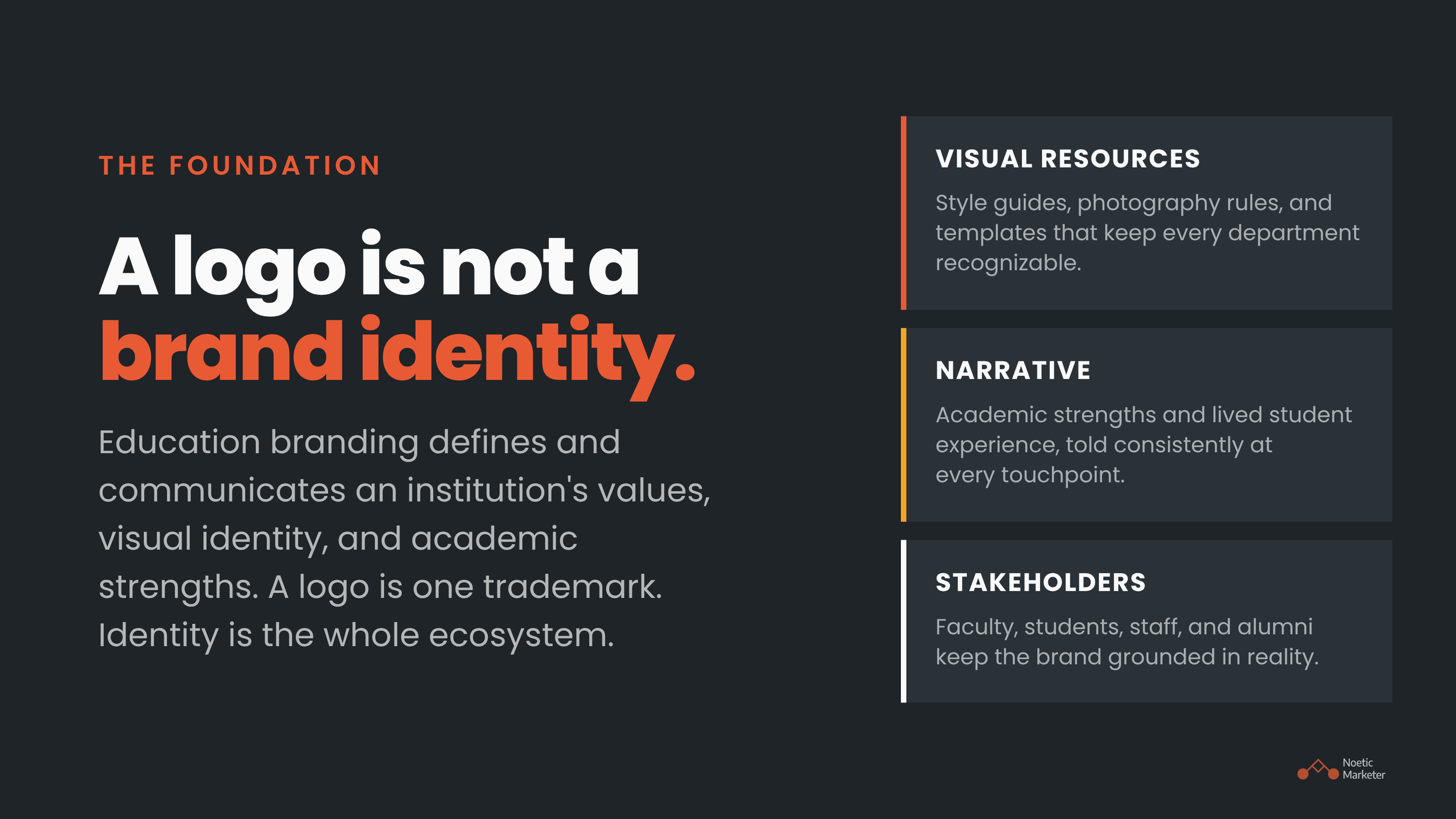
Brand identity differs from an institutional logo because a logo is a singular visual trademark.
In contrast, brand identity encompasses the full ecosystem of institutional values, photography guidelines, digital templates, style guides, and community culture that shape public perception.
While brand colours and logos make an institution recognizable, a complete brand identity reflects its actual academic strengths and lived student experience.
Why is stakeholder involvement essential for authentic brand definition?
Stakeholder involvement is essential for authentic brand definition because engaging faculty, current students, staff, and alumni ensures the institutional brand reflects reality rather than performative marketing.
When brand messaging aligns with actual campus culture, institutions build long-term trust and attract candidates who thrive within their academic environment.
Why is education branding essential for student recruitment?
Education branding is essential for student recruitment because a strong, distinctive brand simplifies the decision-making process for prospective applicants by establishing credibility, reducing financial anxiety, and highlighting clear academic benefits in a crowded market.
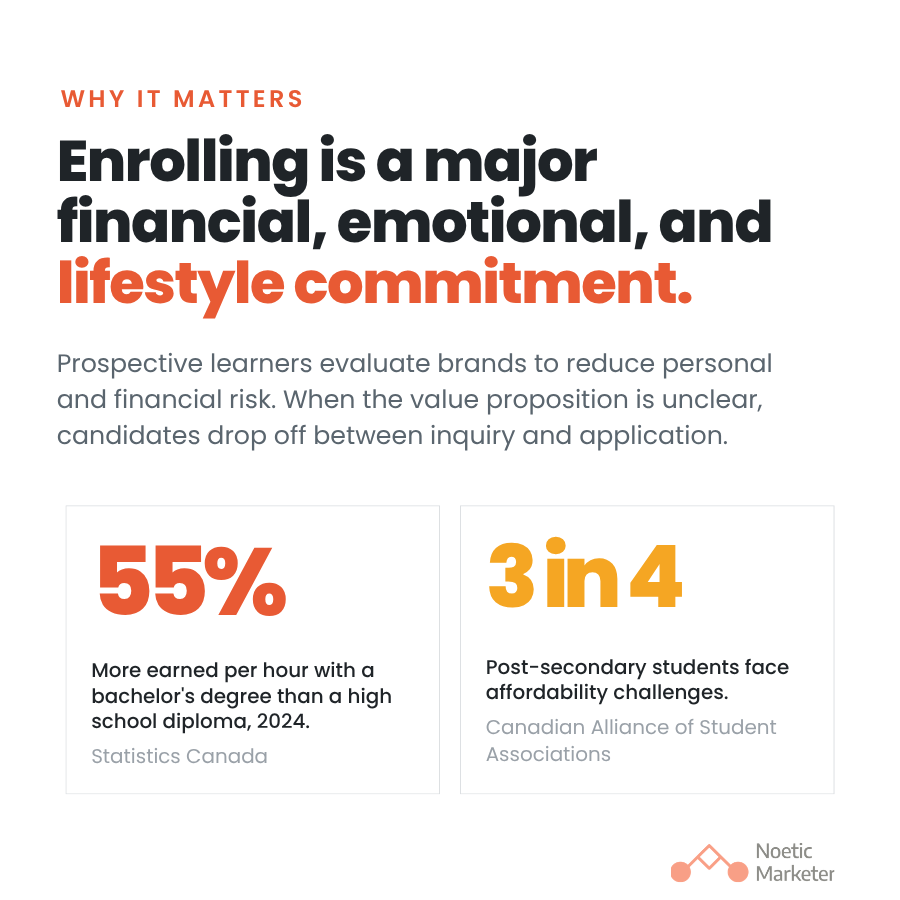
Enrolling in an educational program represents a major financial, emotional, and lifestyle commitment.
According to Statistics Canada's post-secondary earnings study, employees aged 25 and over with a bachelor's degree earned 55% more per hour than those with a high school diploma in 2024, demonstrating the long-term value of higher education.
However, with 3 in 4 post-secondary students facing affordability challenges, according to the Canadian Alliance of Student Associations' national survey, prospective learners actively evaluate institutional brands to reduce personal and financial risk, which is why brand positioning increasingly serves as a core input to strategic enrolment planning rather than a separate marketing exercise.
Building trust through this process typically moves through four stages:
Identity Definition: Establishing a clear institutional identity and set of core values.
Consistent Communication: Communicating that identity consistently across channels, through visual identity guidelines, authentic storytelling backed by real student proof, and transparent career and financial aid outcomes.
Earning Trust: Earning prospective student trust once stated messaging and lived experience align.
Conversion Yield: Converting that trust into a higher application yield and a lower cost-per-enrolment.
How do prospective students evaluate brand authenticity?
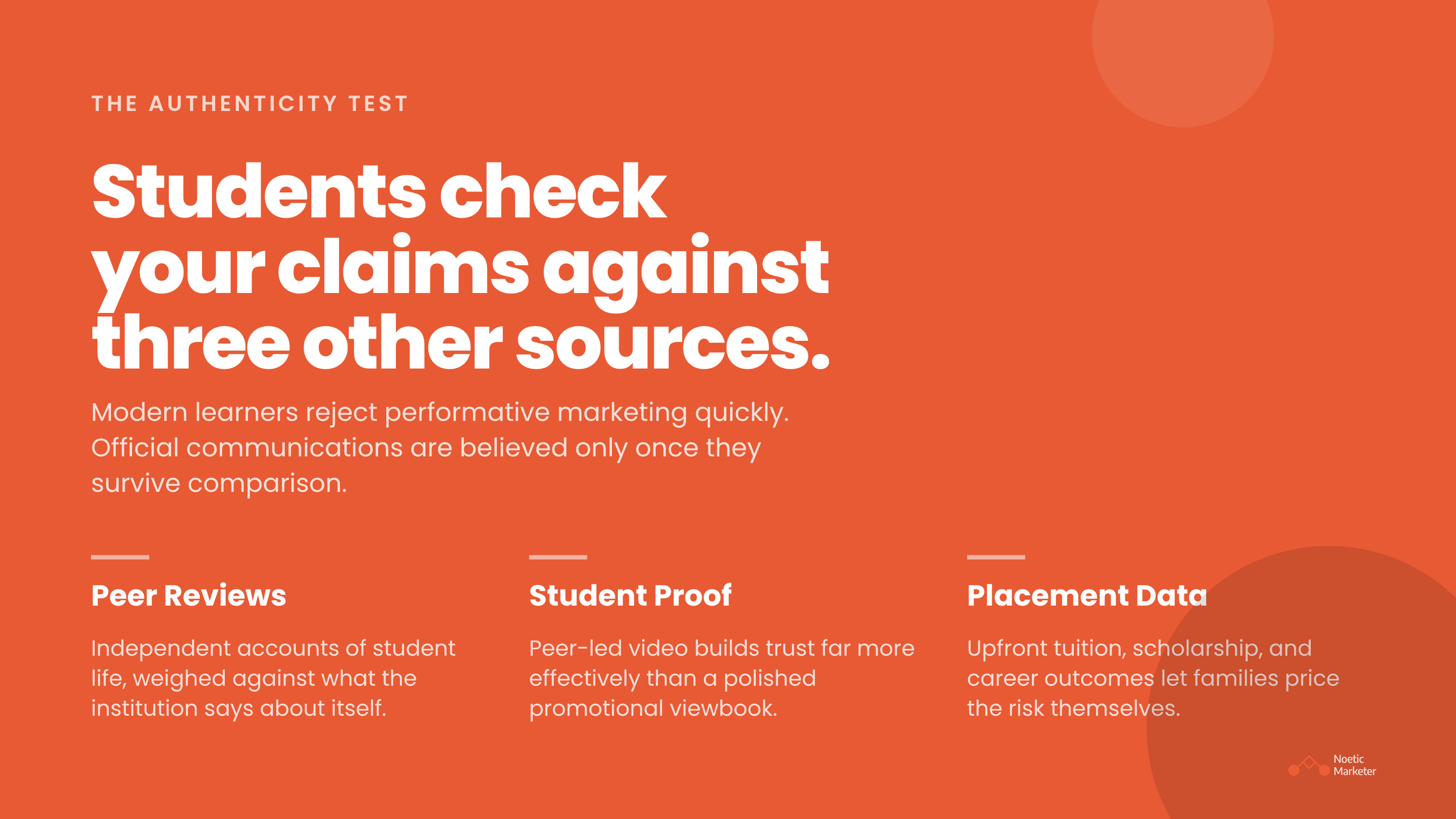
Prospective students evaluate brand authenticity by comparing official university communications against peer reviews, student-generated social media content, and transparent career placement statistics.
Modern learners quickly reject performative marketing and favour institutions that demonstrate authentic social responsibility, inclusive communities, and real student success stories.
What role do visual identity guidelines play in university communications?
Visual identity guidelines play a critical role in university communications by establishing design standards, typography rules, brand resources, and digital templates that maintain visual consistency across all academic departments and administrative channels.
Consistent visual communication builds brand recognition and reinforces institutional credibility over time, helping colleges stand out from the crowd to prospective students.
How does financial and career transparency influence brand trust?
Financial and career transparency influences brand trust by giving prospective applicants and families clear, upfront information about tuition, scholarship opportunities, and graduate career placement outcomes. Clear career pathways reduce financial anxiety during the application cycle, and tracking those outcomes over time helps institutions measure the ROI of their marketing against enrolment goals.
How does education branding strategy vary across sectors?
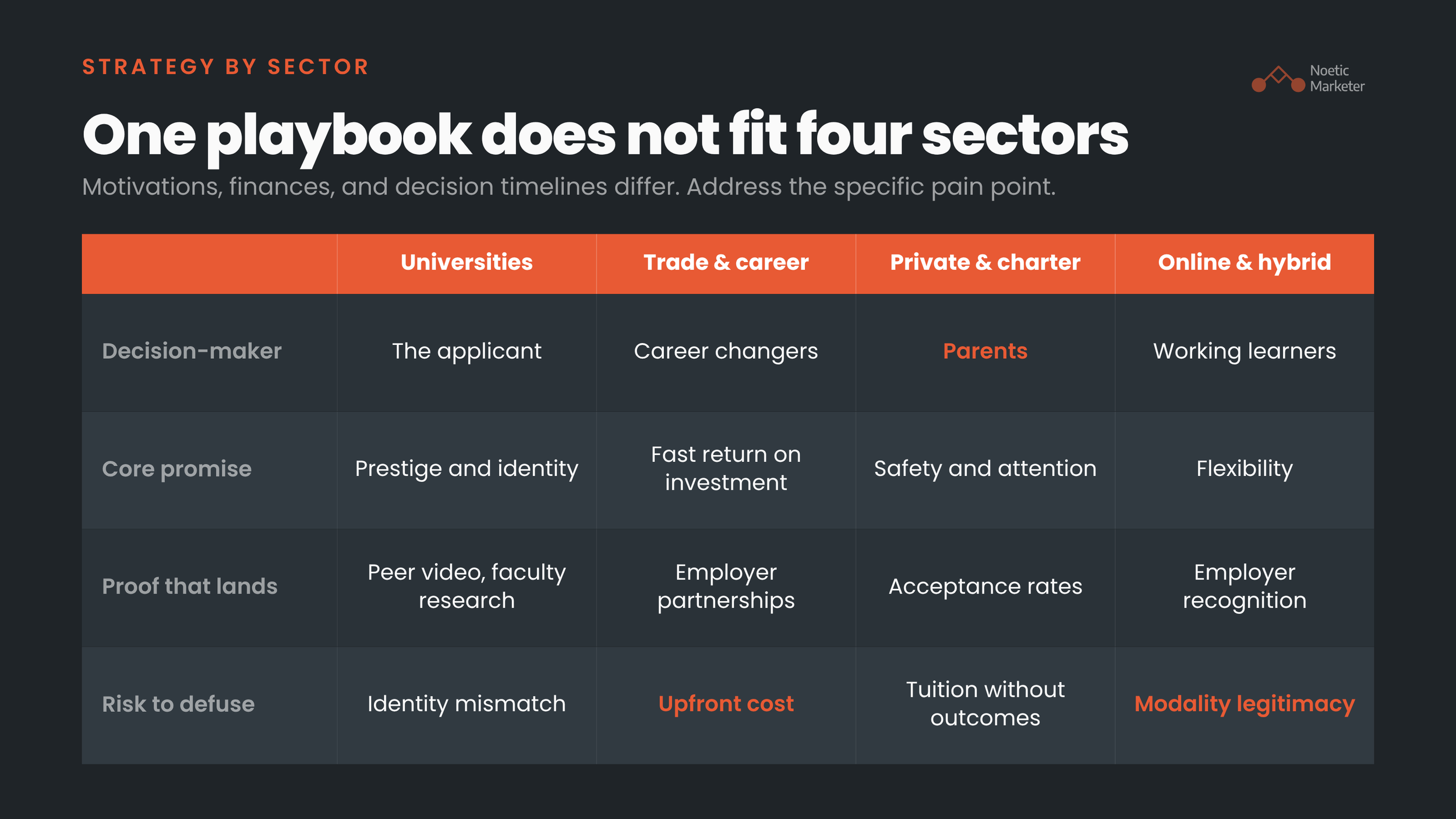
Education branding strategy varies across sectors because candidate motivations, financial considerations, and decision-making timelines differ significantly between universities, trade schools, private K-12 schools, and online learning providers.
To maximize recruitment impact, an educational brand must address its target audience's specific pain points and ambitions rather than broadcasting generic promises of excellence.
How do higher education institutions build brand equity and student trust?
Higher education institutions build brand equity and student trust by positioning their brand strategy around long-term institutional prestige, faculty research excellence, vibrant campus life, and an active alumni network.
Identity Congruence: Higher education applicants select institutions that mirror their personal values and aspirational identity. Messaging must connect with prospective students by illustrating who they will become through attendance.
Student-Generated Proof: Peer-led video content on social platforms builds authentic trust far more effectively than polished promotional viewbooks.
Faculty and Research Authority: Showcasing faculty mentorship and research opportunities, the same strength Noetic Marketer highlighted for a niche faculty of social sciences, reinforces academic rigour and institutional prestige.
How do trade schools and career colleges brand for rapid return on investment?
Trade schools and career colleges brand for rapid return on investment by highlighting employment velocity, practical skills training, flexible scheduling, and clear career placement pathways aligned with labour market demand.
Employment Velocity: Working adults and career changers prioritize fast-track credentials that lead directly to employment in high-demand fields.
Laddering Pathways: Framing short-term certificates as stackable credentials toward full diplomas or degrees reduces upfront risk for prospective learners.
Employer Partnerships: Highlighting direct ties with regional employers proves program legitimacy and job readiness, the same positioning behind Noetic Marketer's work with Alpha Career College and the Canadian College of Health Science and Technology.
How do private, charter, and boarding schools build brand trust with parents?
Private, charter, and boarding schools build brand trust with parents by centring messaging on campus safety, individualized academic attention, character development, and university-preparation tracks.
Parent-Centric Communication: Marketing campaigns must target parents as primary financial decision-makers while providing age-appropriate content for students.
Safety and Community: Highlighting secure campus environments, low student-to-teacher ratios, and supportive community values resolves safety anxieties.
Placement Success: Demonstrating high acceptance rates into post-secondary institutions provides tangible return-on-investment proof for parents, which is part of what private schools get right when they approach marketing this way.
How do online and hybrid education programs establish brand credibility?
Online and hybrid education programs establish brand credibility by emphasizing scheduling flexibility, clean digital experiences, credit portability, and faculty accessibility, the same ground covered in targeted advertising for online university courses.
Flexibility Signals: Addressing non-traditional learners requires proving that coursework fits around existing work and family commitments.
Digital Experience Quality: Because websites and learning management systems serve as the campus, clean, reliable digital experiences directly correlate with perceived academic quality.
Modality Legitimacy: Reassuring learners that online credentials carry the same academic weight and employer recognition as on-campus equivalents reduces hesitation.
How do Noetic Marketer campaigns translate brand identity into enrolment growth?
Noetic Marketer campaigns translate brand identity into enrolment growth by combining purpose-driven storytelling with full-funnel campaign architecture, audience targeting, and ongoing market research that grounds every message in real student behaviour.
Landing pages, paid search, and social media put that brand message in front of prospective students, while CRM and lead nurturing turn early interest into applications through automated email sequences.
Ongoing reporting and conversion rate optimization then confirm which messages are actually building trust.
Digital advertising campaigns launched and managed by Noetic Marketer align institutional purpose with market realities, helping educational organizations lower acquisition costs while driving qualified applicant volume.
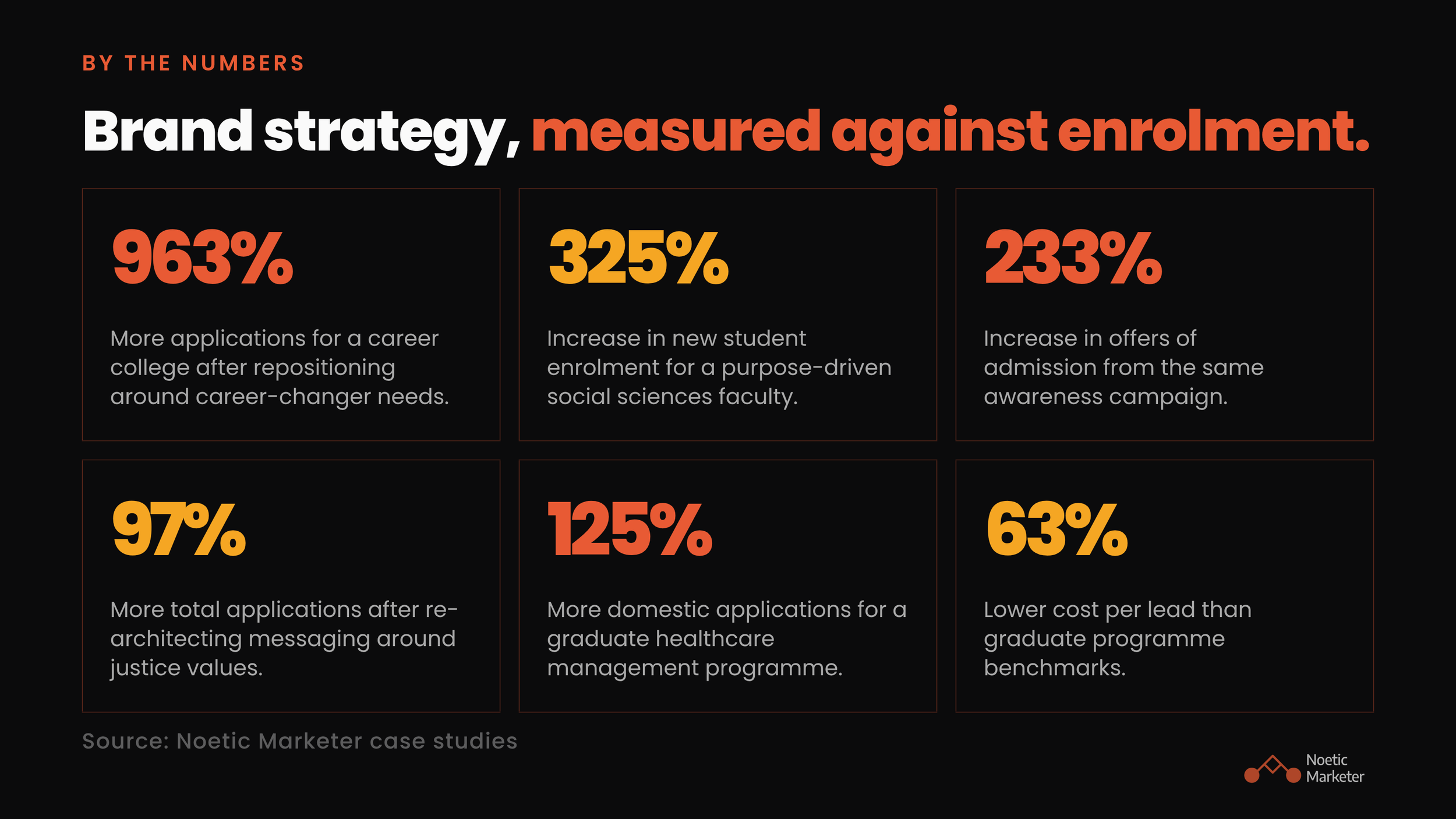
Proven outcomes documented across Noetic Marketer case studies illustrate this impact:
Conclusion
Education branding earns trust long before a prospective student submits an application. Institutions that define a clear, authentic identity, communicate it consistently across every channel, and back it with transparent financial and career information give prospective students the confidence they need to move from inquiry to enrolment.
Institutions that treat brand strategy as core recruitment infrastructure, rather than a one-time visual refresh, are best positioned to convert that trust into measurable enrolment growth.
Boost your student enrolment
Schedule a meeting with our education marketing experts today for a focused conversation about your enrolment goals and marketing opportunities.
Don’t miss our other posts on digital marketing for education.
How do you measure ROI in higher education marketing?
How does paid advertising drive student applications for higher education?
How do you choose the best higher education marketing agency?
Why is enrolment marketing essential for higher education institutions in 2026?
How can boarding schools create effective marketing strategies to attract students in 2026?
How do private schools approach marketing?
What does a higher education marketing agency actually do?
What is higher education marketing, and how is it different from traditional marketing?
How Can Universities Create an Effective Higher Education Marketing Budget?
What Are 11 Valuable Strategies for Recruiting International Students?
What Are 9 Proven Strategies for Marketing Higher Education to Adults?
What Makes Student Testimonials Crucial for University Recruitment Marketing?
How Can Universities Use Video Content to Boost Student Recruitment?
What Are 5 Effective Marketing Strategies for Recruiting Undergraduate Students?
How Can Universities Use AI for Marketing?
What Are the 7 Key Challenges in Higher Education Digital Marketing and How Can They Be Solved?
Key education branding terms
Education branding: The strategic management of an educational institution's identity, values, visual assets, and communications to build trust and recognition with prospective students and stakeholders.
Brand identity: The collective visual elements, style guides, digital templates, and messaging frameworks that portray an institution's unique character to the public.
Visual identity guidelines: A documented set of specifications defining logos, colours, typography, and photography standards for cohesive communication across departments.
Identity congruence: The psychological alignment between a prospective student's personal self-concept or values and the public brand identity of an educational institution.
Marketing qualified lead: A prospective student who meets predefined demographic and engagement criteria, indicating a high likelihood to apply.