How can universities build an effective domestic student recruitment strategy in 2026?
By Morgan Northmore, Copywriter and Digital Marketing Coordinator at Noetic Marketer. Morgan specializes in crafting digital content and social media advertising strategies that help higher education institutions and career colleges engage domestic and regional prospects and strengthen enrolment.
Key takeaways:
Strategy focus: A domestic student recruitment strategy focuses on engaging local, regional, and working adult learners to stabilize post-secondary enrolment as international enrolment declines.
Decision drivers: Career outcomes and financial transparency are primary decision drivers for domestic prospects, and post-secondary graduates continue to earn substantially more over their working lives than non-graduates.
Communication expectations: Prospective students expect fast and frequent communication from admissions offices, and institutions that respond quickly convert more inquiries into completed applications.
Community trust: Peer ambassador programs and authentic student-generated content build trust with domestic prospects more effectively than traditional promotional materials.
Flexible credentialing: Flexible credentials, laddered pathways, and community college partnerships help institutions capture working adult learners and offset declining traditional-age enrolment.
Canadian and American post-secondary institutions are confronting a sharp decline in international enrolment just as competition for domestic students intensifies. A domestic student recruitment strategy gives universities and colleges a structured way to re-engage local, regional, and working adult learners while protecting tuition revenue. Institutions that adapt to what these prospects want most, clear career outcomes, flexible scheduling, and transparent costs, are best positioned to offset international shortfalls.
Why is a domestic student recruitment strategy essential today?
A domestic student recruitment strategy is essential today because federal international study permit caps have sharply reduced incoming international cohorts, creating revenue deficits that institutions must offset through regional enrolment growth.
New study permit approvals for Canada fell 64% year over year in 2025, according to ICEF Monitor's reporting on IRCC data, forcing public institutions across North America to re-evaluate revenue targets and diversify their applicant base.
Reallocating recruitment budgets away from recruiting international students toward regional markets allows universities to diversify their applicant pool while addressing local workforce shortages.
Institutions can manage this transition through strategic enrolment planning and precise budget strategy to align marketing spend with high-performing regional programs.
Domestic learners and working adults actively evaluate the economic return of post-secondary credentials.
According to Statistics Canada’s Quality of Employment in Canada report, employees aged 25 and older with a bachelor's degree earned 55% more per hour ($44.67 per hour compared to $28.82 per hour) in 2024 than those with a high school diploma or less. This gives colleges and universities a compelling value proposition when marketing to adults for degree-completion and upskilling pathways.
How does domestic student recruitment differ from international recruitment?
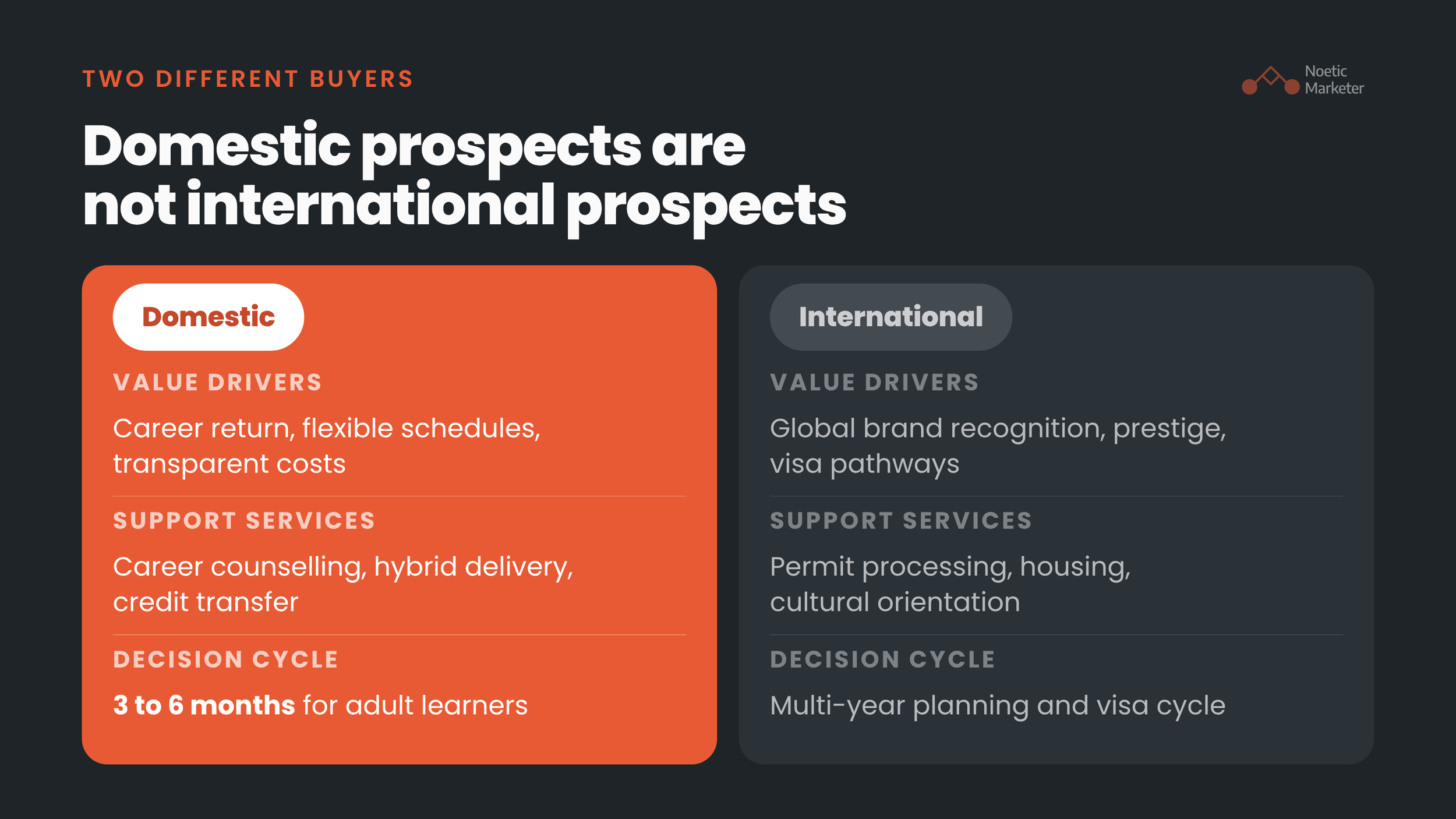
Domestic student recruitment differs from international recruitment because domestic prospective students prioritize local career advancement, tuition transparency, and schedule flexibility over visa processing and cultural adaptation support.
Proximity to home also plays a significant role: the typical undergraduate stays remarkably close to their local community, travelling a median distance of just 17 miles, with 69% of students enrolling within 50 miles of home, according to research from the Institute for College Access and Success.
Domestic recruitment strategies must also account for the realities of commuting and part-time study. Working adults and local students frequently balance coursework with jobs and family responsibilities, which is why flexible scheduling, hybrid delivery, and marketing higher education to adults around degree-completion pathways carry more weight for this audience than campus prestige alone.
What are the key steps in the student recruitment process?
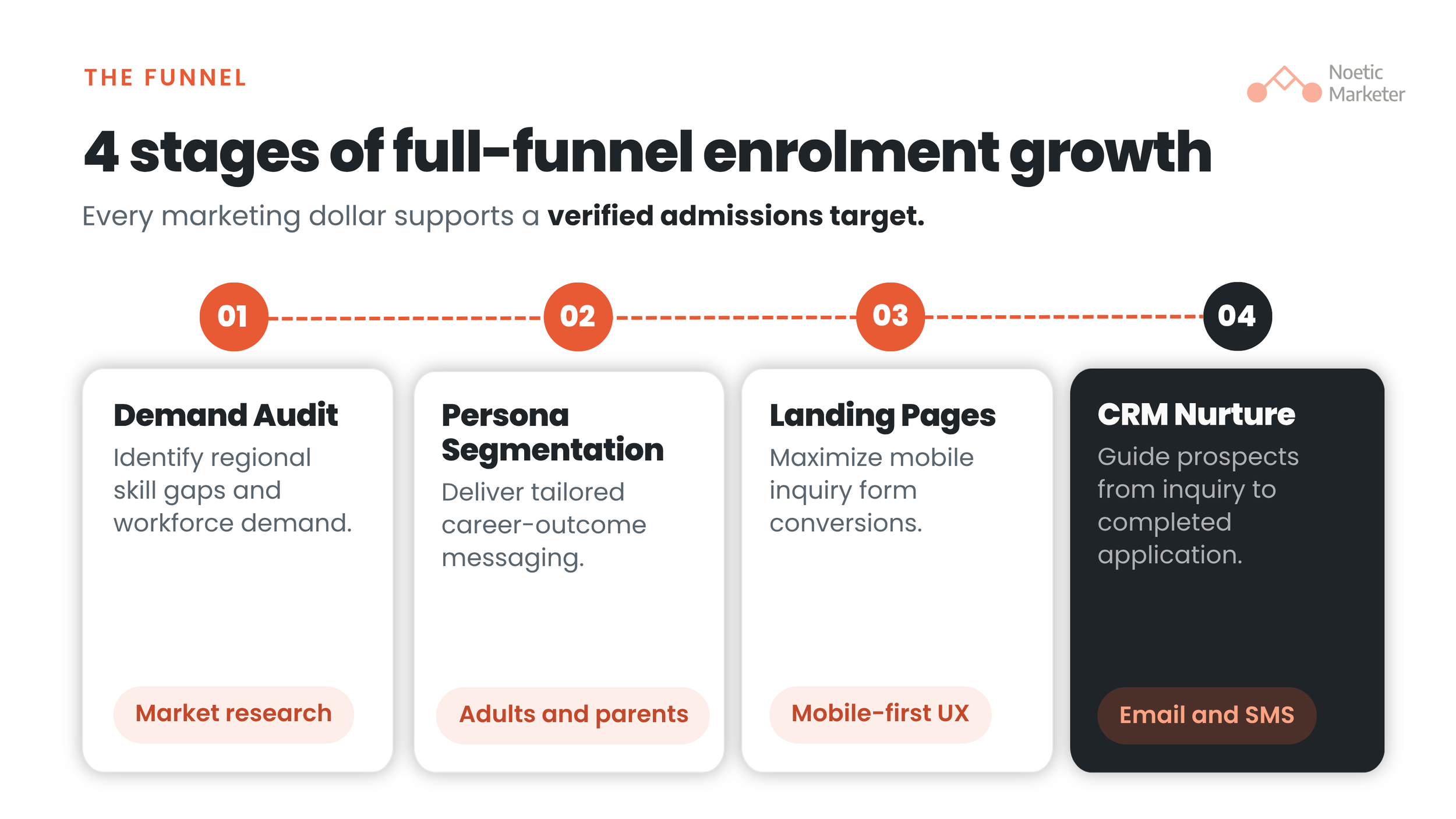
The key steps in the student recruitment process are auditing regional workforce demand, segmenting prospective student personas, deploying conversion-focused landing pages, and automating multi-channel lead nurturing workflows. Following a structured framework ensures every dollar spent from a higher education marketing budget directly supports verified admissions targets.
Audit regional market demand. Conduct thorough market research and perform campaign audits to analyze historical admissions data, local employment shortages, and competitor positioning.
Segment audiences and value messaging. Execute precise audience segmenting to create persona-driven frameworks tailored to distinct applicant groups, including parents and guardians. Align brand messaging around clear career outcomes, framing degrees and short-term credentials around graduate success stories.
Deploy purpose-built landing pages. Execute targeted landing page deployment and optimize website design for mobile devices to cater to Gen Z and millennial browsing habits.
Automate lead nurturing and human outreach. Implement comprehensive lead nurturing workflows using automated email marketing and SMS outreach to communicate deadlines and event updates and guide prospects from inquiry to submitted application.
How do universities utilize CRM platforms to track student behaviour?
Universities utilize CRM platforms to track student behaviour by capturing digital touchpoints, scoring prospect engagement, and segmenting automated communications across the enrolment journey.
Centralized CRM implementation and dedicated CRM systems become critical when an institution manages prospect data across dozens of disconnected tools and spreadsheets.
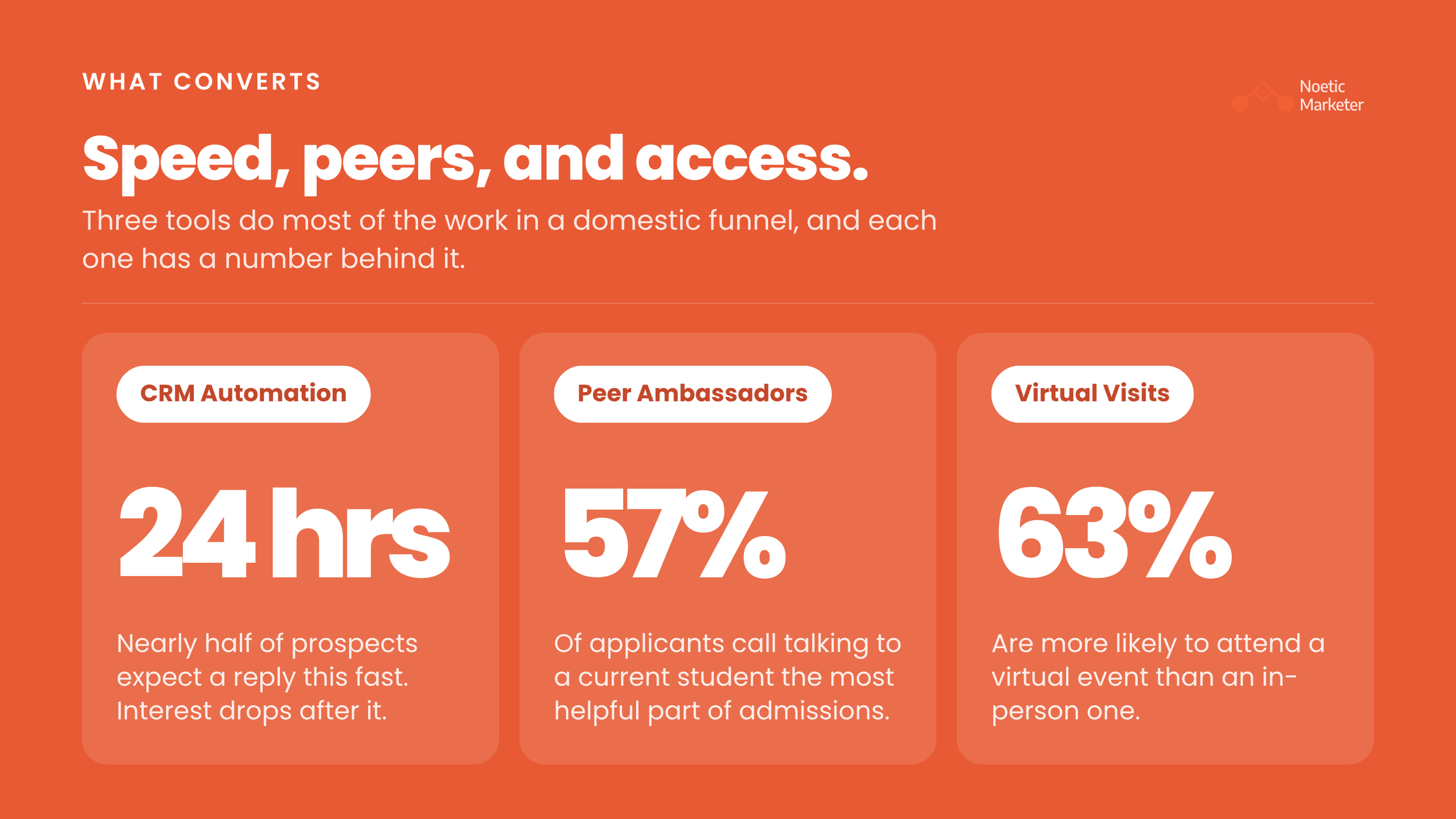
Nearly half of prospective students expect a response within 24 hours of an inquiry, and interest drops sharply if institutions take longer to respond, according to Ruffalo Noel Levitz research on student expectations.
Automated lead nurturing workflows help institutions meet that expectation without relying on manual follow-up.
What are the best recruiting strategies to engage potential students online?
The best recruiting strategies to engage potential students online are persona-driven paid advertising, peer-to-peer ambassador outreach, localized video storytelling, and automated communications.
A modern recruitment plan combines organic search engine optimization with targeted pay-per-click advertising, social media advertising, content marketing, and digital advertising to reach potential students across multiple touchpoints.
Forge community college articulation agreements. Build strategic partnerships and articulation agreements with regional community colleges to support transfer pathways and dual-enrolment pipelines for high school students.
Offer flexible hybrid programs. Develop flexible online and hybrid options to attract working adult learners seeking short-term credentials. Undergraduate certificate programs were the fastest-growing credential level in the United States this spring, up 10.2%.
Incorporate parents in communication strategy. Include parents in admissions communications, delivering dedicated updates on financial aid, total cost transparency, campus safety, and graduate career outcomes.
Offer localized campus visits. Host localized campus tours and tailored drop-in events, supplementing physical visits with virtual sessions to engage non-local prospects.
Simplify application processes. Streamline online application forms and adopt test-optional policies to reduce friction and speed up admissions decisions before competitors.
Why is peer-to-peer ambassador outreach effective for higher education recruitment?
Peer-to-peer ambassador outreach is effective for higher education recruitment because prospective students view current undergraduates and alumni as authentic sources of institutional credibility and campus culture.
According to research covered by University Business, 57% of applicants say interacting with a current student ambassador is the most helpful part of the admissions process.
Institutions can expand ambassador initiatives by implementing formal student ambassador programs, inviting alumni to speak at recruitment events, and using student testimonials to showcase authentic campus life.
What role does video content play in influencing prospective students?
Video content plays a major role in influencing prospective students because visual storytelling on platforms like YouTube lets prospective learners evaluate campus facilities and academic programs before applying.
80% of prospective students who planned to attend an online university said that watching an online video influenced their application decision, according to Carnegie Higher Ed.
Pairing video content with virtual drop-in sessions can meaningfully increase attendance among regional and adult learners. 63% of people are more likely to attend a virtual event than an in-person event, according to WorkCast.
Institutions can also use AI for marketing to personalize video distribution and scale prospect engagement.
How have partner universities successfully increased domestic application yield?
Partner universities have successfully increased domestic application yield by deploying multi-channel digital ad funnels, optimizing mobile landing pages, laddering short-term credentials, and personalizing CRM lead nurture sequences.
How did an Alberta-based university business school double its domestic applications in four months?
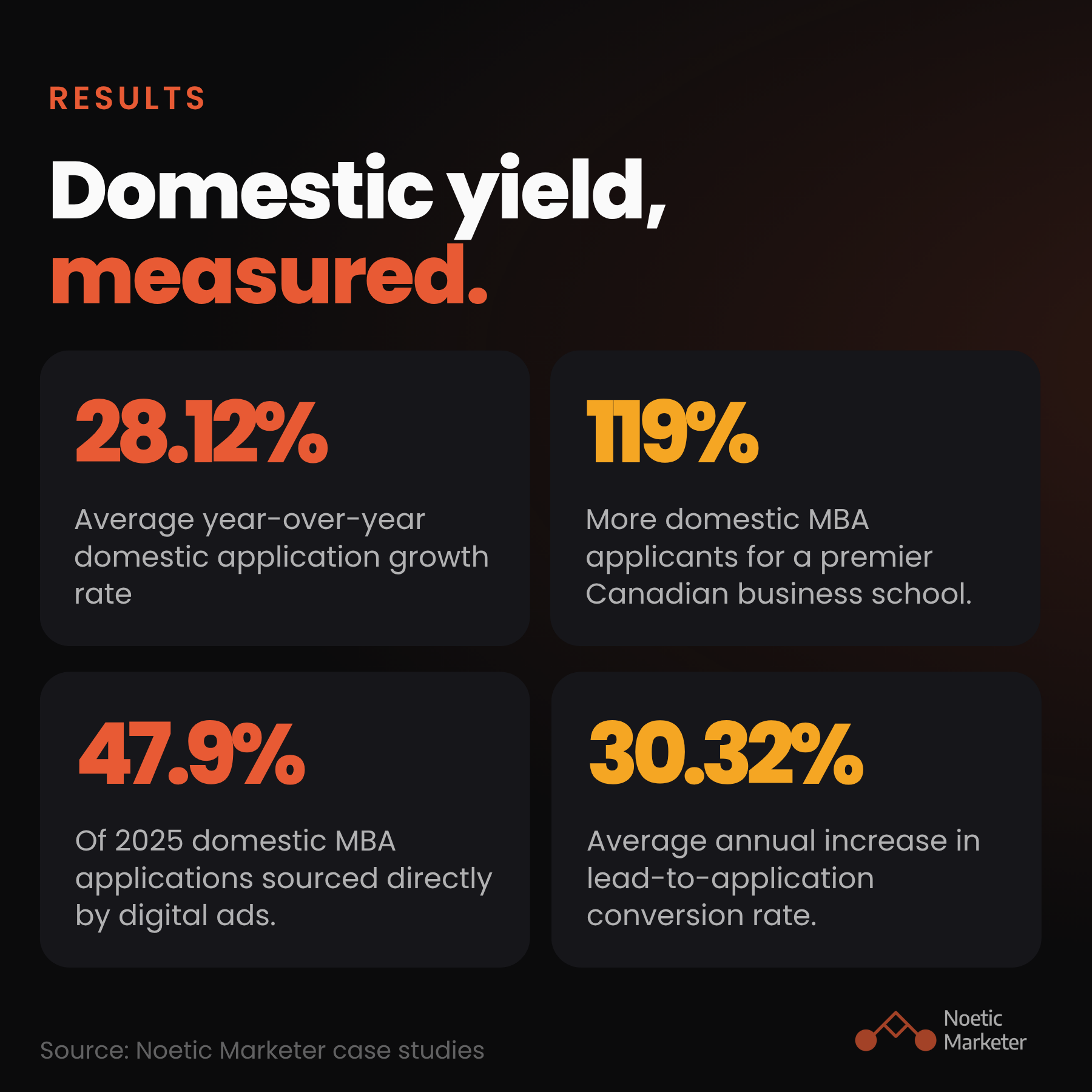
An Alberta-based university business school more than doubled its domestic applications in four months by running a precision digital advertising campaign managed by Noetic Marketer that framed graduate certificates as flexible entry points that ladder directly into full master's degrees.
With a compressed four-month timeline before application deadlines, Noetic Marketer built a complete lead-generation funnel targeting working healthcare professionals in Calgary.
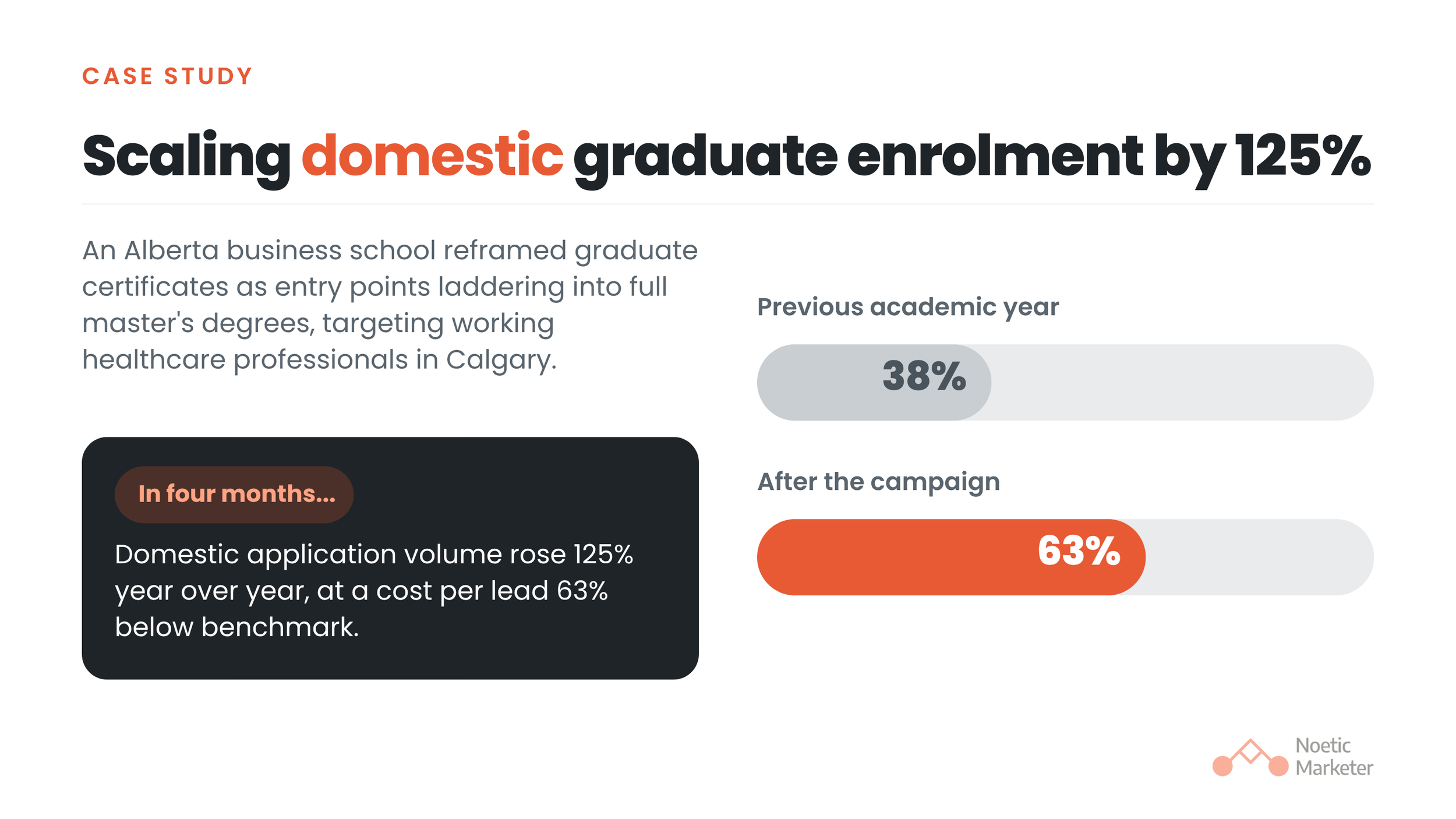
The campaign paired persona-driven ad creative across Meta, LinkedIn, and Google Ads with a high-converting landing page and an automated 10-part email nurture workflow.
Explore Noetic Marketer's work and review the Alberta-based university business school case study to see how full-funnel strategy drives measurable recruitment outcomes.
How did a premier Canadian business school achieve a 119% increase in domestic MBA applicants?
A premier Canadian business school achieved a 119% increase in domestic MBA applicants by partnering with Noetic Marketer to deploy bilingual, full-funnel customer journeys across Google, Meta, and LinkedIn.
Over a multi-year partnership, Noetic Marketer managed cross-channel strategies for both the English in-person MBA and French online MBA programs, demonstrating how paid advertising for higher education and continuous conversion rate optimization build a sustainable recruitment engine.
Read the premier Canadian business school case study for additional insights.
How did an Ontario-based university faculty drive a 325% increase in student enrolment?
An Ontario-based university faculty drove a 325% increase in student enrolment by collaborating with Noetic Marketer to execute a bilingual, purpose-driven campaign rooted in eco-social justice and community action.
To build brand awareness and drive qualified inquiries for two specialized graduate programs on a modest budget, Noetic Marketer executed performance recruitment campaigns paired with analytics across search engine optimization, Google Search, and Meta Ads.
Review the complete Ontario-based university faculty case study to see the strategic details.
Conclusion
A domestic student recruitment strategy is no longer optional for institutions absorbing the loss of international enrolment.
Universities and colleges that invest in regional demand research, fast and personalized CRM communication, authentic peer ambassador programs, and flexible credential pathways are converting more of their existing inquiry volume into enrolled students, without waiting for international cohorts to recover.
Boost your domestic student enrolment
Schedule a meeting with our education marketing experts today for a focused conversation about your enrolment goals and marketing opportunities.
Don’t miss our other posts on digital marketing for education.
How can universities build brand trust with prospective students in 2026?
How do you measure ROI in higher education marketing?
How does paid advertising drive student applications for higher education?
How do you choose the best higher education marketing agency?
Why is enrolment marketing essential for higher education institutions in 2026?
How can boarding schools create effective marketing strategies to attract students in 2026?
How do private schools approach marketing?
What does a higher education marketing agency actually do?
What is higher education marketing, and how is it different from traditional marketing?
How Can Universities Create an Effective Higher Education Marketing Budget?
What Are 11 Valuable Strategies for Recruiting International Students?
What Are 9 Proven Strategies for Marketing Higher Education to Adults?
What Makes Student Testimonials Crucial for University Recruitment Marketing?
How Can Universities Use Video Content to Boost Student Recruitment?
What Are 5 Effective Marketing Strategies for Recruiting Undergraduate Students?
How Can Universities Use AI for Marketing?
What Are the 7 Key Challenges in Higher Education Digital Marketing and How Can They Be Solved?
Key recruitment marketing terms
Domestic student recruitment strategy: A structured digital marketing and admissions roadmap designed to identify, engage, and enrol local, regional, and working adult learners within an institution's home region.
Cost-per-enrolled student (CPE): An efficiency metric calculated by dividing total recruitment marketing spend by the total number of registered, tuition-paying students.
Application yield rate: The %age of admitted prospective students who complete official registration and enrol in courses for a given academic term.
Laddered credentials: An educational structure allowing students to earn short-term certificates or diplomas that stack as direct credit toward a full bachelor's or master's degree.
Customer relationship management (CRM): Software platforms used by higher education institutions to track prospect interactions, manage admissions funnels, and deliver automated lead nurturing communications.
Dual-enrolment pathway: Programs allowing qualified high school students to enrol in college-level courses, earning high school and university credit simultaneously to build early enrolment pipelines.
Cost-per-lead (CPL): A marketing efficiency metric calculated by dividing total campaign spend by the number of qualified leads generated, used to benchmark efficiency across recruitment channels.