How do universities use social media for student recruitment?
By Morgan Northmore, Copywriter and Digital Marketing Coordinator at Noetic Marketer. Morgan specializes in developing full-funnel social media management and content marketing strategies that help higher education institutions connect with prospective undergraduate students and drive enrolment across the platforms where they spend their time.
Key takeaways:
Direct discovery channel: Prospective students often form their first impression of an institution on social media, making it a primary discovery channel rather than a supporting one.
Platform priorities: TikTok and Instagram lead recruitment-focused social media strategies for undergraduate audiences, while a Facebook page and LinkedIn remain relevant for parents, graduate applicants, and working professionals.
Content that converts: Authentic, user-generated content such as vlogs, virtual campus tours, and peer reviews consistently outperforms polished institutional advertising.
Measurable performance: Universities can track social media recruitment performance through engagement rates, website referral traffic, cost-per-lead (CPL), and application starts tied directly to specific campaign architecture.
Full funnel integration: Social media works best as part of a broader strategic enrolment planning effort rather than as a standalone tactic disconnected from the admissions department.
A prospective student today is more likely to encounter a university for the first time through a short video on TikTok or Instagram than through the institution's own homepage.
Social media usage among younger age groups has made these platforms a primary source of information, with Statistics Canada reporting that Canadians aged 15 to 24 rely on social media as their main source of news and information at more than three times the rate of Canadians 55 and older.
For postsecondary institutions, this shift changes how marketing teams approach social media for student recruitment and what recruitment efforts should prioritize.
Social media is no longer a channel that simply supports recruitment; it has become part of how prospective students form early impressions and make informed decisions about where to apply, long before they contact an admissions department.
Why is social media important to the student recruitment process?
Social media matters in student recruitment because it's where prospective students discover, research, and form early impressions of higher education institutions before engaging directly with an admissions department.
Prospective students, and often their parents, use social media platforms to evaluate campus life, social life, and academic programs well before requesting information or beginning an application. This research happens earlier and more informally than traditional methods like print viewbooks or in-person open houses, which means an institution's social channels have become part of its broader marketing communication and brand strategy.
This trust-building happens earlier than many institutions expect and connects directly to broader efforts around building brand trust with prospective students.
Because so much of the decision-making process now happens on social channels, institutions that treat social media as an afterthought risk losing prospective students to competitors who show up consistently and authentically in those same spaces.
How does social media influence prospective students during early program discovery?
Social media influences prospective students during early program discovery by providing unscripted, peer-to-peer visual proof of academic quality, campus culture, and career outcomes.
When prospective applicants see organic posts from current students or targeted ad campaigns that answer their specific program questions, it demystifies the enrolment process. It accelerates their journey from initial curiosity to formal inquiry.
Why must universities prioritize digital social channels over traditional viewbooks?
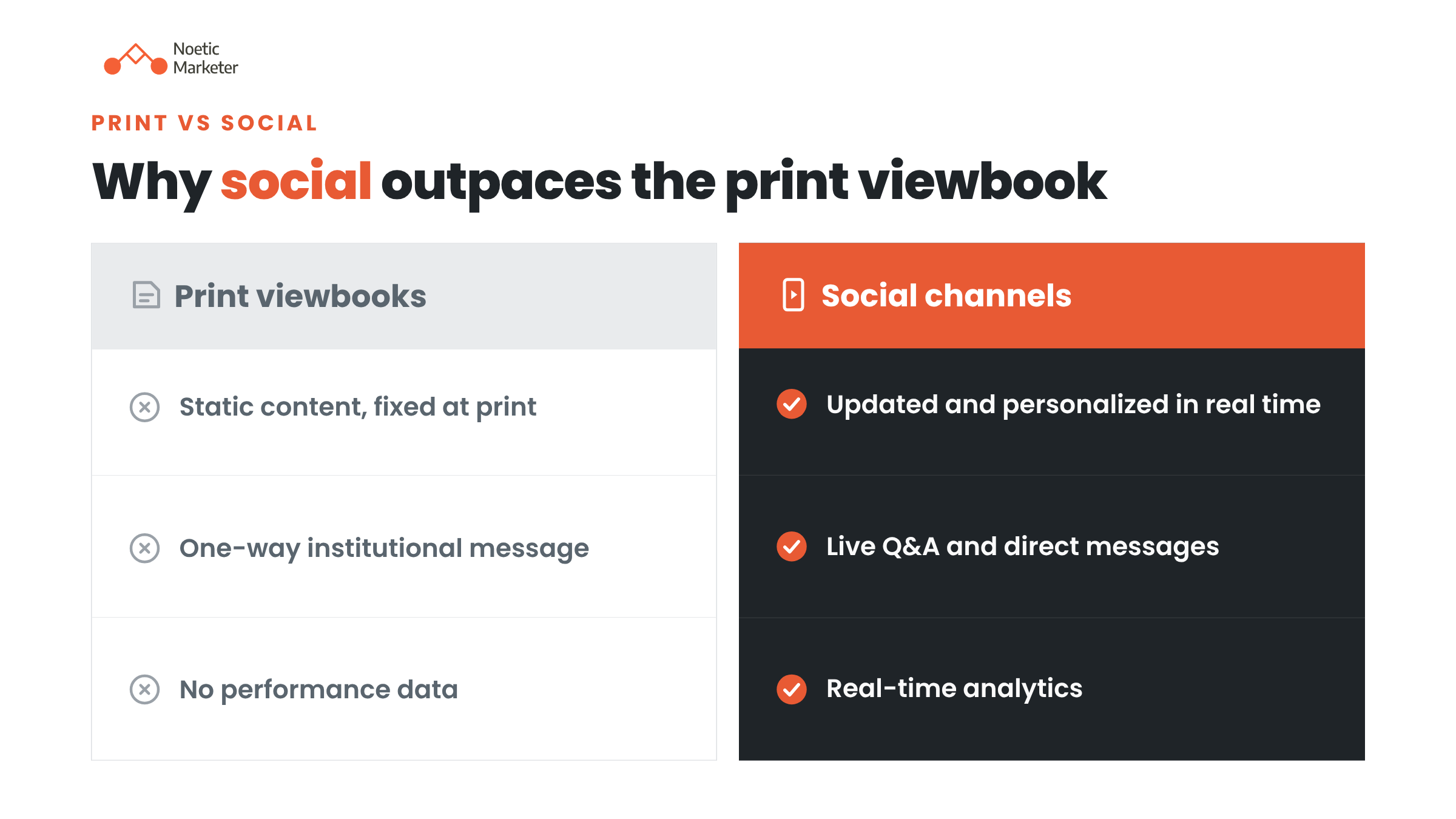
Universities must prioritize digital social channels over traditional viewbooks because prospective students spend significantly more time on interactive digital platforms where content can be updated dynamically and personalized in real time.
Unlike static print materials, social media lets admissions offices run interactive Q&A sessions, send automated direct messages, and collect real-time analytics to refine ongoing recruitment campaigns.
Which social media platforms do universities use most to recruit prospective students?
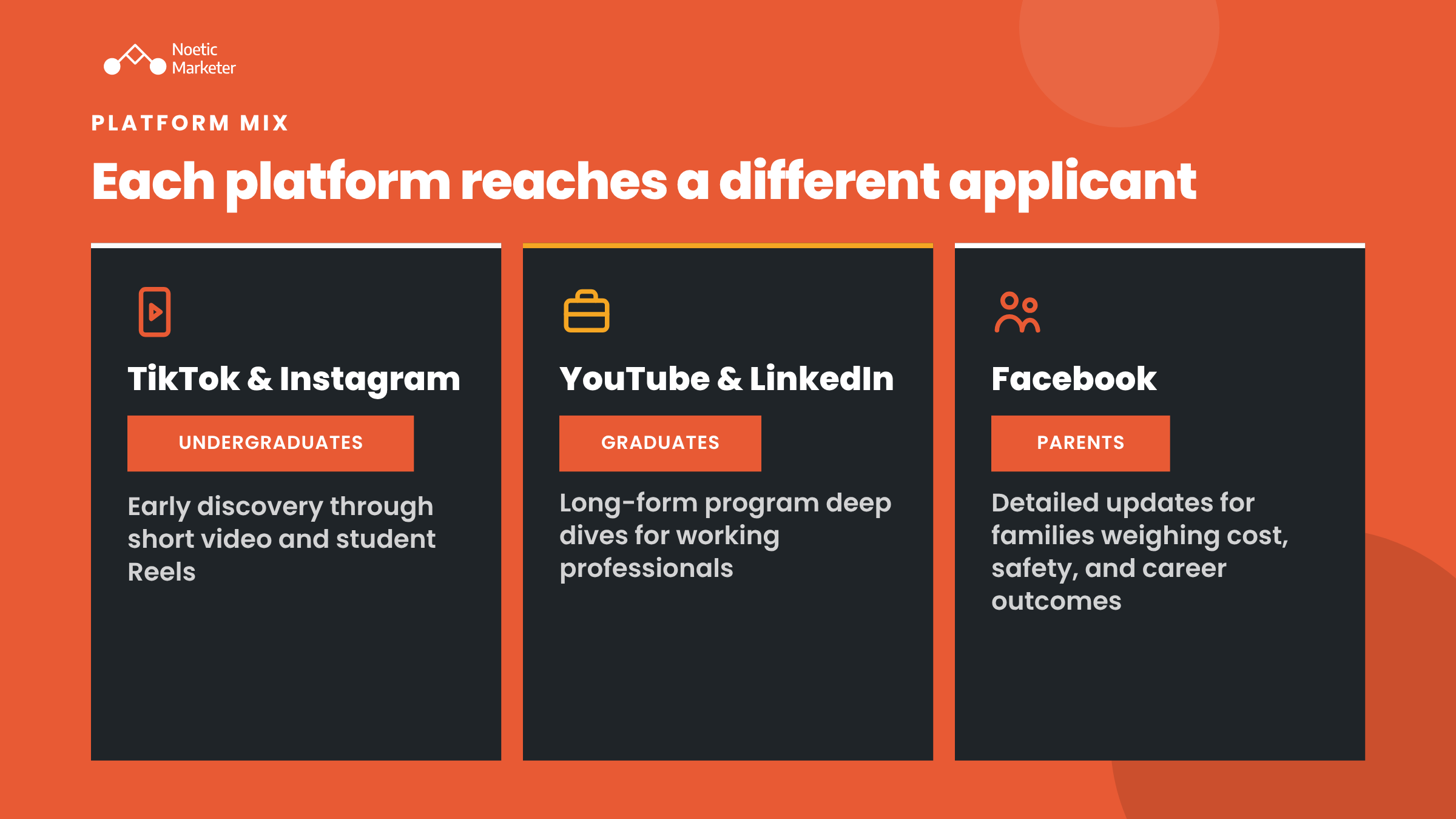
Universities primarily use TikTok, Instagram, and YouTube to reach prospective students, while a Facebook page and LinkedIn remain more relevant for reaching parents, graduate applicants, and professional audiences.
Each platform plays a different role in helping institutions engage prospective students throughout the recruitment process.
Short-form video platforms tend to reach prospective students earlier in their research, while more established social media sites like Facebook continue to reach family members and other applicant groups.
Most universities now run a coordinated presence across several social media channels rather than relying on a single platform.
How do universities use TikTok to recruit prospective students?
Universities use TikTok to recruit prospective students by publishing short, informal videos about application deadlines, program highlights, and everyday campus life directly from their admissions offices.
Toronto Metropolitan University's admissions TikTok account demonstrates this approach in practice, using the platform to share application deadline reminders, program comparisons, and decision release updates aimed directly at prospective and admitted students.
This kind of content works because it mirrors the format prospective students already use to research everything else, rather than asking them to seek out a separate, more formal source of information.
How do universities use Instagram to recruit prospective students?
Universities use Instagram to recruit prospective students by combining polished brand photography and institutional brand-building content with more casual Reels and Stories that show authentic student life.
For example, according to UConn University Communications, the university heavily leverages multimedia and short-form video to reach hundreds of thousands of viewers, contributing to a massive audience of more than 700,000 followers across its five official institutional accounts.
Instagram's mix of permanent posts and temporary Stories also allows admissions departments to run ongoing content, such as student takeovers and live virtual tours, without needing every piece of content to be highly produced.
Is a Facebook page still useful for university recruitment?
A Facebook page remains useful for university recruitment primarily as a channel to reach parents and other family members who influence a student's final enrolment decision, rather than as a primary channel for reaching prospective students directly.
Since parents often compare career prospects, cost, and program details, a well-maintained Facebook page gives institutions a place to share more detailed, longer-form updates that complement the shorter content aimed at prospective students on other platforms.
How can universities leverage YouTube and LinkedIn for graduate student recruitment?
Universities can leverage YouTube and LinkedIn for graduate student recruitment by publishing long-form program deep dives, alumni success stories, and career outcome breakdowns tailored to working professionals.
LinkedIn lets admissions teams target specific audiences by job title and career stage.
At the same time, YouTube serves as an enduring search engine for high-intent applicants seeking detailed program overviews and virtual campus facility tours.
What kind of social media content helps universities attract prospective students?
The social media content that most effectively helps universities attract prospective students is authentic and created or narrated by current students, rather than traditional media advertising.
How does student-generated content improve recruitment performance?
Student-generated content improves recruitment performance because it feels more credible than institutional messaging, giving prospective students a realistic sense of student life rather than a curated marketing narrative.
Student vlogs, day-in-the-life videos, and alumni success stories consistently perform well because they answer the questions prospective students actually have about campus life, workload, and career prospects after graduation.
Peer reviews and peer recommendations from other students carry similar weight.
Noetic Marketer has written previously about the role student testimonials play in university recruitment marketing, and the same principle applies directly to social media, where a short, honest comment from a current student often outperforms a professionally produced advertisement.
Many institutions now invite current students to create content themselves, rather than relying solely on their own marketing communication team.
How do virtual campus tours support recruitment through social media?
Virtual campus tours support recruitment through social media by giving prospective students, including international students and first-generation students who may not be able to visit in person, a realistic view of the campus before they apply.
Sharing virtual tours as short-form video content on Instagram or TikTok, rather than only as a standalone page on the university website, meets prospective students where they are already spending their time researching.
How do behind-the-scenes vlogs and student takeovers drive engagement?
Behind-the-scenes vlogs and student takeovers drive engagement by offering an unedited, relatable look at daily academic schedules, residence dining, and extracurricular clubs directly through the eyes of current peers.
This peer-led storytelling builds emotional resonance, encourages comment section dialogue, and helps prospective applicants visualize themselves thriving on campus.
How can universities tailor social media content for different applicant groups?
Universities tailor social media content for different applicant groups by adjusting both the platform and the message to match what each target audience values most in the decision-making process.
For example, International students often respond to content that addresses visa support, arrival logistics, and campus community. First-generation students tend to engage more with content that walks through the application process and financial aid in plain language. Parents generally respond best to content focused on career prospects, safety, and return on investment.
Reaching the right students with the right message on the right social media platform separates a coordinated domestic student recruitment strategy from a collection of disconnected social media posts.
How should social media messaging differ between undergraduate and graduate applicants?
Social media messaging for undergraduate applicants should focus on campus community, social fit, and identity. For graduate professionals, messaging should emphasize return on investment (ROI), faculty expertise, schedule flexibility, and career advancement.
Undergraduate campaigns thrive on visual, peer-driven platforms like TikTok and Instagram, while graduate recruitment converts better through digital advertising campaigns and detailed YouTube info sessions.
What social media strategies work best for international student recruitment?
Social media strategies work best for international student recruitment when they include multilingual content, clear guidance on study permits and Post-Graduation Work Permits (PGWP), and live Q&A webinars that address cultural transition and housing support.
Highlighting international student ambassadors and cultural student associations on social channels helps build global trust and reduces hesitation due to distance.
How can universities use social media to build trust with parents and guardians?
Universities can build trust with parents and guardians by maintaining transparent communication on Facebook and LinkedIn about tuition values, campus security measures, and graduate employment rates.
Hosting dedicated parent Q&A live streams and sharing alumni success stories reassures families that their financial investment supports a safe environment and a strong career foundation.
How has Noetic Marketer helped higher education partners strengthen social media recruitment?
Noetic Marketer has helped higher education partners strengthen recruitment outcomes by integrating social media into a broader, full-funnel enrolment marketing strategy rather than treating it as an isolated tactic.
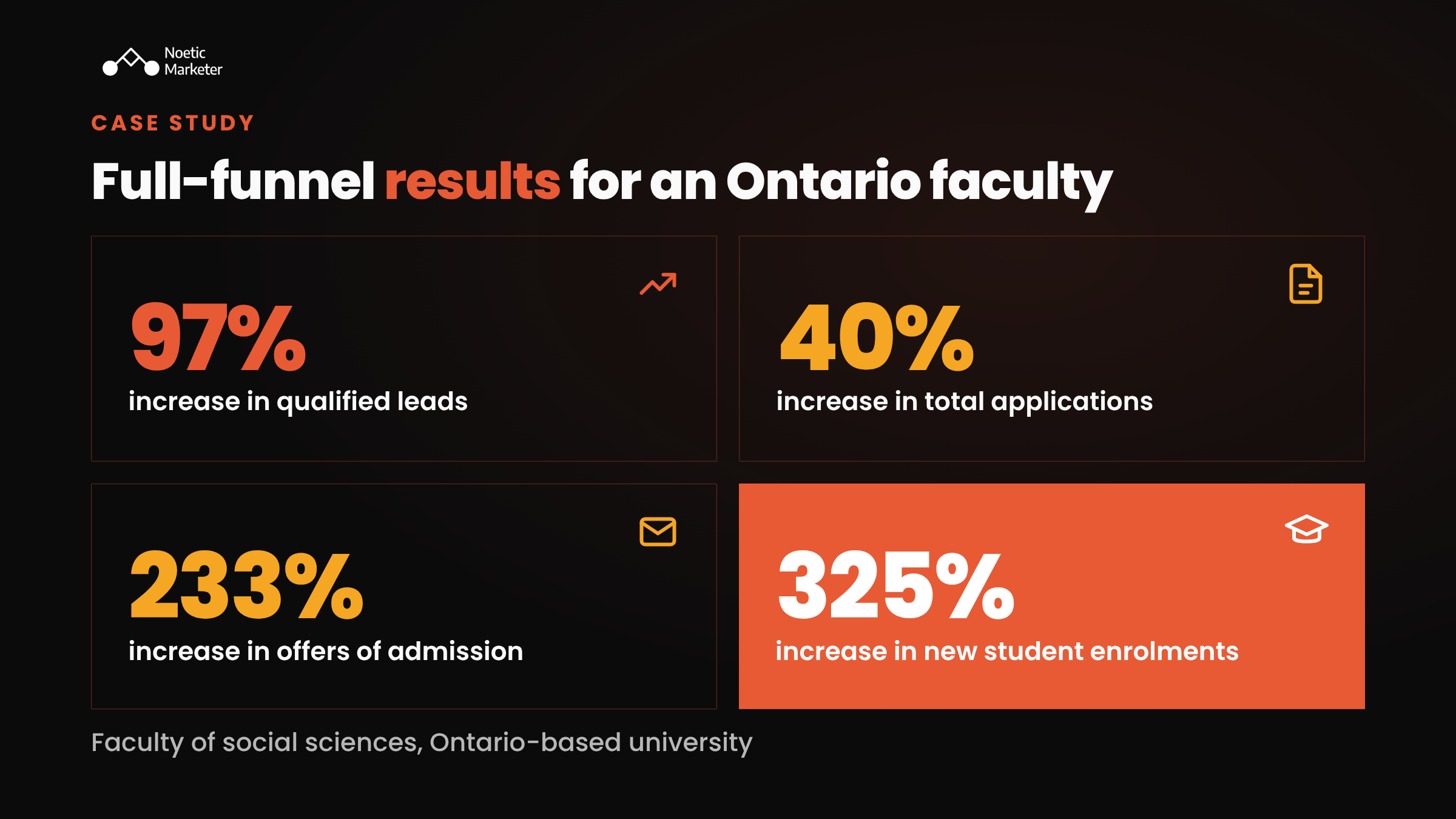
For example, Noetic Marketer partnered with a faculty of social sciences at an Ontario-based university to implement a full-funnel digital strategy that included social media alongside other recruitment channels. That partnership resulted in a 97% increase in qualified leads, a 40% increase in total applications, a 233% increase in offers of admission, and a 325% increase in new student enrolments.
Similarly, in a multi-year partnership with a premier business school, Noetic Marketer deployed cross-channel social and search campaigns that drove a 119% increase in total domestic MBA applications, with ad-promoted channels sourcing 47.92% of all domestic applications in 2025.
This kind of result reflects what happens when social media advertising and recruitment channels are coordinated with the rest of an institution's overall strategy, rather than managed separately from admissions goals.
How should universities measure the performance of a social media recruitment strategy?
Universities should measure the performance of a social media recruitment strategy by tracking a combination of on-platform engagement and off-platform actions that connect back to the admissions funnel.
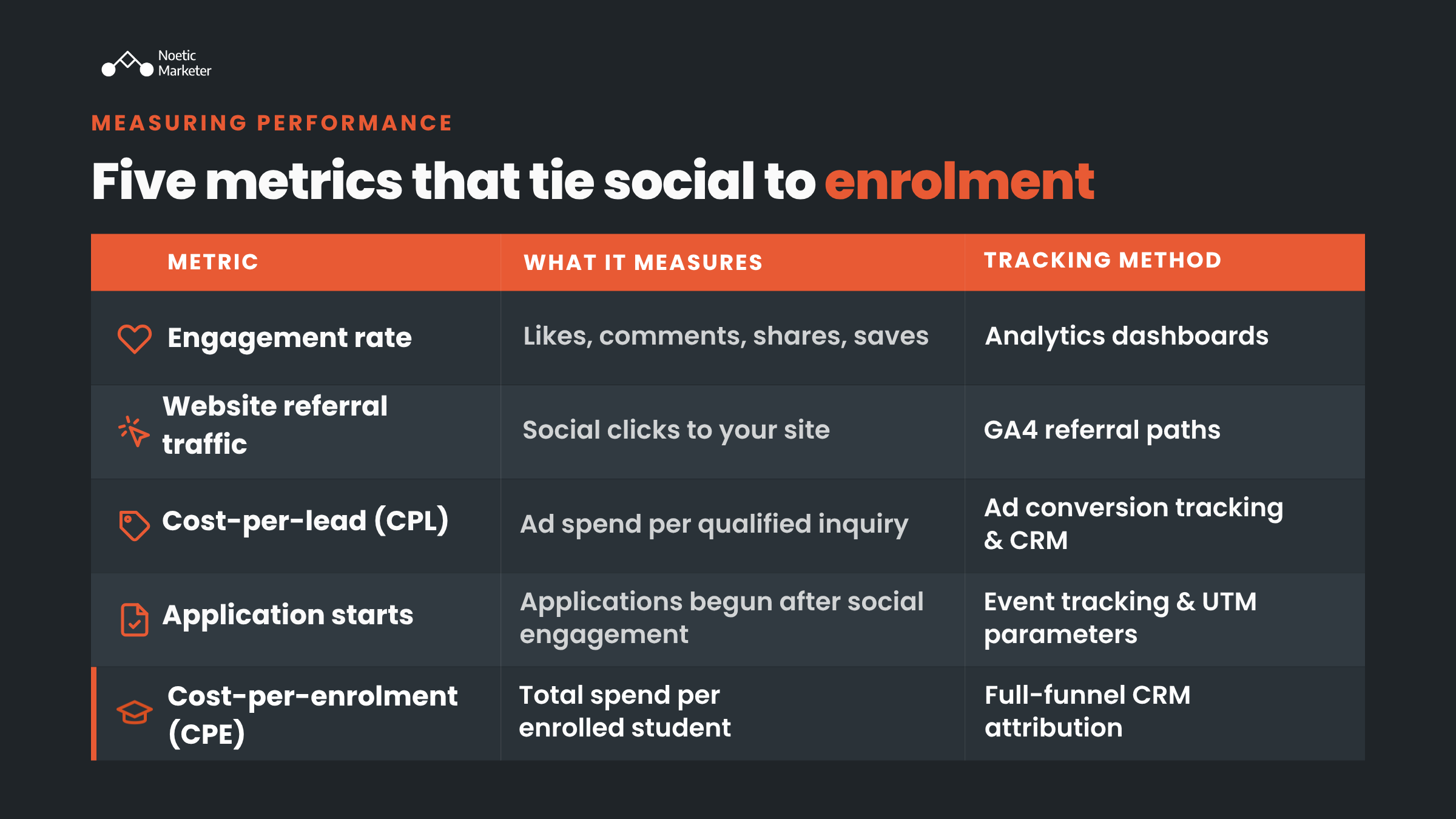
Tracking these metrics together gives institutions a clearer picture of recruitment performance than engagement numbers alone, since a highly engaging post that never drives website traffic or application activity has limited value for enrolment goals.
Noetic Marketer's guide on measuring return on investment in higher education marketing covers this kind of full-funnel measurement in more depth.
What are the most critical KPIs for evaluating full-funnel social media recruitment?
The most critical KPIs for evaluating full-funnel social media recruitment are qualified lead conversion rate, cost per application (CPA), application completion rate, and cost per enrolment (CPE).
While top-of-funnel metrics like impressions and video views measure brand awareness, bottom-of-funnel financial metrics ensure ad spend directly translates into net tuition revenue and filled cohort seats.
Conclusion
Social media has become one of the first places prospective students encounter a higher education institution, which makes it a core part of the recruitment process rather than a secondary marketing activity.
Universities that prioritize authentic, student-driven content, choose platforms based on where specific applicant groups spend their time, and connect social media performance back to admissions outcomes are best positioned to recruit prospective students effectively in the current environment.
Reach more prospective students.
Ready to elevate your university's recruitment outcomes? Schedule a meeting with our education marketing experts today for a focused conversation about your enrolment goals and marketing opportunities.
Don’t miss our other posts on digital marketing for education.
How can universities build an effective domestic student recruitment strategy in 2026?
How can universities build brand trust with prospective students in 2026?
How do you measure ROI in higher education marketing?
How does paid advertising drive student applications for higher education?
How do you choose the best higher education marketing agency?
Why is enrolment marketing essential for higher education institutions in 2026?
How can boarding schools create effective marketing strategies to attract students in 2026?
How do private schools approach marketing?
What does a higher education marketing agency actually do?
What is higher education marketing, and how is it different from traditional marketing?
How Can Universities Create an Effective Higher Education Marketing Budget?
What Are 11 Valuable Strategies for Recruiting International Students?
What Are 9 Proven Strategies for Marketing Higher Education to Adults?
What Makes Student Testimonials Crucial for University Recruitment Marketing?
How Can Universities Use Video Content to Boost Student Recruitment?
What Are 5 Effective Marketing Strategies for Recruiting Undergraduate Students?
How Can Universities Use AI for Marketing?
What Are the 7 Key Challenges in Higher Education Digital Marketing and How Can They Be Solved?
Key terms
Engagement rate: A measure of how actively an audience interacts with social media content, typically calculated from likes, comments, shares, and saves relative to views.
User-generated content: Content created by current students or alumni, such as vlogs or reviews, rather than by an institution's own marketing team.
Virtual campus tour: A video or interactive walkthrough of a campus that allows prospective students to explore facilities and student life remotely.
Social proof: The influence that seeing other students' genuine experiences and opinions has on a prospective student's decision-making process.
UTM parameters: Tracking codes added to a URL that allow marketing teams to identify which social media platform, post, or campaign drove a specific website visit or application start.
Full funnel strategy: A marketing approach that addresses every stage of the student journey, from initial awareness on channels like social media through to final enrolment.
Cost-per-enrolment (CPE): A key financial metric calculated by dividing total recruitment marketing expenditure by the number of actual enrolled students.
Generative Engine Optimization (GEO): The practice of structuring and optimizing web content so generative AI models (such as Gemini and ChatGPT) can easily parse, synthesize, and cite it in AI-generated search overviews.
Answer Engine Optimization (AEO): The process of optimizing content to directly answer specific user search queries in concise formats suitable for featured snippets and conversational AI assistants.
Post-Graduation Work Permit (PGWP): A document issued by Canadian immigration authorities that allows eligible international graduates to gain valuable Canadian work experience after completing their studies.