How do career colleges approach marketing?
By Morgan Northmore, Copywriter and Digital Marketing Coordinator at Noetic Marketer. Morgan specializes in crafting digital content and marketing strategies that help career colleges and vocational education providers connect with prospective students and build a full-funnel path to enrolment.
Key takeaways:
Shorter decision cycles: Career college marketing differs from traditional higher education marketing because prospective students move through a shorter decision cycle and prioritize job opportunities and career outcomes over campus experience.
Regulatory compliance: In Ontario, career college marketing operates under the Ontario Career Colleges Act, 2005, which restricts guaranteed employment claims and requires verifiable statistics and registration disclosures in every advertisement.
Performance-driven strategy: Digital marketing strategies built around local SEO, performance-driven paid media, and program-specific landing pages tend to generate stronger lead generation results for career colleges than broad brand campaigns.
Evidence-based messaging: Current labour market data on skills-based hiring and the shortage of certificate and associate-level credentials gives career colleges a strong, evidence-based case to build marketing campaigns around.
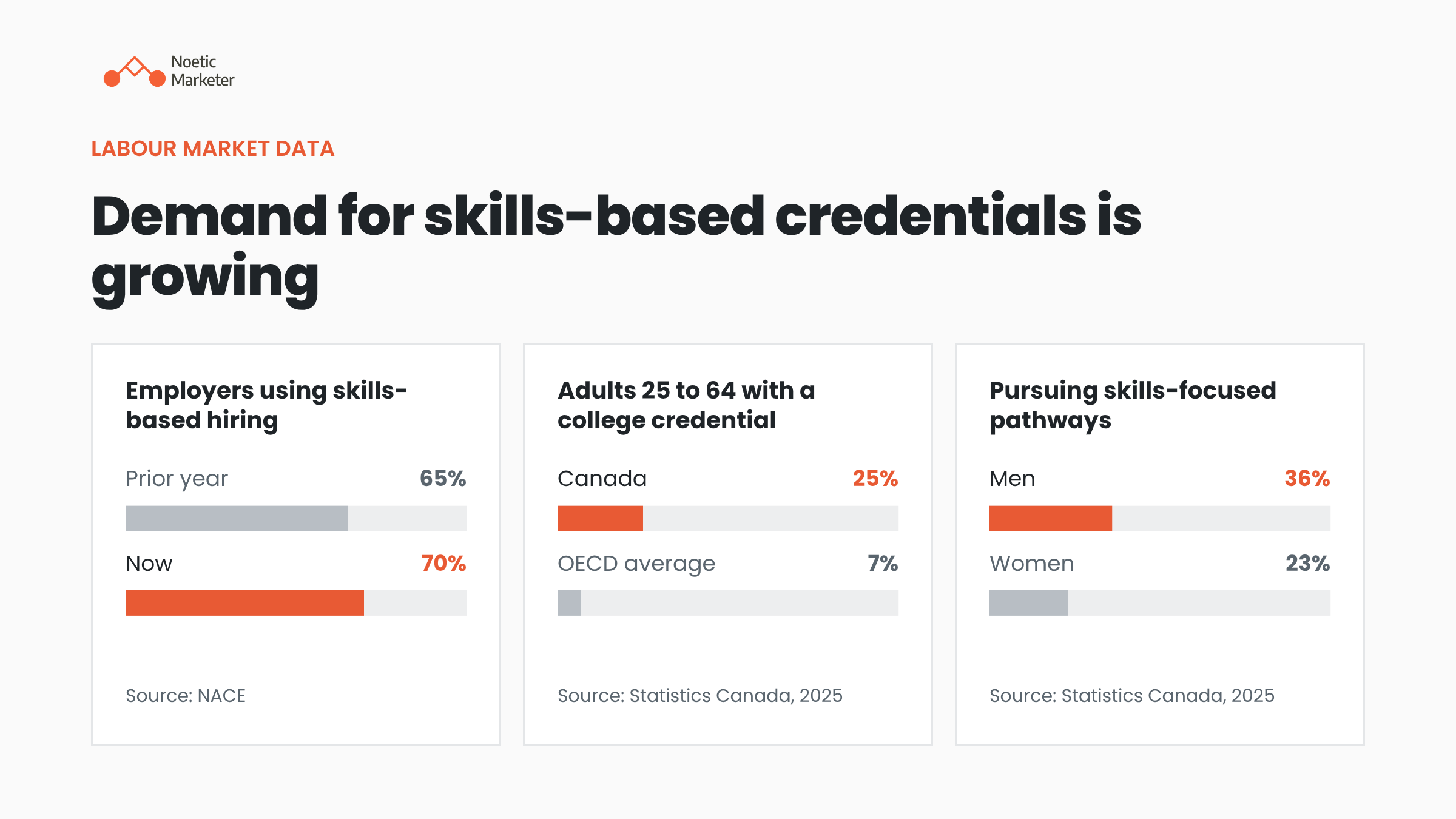
70% of employers now use skills-based hiring to fill entry-level roles, up from 65% the year before, according to the National Association of Colleges and Employers.
For career colleges, that shift is an opening. A labour market that increasingly hires for demonstrated skills over degree pedigree is exactly the market vocational education was built for.
Career college marketing must communicate that value quickly and credibly, within a shorter decision window than a university faces and, in provinces like Ontario, under a stricter regulatory framework than most degree-granting institutions encounter.
This guide explains how career colleges approach marketing, what makes their strategy different from a university's, and how Noetic Marketer has applied that approach to grow enrolment for a real career college client.
What is career college marketing?
Career college marketing is the set of strategies career colleges and vocational schools use to recruit students into diploma and certificate programs, built around short decision cycles, verifiable employment outcomes, and, in Ontario, compliance with the Ontario Career Colleges Act, 2005.
A career college is a privately owned, provincially regulated institution that offers vocational programs, focused, job-specific training designed to prepare students for a single career path in a fixed, usually short, timeframe.
That distinction shapes everything about how career colleges market themselves. Where a university markets an academic experience, a career college markets an outcome: a specific job opportunity at the end of a specific program.
Why does career college marketing differ from traditional higher education marketing?
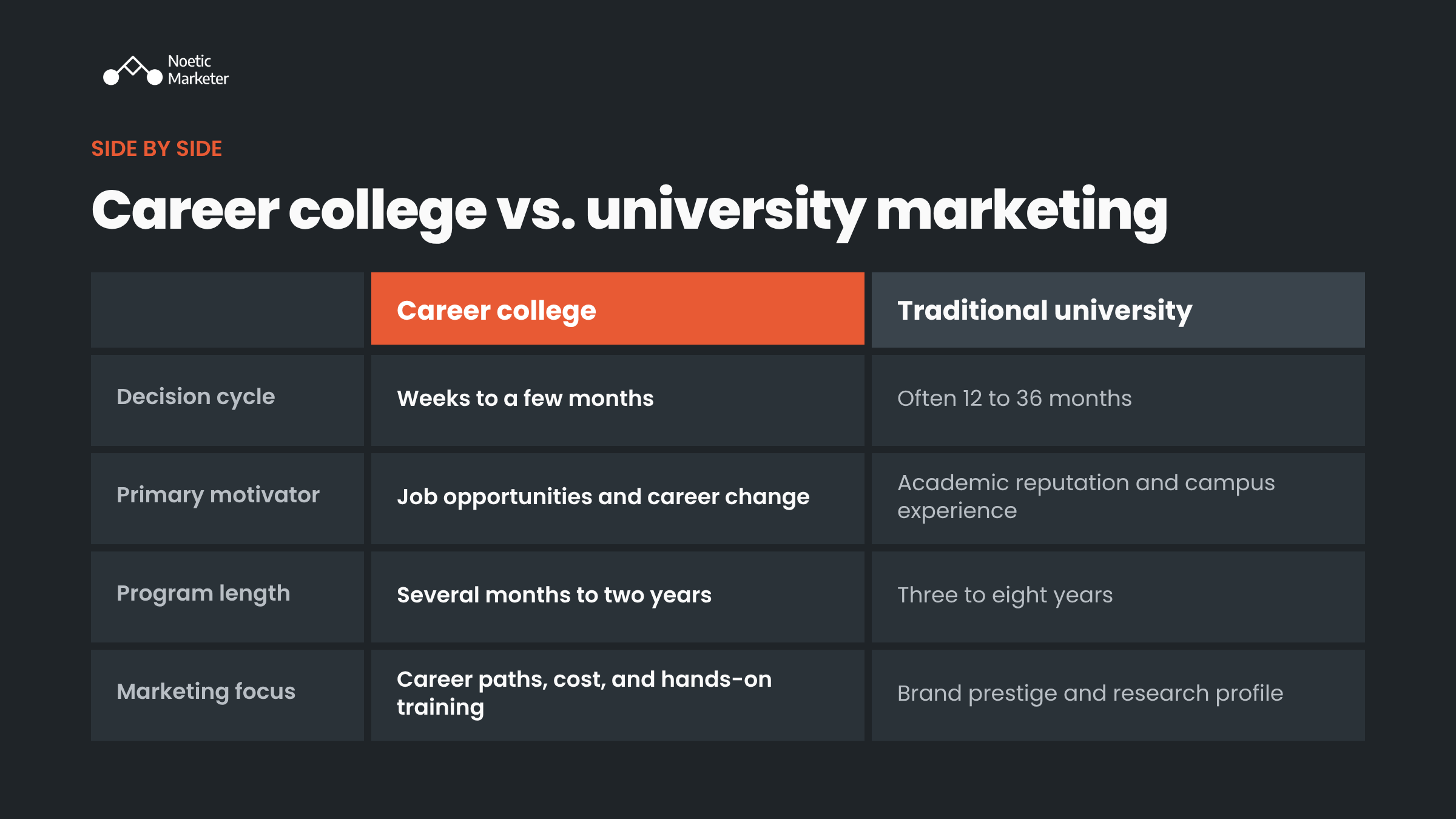
Career college marketing differs from traditional higher education marketing because prospective students move through a much shorter decision cycle and evaluate programs primarily on cost, timeline, and job outcomes rather than campus life or academic prestige.
Who are typical career college students?
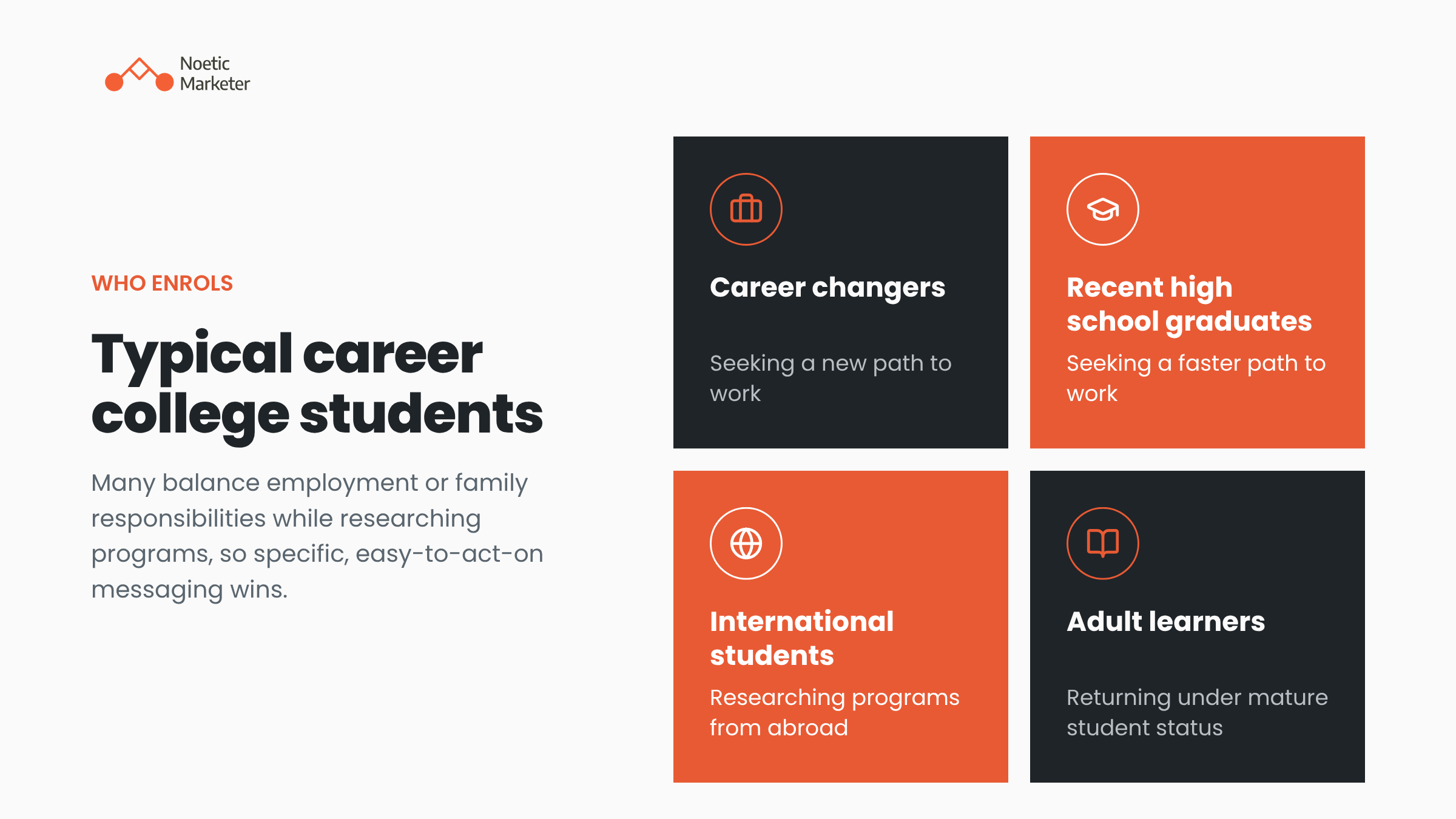
Typical career college students include career changers, recent high school graduates seeking a faster path to work, international students, and adult learners returning to school under mature student status. Many balance employment or family responsibilities while researching programs, so specific, easy-to-act-on messaging tends to outperform broad brand storytelling.
Mature student status matters here in particular. It is the admissions category many career colleges use to admit adult applicants who do not hold a high school diploma but meet a minimum age and can demonstrate readiness for the program. It is often the deciding factor in whether a career-changing adult applies.
What role does the Ontario Career Colleges Act play in career college marketing?
The Ontario Career Colleges Act, 2005 shapes career college marketing by setting strict rules on what a career college can claim in an advertisement and requiring specific disclosures before any ad can run.
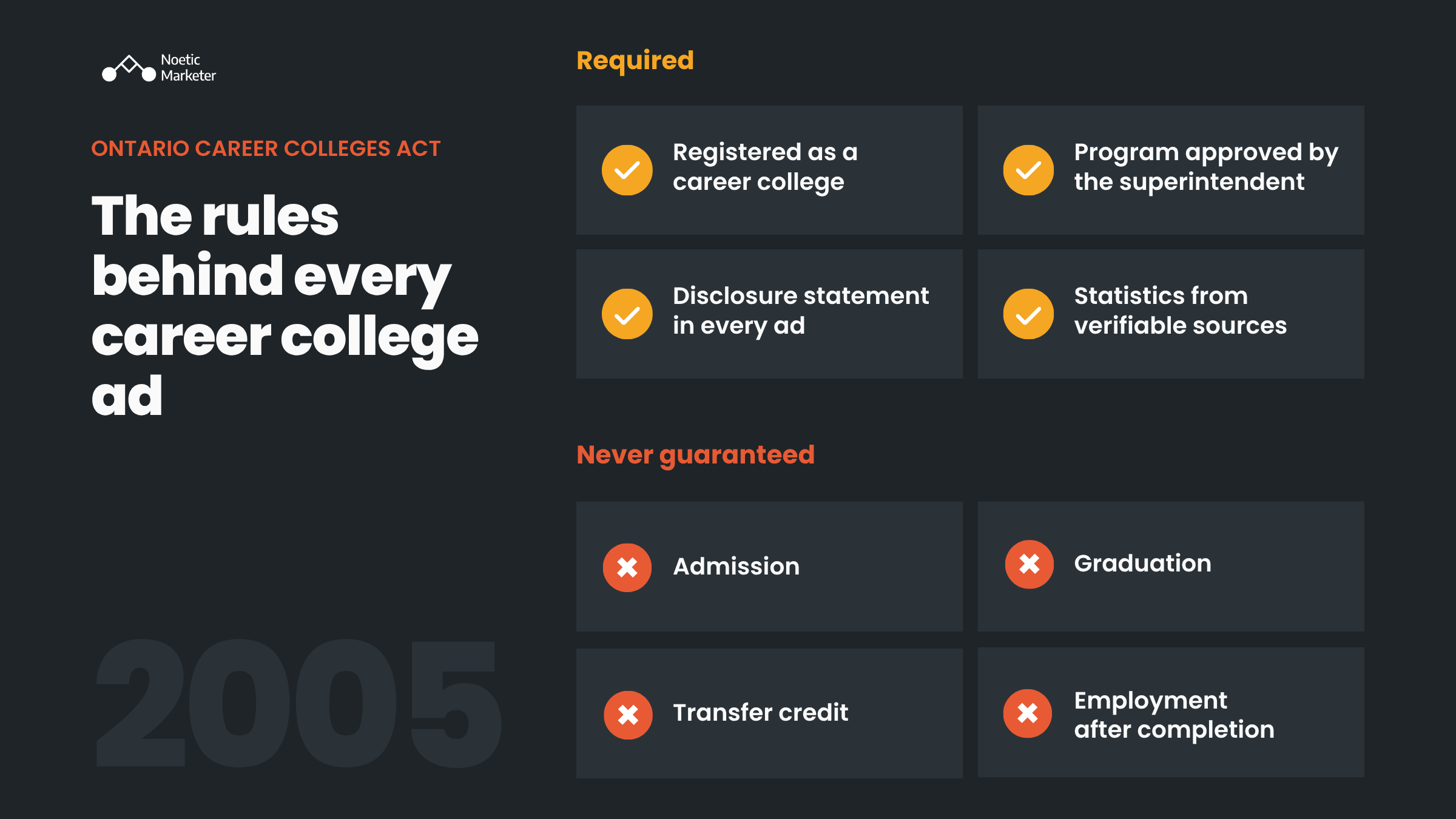
Under the Act and its regulations, as outlined by the Government of Ontario's advertising rules for career colleges, an Ontario career college cannot advertise a vocational program until it is registered and the superintendent has approved the program. Every ad must carry the correct disclosure statement, confirming that the institution is registered as a career college under the Ontario Career Colleges Act, 2005.
Career colleges are also prohibited from guaranteeing admission, graduation, employment after completion, or transfer credit, and any statistics used in marketing, including job opportunities, salaries, and graduation rates, must come from verifiable sources.
For a marketing strategy, this is not just a compliance checkbox.
It means career college marketing must lead with accurate, sourced information rather than promises, which, when done well, builds more durable trust with prospective students than an unverifiable guarantee ever could.
What do prospective career college students want to know before enrolling?
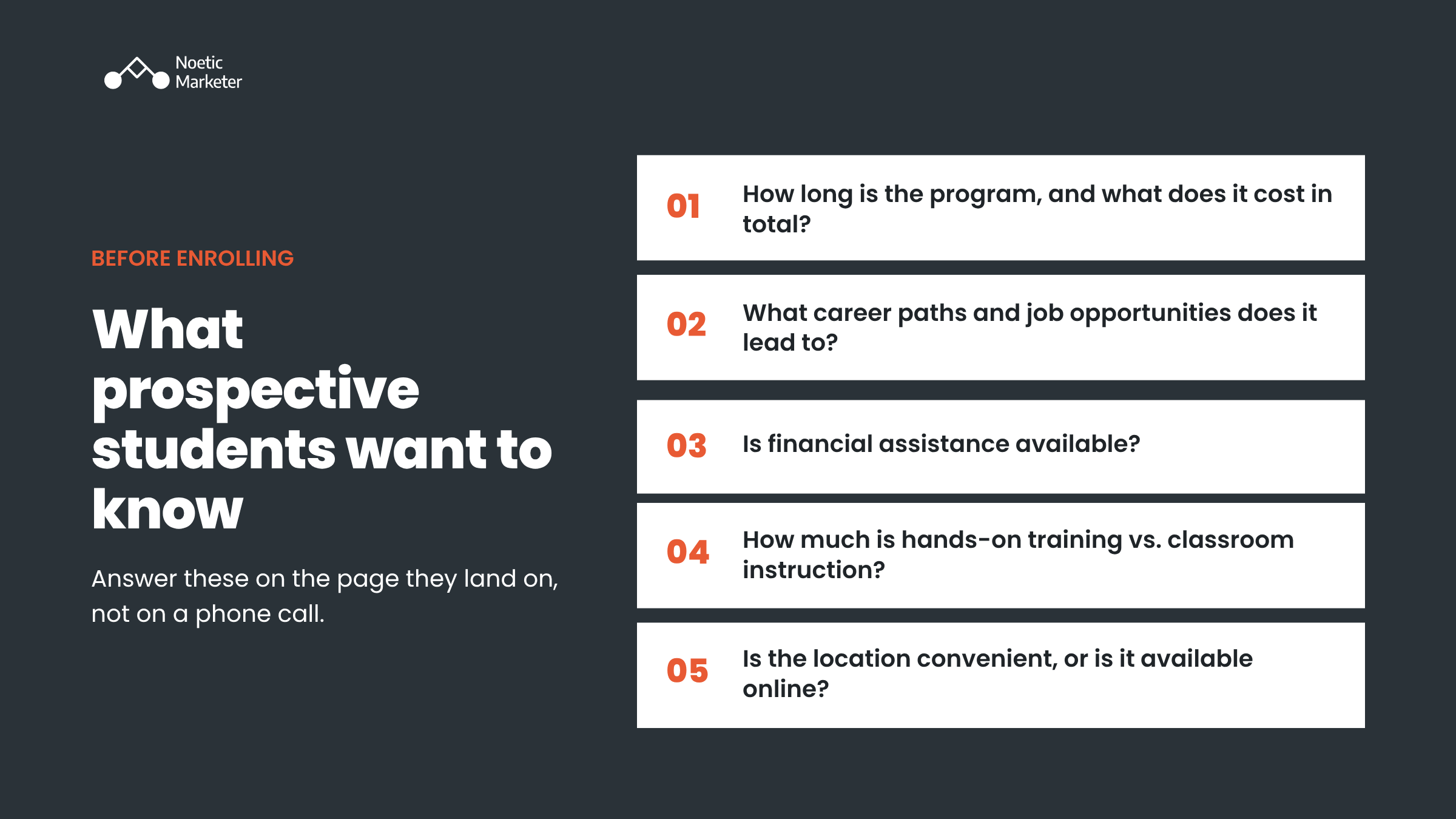
Prospective career college students want clear, upfront answers about program length and cost, the job opportunities the program leads to, whether financial assistance is available, and how much hands-on experience they will get before graduating.
How long is the diploma or certificate program, and what does it cost in total?
What career paths and job opportunities does this program lead to?
Is financial assistance, such as government student loans or payment plans, available?
How much of the program is practical, hands-on training vs. classroom instruction?
Is the diploma location convenient, or is the program available through online courses?
Career college marketing that answers these questions directly, on the page a prospective student lands on, tends to convert better than marketing that requires a phone call to get basic facts.
What types of programs do career colleges typically market?
Career colleges typically market vocational, diploma-level programs in high-demand fields such as business administration, project management, social media marketing, and public relations, each built to give students practical, job-ready skills in under two years.
Business administration: Comprehensive training in business and administrative skills, giving students a solid foundation in bookkeeping, office software such as Microsoft Word, and the key concepts behind day-to-day business operations.
Project management: A hands-on, experience-driven program that teaches students to plan timelines, coordinate teams, and manage the practical skills needed to deliver projects across various industries.
Social media manager and digital marketing: Training in content creation, online platforms, and digital marketing fundamentals, with an emphasis on staying current with trends in how businesses reach audiences online.
Public relations: A program built around communications strategy, market research, and the skills needed to manage a brand's public-facing reputation.
Marketing these programs well means treating each one as its own small business growth story: a distinct target audience, a distinct set of career opportunities, and a distinct reason a prospective student should choose this program over a competing diploma.
What marketing channels and strategies work best for career colleges?
Performance-driven paid search and social advertising, hyperlocal and program-specific SEO, and streamlined lead generation typically outperform broad brand-awareness campaigns for career colleges, because the goal is to convert a decisive, outcome-focused learner quickly.
How important is local and program-specific SEO for career colleges?
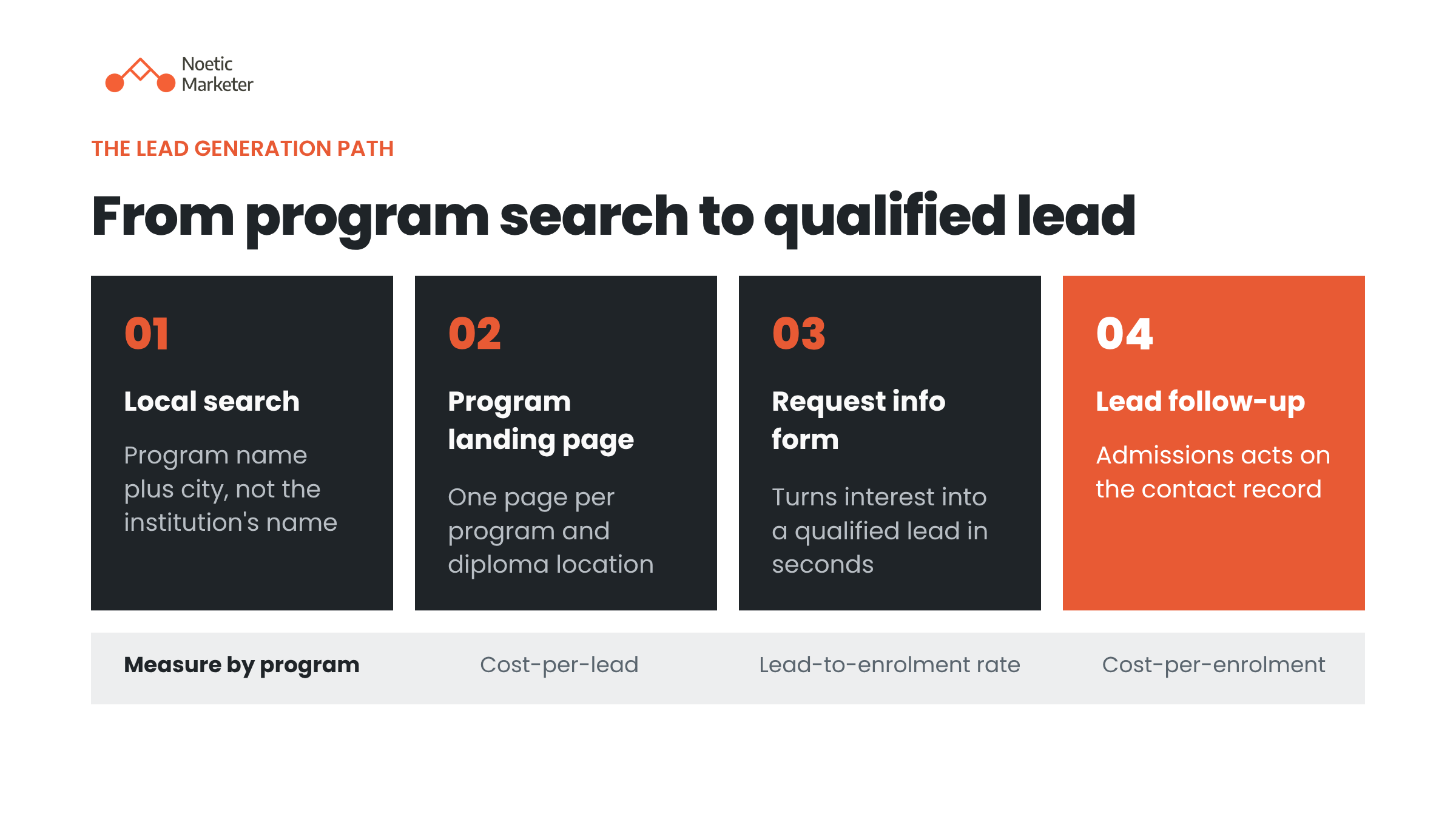
Local and program-specific SEO is critical for career colleges because most prospective students search using a program name and a location, such as business administration diploma plus their city, rather than searching for the institution by name.
A dedicated landing page for each program and diploma location, built around the language a target audience actually searches, consistently outperforms a single general admissions page.
What role does paid media and lead generation play in career college recruitment?
Paid media and lead generation play a direct role in career college recruitment by putting program-specific offers in front of high-intent searchers and converting that interest into a contact record the admissions team can follow up on.
A simple, low-friction request info form on every program landing page is usually the single most effective piece of online marketing a career college can run, since it turns interest into a qualified lead in seconds rather than requiring a phone call.
Noetic Marketer's performance recruitment campaigns and localized SEO, built around program-specific search intent, follow this principle: meet a decisive learner with the specific answer they are searching for, then make it effortless to request more information.
How has Noetic Marketer helped a career college grow enrolment?
A performance strategy for Alpha Career College resulted in a 919% improvement in conversion rates, a 30% reduction in cost-per-lead, and a 53% increase in applications from 2022 to 2024.
That result came from applying the same principles outlined above: program-specific landing pages built around what each diploma actually leads to, continuous messaging testing, and a request info form designed to remove friction rather than add it.
Rather than one large change, the gains came from a culture of ongoing, incremental optimization across landing pages, messaging, and lead follow-up, sustained even as competition in the career college marketing space increased.
Why do employment outcomes and skills-based hiring matter in career college marketing?
Employment outcomes matter more than ever in career college marketing because current labour market data shows a growing gap between the workers employers need and the number of credentialed graduates available to fill those roles.
According to Statistics Canada, 25% of Canadians aged 25 to 64 held a college credential in 2025, more than triple the OECD average of 7%, and men in particular are pursuing skills-focused pathways leading directly into the labour market at a rate of 36%, compared with 23% of women.
At the same time, Georgetown University's Center on Education and the Workforce found an annual shortage of nearly 712,000 certificates and associate's degrees needed to meet employer demand in high-paying middle-skills occupations through 2032.
For career colleges, this data supports a marketing message that doesn't need to be inflated to be compelling: real, sourced demand exists for the credentials career colleges grant across industries and career paths, and that demand is only growing.
How can career colleges measure marketing success?
Career colleges measure marketing success primarily through cost-per-lead, lead-to-enrolment conversion rate, and cost-per-enrolment, tracked by program and by channel rather than as a single institution-wide average.
Because different programs attract different target audiences at different costs, treating key performance indicators at the program level, rather than blending them, is what allows a career college's marketing and business development teams to see which diplomas are worth additional investment.
Ongoing market research, paired with these KPIs, is what turns a marketing budget from a fixed cost into a tool for measurable business growth.
What should career colleges look for in a marketing partner?
Career colleges should look for a marketing partner with direct experience in career and skills-based education, a track record of measurable enrolment results, and fluency in the compliance requirements that govern career college advertising in their province.
A partner that understands career and skills-based education specifically, rather than applying a generic higher education playbook, will build campaigns around the realities covered in this guide: short decision cycles, verifiable outcomes, and program-specific offers, all within the rules set by the Ontario Career Colleges Act, 2005, or the equivalent framework in other provinces.
For more on how these principles apply across related sectors, see how private schools approach their own recruitment marketing, how charter schools build compliance-safe marketing, and how boarding schools create effective marketing strategies.
Conclusion
Career college marketing succeeds when it moves at the pace its students need: fast, specific, and honest about outcomes.
The institutions that do this well treat every program as its own small business growth story, back their marketing with verifiable data rather than guarantees, and build digital experiences, from search results to the request info form, that respect how little time a decisive, outcome-focused learner has to spend researching.
That combination, not a bigger brand campaign, is what turns interest into enrolment.
Grow your career college's enrolment.
Schedule a meeting with a Noetic Marketer strategist for a focused, mission-led conversation about your enrolment goals and marketing opportunities.
Don’t miss our other posts on digital marketing for education.
How do universities use social media for student recruitment?
How can universities build brand trust with prospective students in 2026?
How do you measure ROI in higher education marketing?
How does paid advertising drive student applications for higher education?
How do you choose the best higher education marketing agency?
Why is enrolment marketing essential for higher education institutions in 2026?
How can boarding schools create effective marketing strategies to attract students in 2026?
How do private schools approach marketing?
What does a higher education marketing agency actually do?
What is higher education marketing, and how is it different from traditional marketing?
How Can Universities Create an Effective Higher Education Marketing Budget?
What Are 11 Valuable Strategies for Recruiting International Students?
What Are 9 Proven Strategies for Marketing Higher Education to Adults?
What Makes Student Testimonials Crucial for University Recruitment Marketing?
How Can Universities Use Video Content to Boost Student Recruitment?
What Are 5 Effective Marketing Strategies for Recruiting Undergraduate Students?
How Can Universities Use AI for Marketing?
What Are the 7 Key Challenges in Higher Education Digital Marketing and How Can They Be Solved?
Key terms
Career college: A privately owned, provincially regulated institution that offers vocational programs designed to prepare students for a specific career path within a fixed, usually short, timeframe.
Vocational program: A course of study focused on the practical skills and comprehensive training needed for a specific occupation, rather than a broad academic curriculum.
Ontario Career Colleges Act, 2005: The Ontario legislation that governs the registration, program approval, and advertising rules for private career colleges operating in the province.
Mature student status: An admissions category used by many career colleges to admit adult applicants who do not hold a high school diploma but meet a minimum age requirement and can demonstrate readiness for the program.
Cost-per-lead (CPL): Total marketing spend divided by the number of leads, such as request-info form submissions, generated by a campaign.
Key performance indicator (KPI): A specific, measurable metric, such as cost-per-lead or conversion rate, used to track whether a marketing strategy is achieving its goals.