
By Jessica Josefchuk, Content Strategist & Copywriter at Noetic Marketer. Jessica helps educational institutions strengthen their online presence with custom, optimized content. She specializes in creating audience-focused content that connects institutional purpose, brand identity, and student recruitment goals to support engagement and enrolment growth.
Key takeaways:
Competitive benchmarking helps higher education institutions understand their market position and make more informed enrolment decisions.
Effective competitor analysis covers tuition and program offerings, student expectations, institutional reputation, accessibility, and recruitment experience.
The most valuable benchmarking metrics link institutional positioning to student demand, application trends, enrolment outcomes, and marketing performance.
Regular benchmarking helps institutions strengthen their competitive advantage while remaining true to their academic mission and values.
Turning competitive research into actionable insights requires collaboration between marketing, admissions, academic leadership and institutional planning teams.
Higher education and market trends are changing. Prospective students have more educational pathways to consider, from traditional degrees and online programs to professional certificates and alternative credentials.
According to Statistics Canada (2026), international student enrolments at Canadian public colleges and universities declined by 6.9% in 2024/2025, while domestic enrolments increased by 2.1%. Meanwhile, the National Student Clearinghouse Research Center (2026) reported that U.S. community college enrolment grew by 3% in fall 2025, while undergraduate enrolment at private nonprofit four-year institutions declined by 1.6%.
These differences highlight an important reality: enrolment trends don't affect every institution or program equally.
That's where competitor benchmarking becomes valuable. By understanding how comparable institutions engage and support prospective students, you can make more informed decisions about program positioning, recruitment investments, and long-term growth.
What is competitive benchmarking in strategic enrolment planning?
Competitive benchmarking compares your institution's positioning, programs, recruitment strategies, and performance against relevant educational competitors to identify opportunities for improvement.
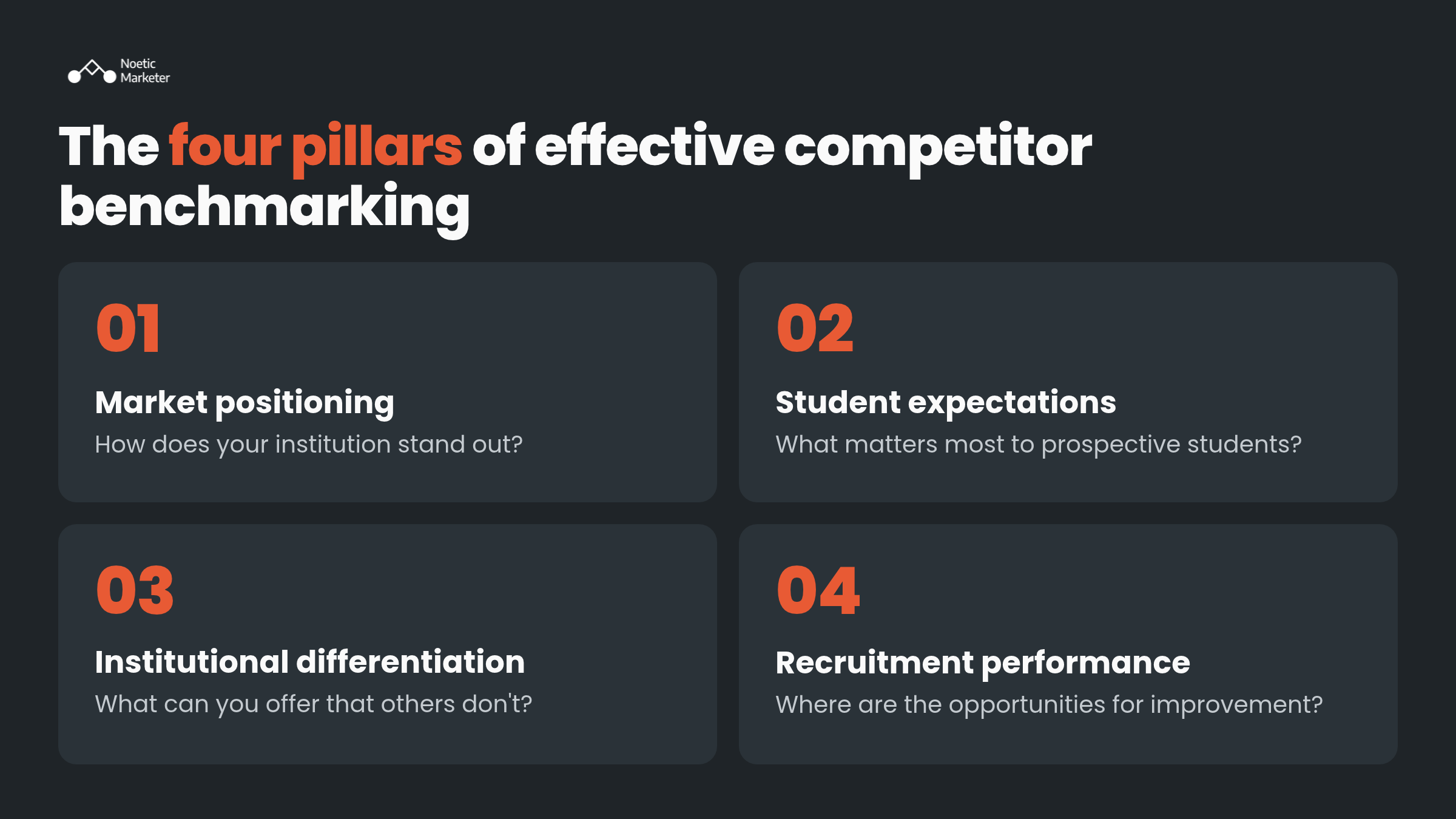
Within strategic enrolment planning, benchmarking helps you understand where your institution stands in a changing market and how to respond to student expectations.
Rather than relying solely on historical enrolment figures or internal assumptions, you gain an external perspective on the factors influencing student decisions.
For example, an institution experiencing declining applications to a graduate program might discover that competitors attract working professionals with more flexible delivery options, clearer career outcomes, or better communication about financial support.
These findings can inform strategic decisions about program development, marketing strategy, and recruitment.
How does competitor analysis differ from broader competitive analysis?
Competitor analysis focuses on specific institutions' strategies and offerings, while competitive analysis examines the broader market conditions that influence student recruitment.
Both are important, but they answer different questions.
Competitor analysis helps you understand how individual institutions present themselves to prospective students. This might involve evaluating their program offerings, tuition information, recruitment campaigns, online presence, and admissions experience.
Competitive analysis looks beyond individual institutions to assess market-wide trends, demographic shifts, emerging educational pathways, and changing student preferences.
Together, these perspectives can help you determine whether the opportunity lies in launching a new program, adapting an existing offering, or strengthening how you communicate its value.
How do you choose competitors that students consider?
To choose competitors effectively, focus on institutions and educational alternatives prospective students are likely to compare with your offerings.
A useful benchmarking group typically includes:
Direct competitors: Institutions offering similar credentials, programs, and learning experiences to comparable audiences.
Regional competitors: Institutions that recruit from the same geographic markets or serve similar communities.
Aspirational competitors: Institutions recognized for strengths you want to develop, such as student support or program flexibility.
Alternative education providers: Online universities, career colleges, professional training organizations, and other providers that address similar learner needs.
The goal is to build a realistic picture of your audience's choices rather than assemble an exhaustive list of every institution in your region.
Which benchmarking metrics matter most for sustainable enrolment growth?
The most useful strategic benchmarking metrics explain student demand, recruitment performance, and the quality of the enrolment experience.
While metrics such as website traffic and social media engagement offer useful context, they rarely provide enough information to guide strategic enrolment decisions independently.
Instead, consider a framework that connects market visibility with measurable institutional outcomes.
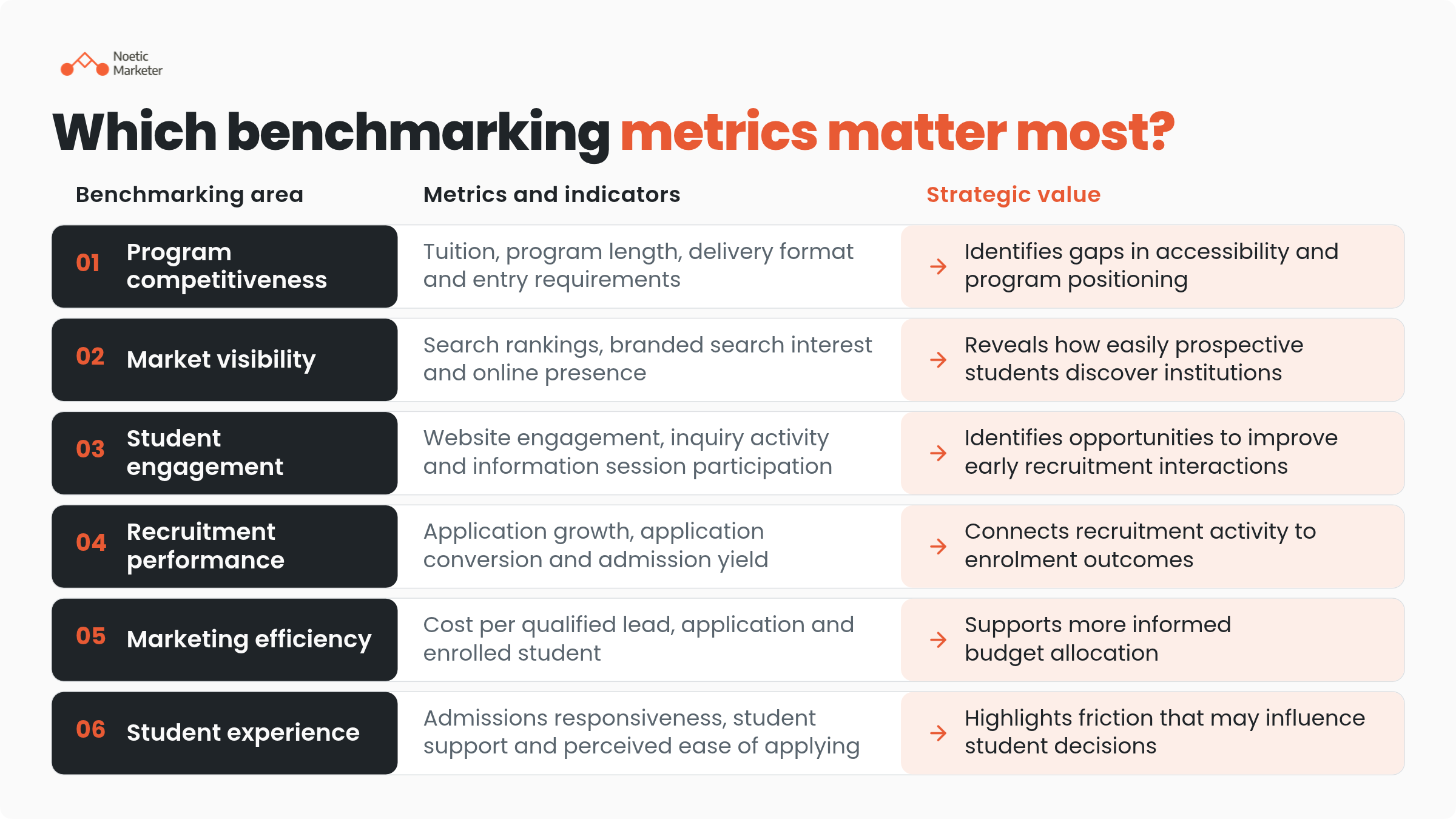
Not all metrics will be publicly available for competing institutions.
Public enrolment reports, institutional websites, government datasets, and published research can provide reliable comparison points. Privately held conversion figures or advertising costs may require reputable third-party research, shared benchmarking studies, or institutional partnerships.
What can competitive intelligence reveal about different educational business models?
Competitive intelligence helps institutions understand how different educational business models respond to student needs and market pressures.
For example, a traditional university may emphasize research opportunities and campus experiences, while an online institution may compete through flexible scheduling and accessibility. A career-focused provider might emphasize shorter completion timelines and practical skills development.
Understanding these differences can reveal opportunities that aren't immediately obvious from comparing similar degree programs.
Consider three areas:
Program delivery: Are competing institutions expanding online, hybrid, or accelerated options to attract learners who can't attend traditional daytime classes?
Pricing strategy and financial accessibility: How do tuition structures, scholarships, payment arrangements, and employer partnerships influence affordability?
Credential pathways: Are institutions introducing stackable certificates, transfer agreements, or degree-completion options that help learners build on previous education?
The purpose is to understand which approaches align with your prospective students' needs and where your institution can respond meaningfully. These findings can inform longer-term academic planning, helping leaders evaluate whether evolving student expectations warrant changes to existing offerings.
How can institutions benchmark the prospective student journey?
One practical approach is to examine the publicly accessible recruitment experience at several comparable institutions.
Consider the following questions:
How easily can prospective students locate program details, tuition information, and deadlines?
How clearly does your institution communicate career pathways and available support?
How accessible and mobile-friendly are your website and application instructions?
What opportunities are available to connect with students, faculty, or admissions representatives?
How do public reviews, testimonials, and student-generated content reflect the institution's reputation?
These observations become more valuable when paired with direct feedback from prospective and current students. Instead of assuming a competitor's approach works because it looks polished, you can investigate which experiences students truly find helpful.
Noetic Marketer explores this relationship further in its article on how universities can build brand trust with prospective students.
How can performance benchmarking help institutions identify a competitive advantage?
Performance benchmarking helps institutions identify a competitive advantage by revealing strengths that are distinctive and relevant to prospective students.
A competitive advantage doesn't have to mean offering the lowest tuition or the most programs. It might involve meaningful industry partnerships, accessible academic support, flexible learning pathways, or a strong connection to a particular community.
The challenge is recognizing which strengths matter most to your intended audience.
A useful competitive advantage should answer three questions:
Is it meaningful? Does the strength address something prospective students genuinely value?
Is it distinctive? Does it offer a relevant difference from comparable options?
Is it credible? Can your institution demonstrate the advantage through real experiences, evidence or outcomes?
The strongest positioning emerges where institutional strengths and student priorities meet.
How can institutions turn benchmarking into actionable insights?
Institutions turn benchmarking into actionable insights by translating competitive research into clear priorities and coordinated improvements.
Collecting competitor information is only the starting point. The greatest value comes from determining what the findings mean for your institution and how they should influence planning.
A practical framework involves four stages.
1. Identify opportunities
Review benchmarking findings alongside your institutional goals.
Where do competitors appear to be meeting student expectations more effectively? Where does your institution offer an advantage that isn't being communicated clearly?
Separate opportunities you can address through marketing from those that require academic, admissions, or operational changes.
2. Prioritize strategic decisions
Not every identified difference requires action.
Focus on opportunities that support your enrolment objectives, align with institutional priorities, and can realistically be addressed with available resources.
For instance, improving information about existing student support services may be achievable sooner than developing an entirely new credential.
3. Connect insights to recruitment strategy
Use relevant findings to inform audience targeting, messaging, campaign development, and budget allocation.
This might involve refining how a program communicates its benefits to working professionals or developing recruitment journeys for underserved student segments.
Noetic Marketer's guide to higher education marketing budgets offers additional guidance on aligning resources with institutional priorities.
4. Measure progress and revisit assumptions
Establish key performance indicators connected to the changes you've introduced.
If you've updated program messaging, examine qualified inquiry and application trends. If you've improved the admissions experience, monitor student feedback and relevant conversion rates.
Regular reviews will help distinguish meaningful improvements from short-term fluctuations.
What does competitor benchmarking look like in practice?
Noetic Marketer's work with University of Ottawa's Faculty of Engineering illustrates how competitive research and competitor benchmarking can inform a broader enrolment strategy.
The faculty needed to strengthen recruitment for an established management-focused master's program while launching two additional graduate programs focused on artificial intelligence and digital transformation.
The new programs faced a key constraint: each had to build market awareness with only one-fifth of the established program's advertising budget in a competitive landscape.
Noetic Marketer began by examining direct and indirect competitors and existing performance, then developed student personas and tailored recruitment journeys. The resulting digital marketing strategy combined differentiated program messaging, targeted advertising, landing pages, email nurturing, and continuous optimization.
Among the reported outcomes:
6,000+ marketing qualified leads were generated during the new programs' first year.
20.21% year-over-year reduction in cost per enrolment was achieved for the established management program.
68.94% lower combined cost per admission was achieved for the two new programs in 2024 compared with the management program.
The lesson for higher education leaders is that competitive research becomes most useful when it informs a coordinated approach to attracting and engaging students.
How often should institutions update their competitor benchmarking?
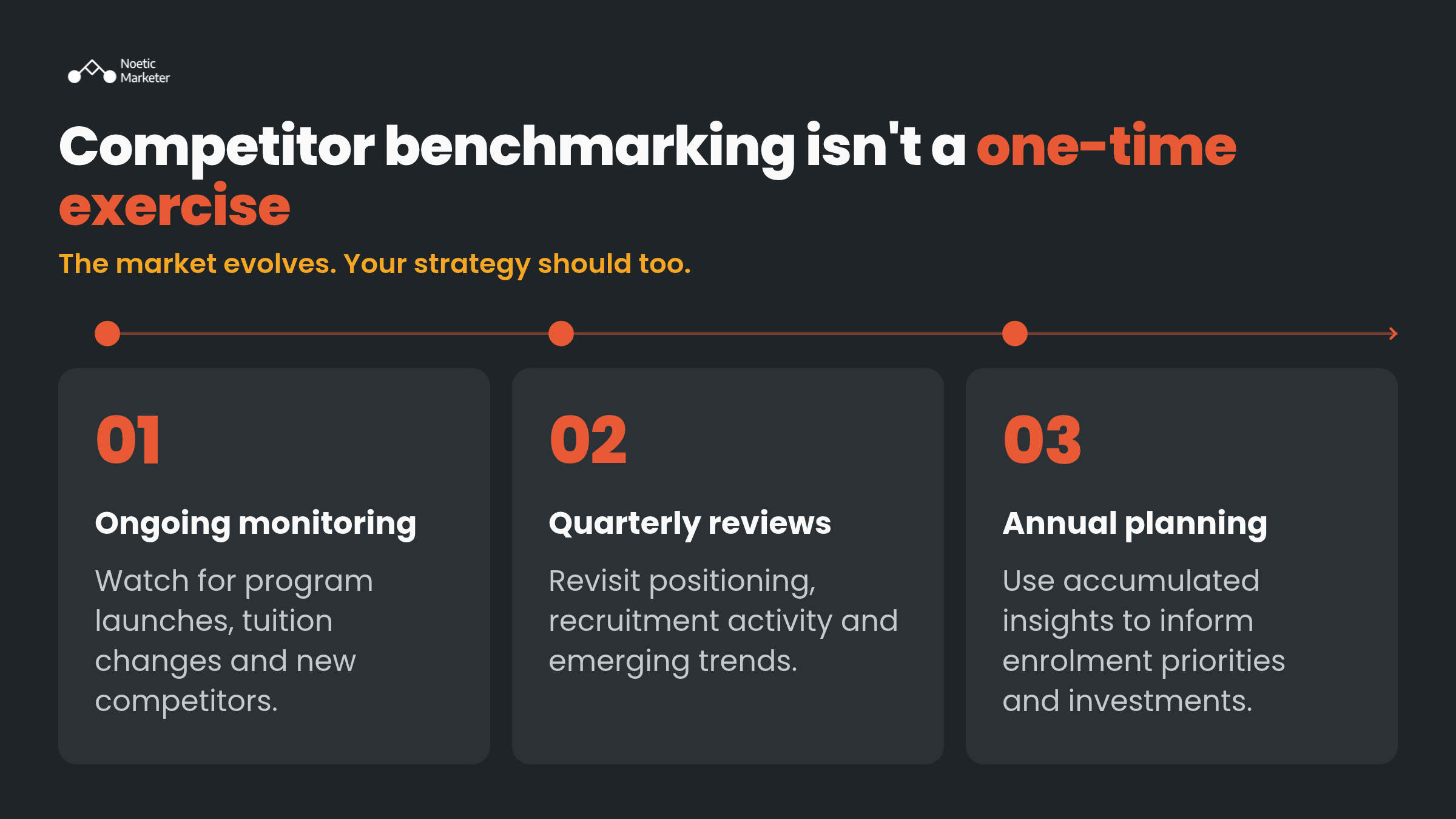
Institutions should review their competitive benchmarks at least annually as part of strategic enrolment planning, and update them more frequently when significant market shifts occur.
However, important developments may require attention throughout the year, including new program launches, tuition changes, policy updates, or emerging recruitment approaches.
A practical schedule might include quarterly reviews of key competitors and more comprehensive annual assessments.
Can competitor benchmarking predict future enrolment?
Competitor benchmarking can strengthen enrolment forecasting, but it can't reliably predict future student numbers on its own.
Forecasting requires internal application trends, demographic information, historical yield rates, program capacity, and other institution-specific data.
Together, these inputs help leaders develop more realistic scenarios and make better-informed decisions about future recruitment investments.
What is the biggest benefit of competitor benchmarking for strategic enrolment planning?
The greatest benefit of competitor benchmarking is the ability to make more informed enrolment decisions without losing sight of what makes your institution unique.
Understanding those differences is just as important as identifying similarities.
When approached thoughtfully, benchmarking reveals where student expectations are evolving, where recruitment experiences can improve, and where institutional strengths deserve greater visibility.
It makes strategic enrolment planning more responsive and evidence-informed.
Ready to strengthen your strategic enrolment planning?
At Noetic Marketer, we work alongside education leaders to connect institutional goals with data-informed recruitment strategies.
Schedule a meeting to explore your enrolment opportunities and develop a clearer path forward.
Don’t miss our other posts on digital marketing for education.
Why is a year-round enrolment management strategy essential for private school growth?
How do universities use social media for student recruitment?
How can universities build brand trust with prospective students in 2026?
How do you measure ROI in higher education marketing?
How does paid advertising drive student applications for higher education?
How do you choose the best higher education marketing agency?
Why is enrolment marketing essential for higher education institutions in 2026?
How can boarding schools create effective marketing strategies to attract students in 2026?
How do private schools approach marketing?
What does a higher education marketing agency actually do?
What is higher education marketing, and how is it different from traditional marketing?
How Can Universities Create an Effective Higher Education Marketing Budget?
What Are 11 Valuable Strategies for Recruiting International Students?
What Are 9 Proven Strategies for Marketing Higher Education to Adults?
What Makes Student Testimonials Crucial for University Recruitment Marketing?
How Can Universities Use Video Content to Boost Student Recruitment?
What Are 5 Effective Marketing Strategies for Recruiting Undergraduate Students?
How Can Universities Use AI for Marketing?
What Are the 7 Key Challenges in Higher Education Digital Marketing and How Can They Be Solved?
Key terms
Competitive benchmarking: The systematic comparison of an institution's programs, positioning, and performance against relevant competitors or sector standards.
Competitive intelligence: Information gathered and analyzed about competing institutions, alternative educational pathways, and market developments to inform strategic decisions.
Strategic enrolment planning: A coordinated, data-informed approach to aligning institutional priorities, student demand, recruitment activities, and long-term enrolment goals.
Competitive advantage: A meaningful institutional strength that distinguishes an educational offering from relevant alternatives and provides value to prospective students.
Enrolment yield: The proportion of admitted students who ultimately enrol at an institution, commonly used to evaluate recruitment effectiveness and support enrolment forecasting.
